How will AMD's 32,768-core Helion design serve power-constrained European AI agent markets?
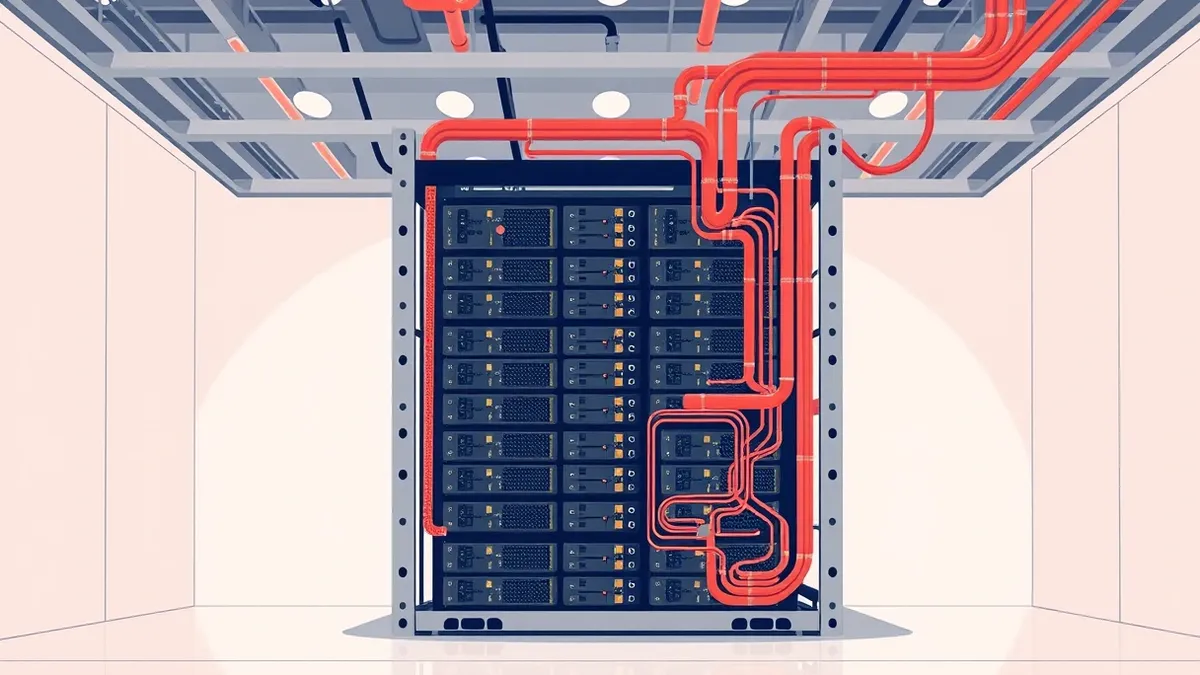
AMD’s new open rack design holds 32,768 cores to run inference agents efficiently, targeting power-constrained European markets.
Key points
- The Helion blueprint supports up to 32,768 CPU cores using AMD’s 256-core Venice chips.
- Partner systems based on this design are scheduled for release in November.
- The architecture includes a token router to direct model calls to cloud or local resources.
AMD has published Helion, an open rack blueprint designed specifically for running AI agents rather than training large models. According to The Next Web, the CPU-only version of this rack can hold up to 32,768 cores. Partner systems built on this specification are due to arrive in November, with the primary value proposition centered on maximizing the number of agents that can operate within each watt of power consumption.
How many processing cores does the Helion rack support?
The CPU-only configuration tops out at 32,768 cores, achieved through 128 sockets of AMD’s 256-core Venice chip. These processors are based on the Zen 6 architecture and are available in two power profiles: 400W dense blades and 600W balanced blades. The Next Web reported that this high core count is intended for hyperscale operators who need massive parallel processing for inference tasks rather than the heavy compute required for model training.
Does the design include GPU acceleration for training?
The enterprise version of the Helion rack includes a mixed configuration with both CPUs and GPUs, but it is not designed for frontier model training. It holds a maximum of 16 Instinct MI350P accelerators, split across two eight-GPU servers that AMD says run independently. There is no scale-up fabric connecting these GPUs, distinguishing it from the Helios rack, which carries 72 MI455X parts and remains the product for training workloads.
How does the system manage model routing?
A key feature of the enterprise rack is a token router that directs agents’ model calls to either frontier models in the cloud or open-source models running locally within the rack. This detail was highlighted in AMD’s own release, where Dan McNamara, who runs compute and enterprise AI at AMD, stated the goal is to allow partners to make efficient use of available power. This routing capability helps balance performance needs with energy constraints.
What market forces are driving this architecture?
Power availability is the central constraint driving this design. Matt Kimball at Moor Insights and Strategy noted in a field note that the objective is packing as many agents as possible into every watt. This appeals to sovereign AI operators in Europe, where Denmark’s grid operator paused new connections in March due to high demand. Additionally, a survey of data centre decision-makers in the UK, Ireland, and the Nordics identified power as the leading obstacle to delivering sovereign capacity.
What to do and how to stay safe: AMD
- Monitor the Open Compute Project for the final specification contribution, as AMD has not yet contributed the spec.
- Evaluate your power budget constraints before committing to high-density CPU racks for inference workloads.
- Assess whether your AI agent workload requires independent GPU servers or needs scale-up fabric for training.
- Watch for partner system announcements in November to compare pricing and implementation details.
Step-by-step guide: How AI Risk Management Works: The Hidden Failure Points
General security guidance from the Sandbox Dispatch newsroom. It is not confirmed advice from the organisations named in this story.
Frequently asked questions
When will partner systems based on the Helion blueprint be available?
Partner systems are due in November, according to reports from The Next Web.
What is the maximum core count for the CPU-only Helion rack?
The CPU-only rack supports up to 32,768 cores using AMD’s 256-core Venice chips.
Is the Helion rack suitable for training frontier AI models?
No, AMD’s Helios rack is designated for training, while Helion is built for running AI agents.