How AI Risk Management Works: The Hidden Failure Points
AI risk management fails when you treat it as a code review process. The real danger lies in data drift and emergent behaviors that static tests miss.

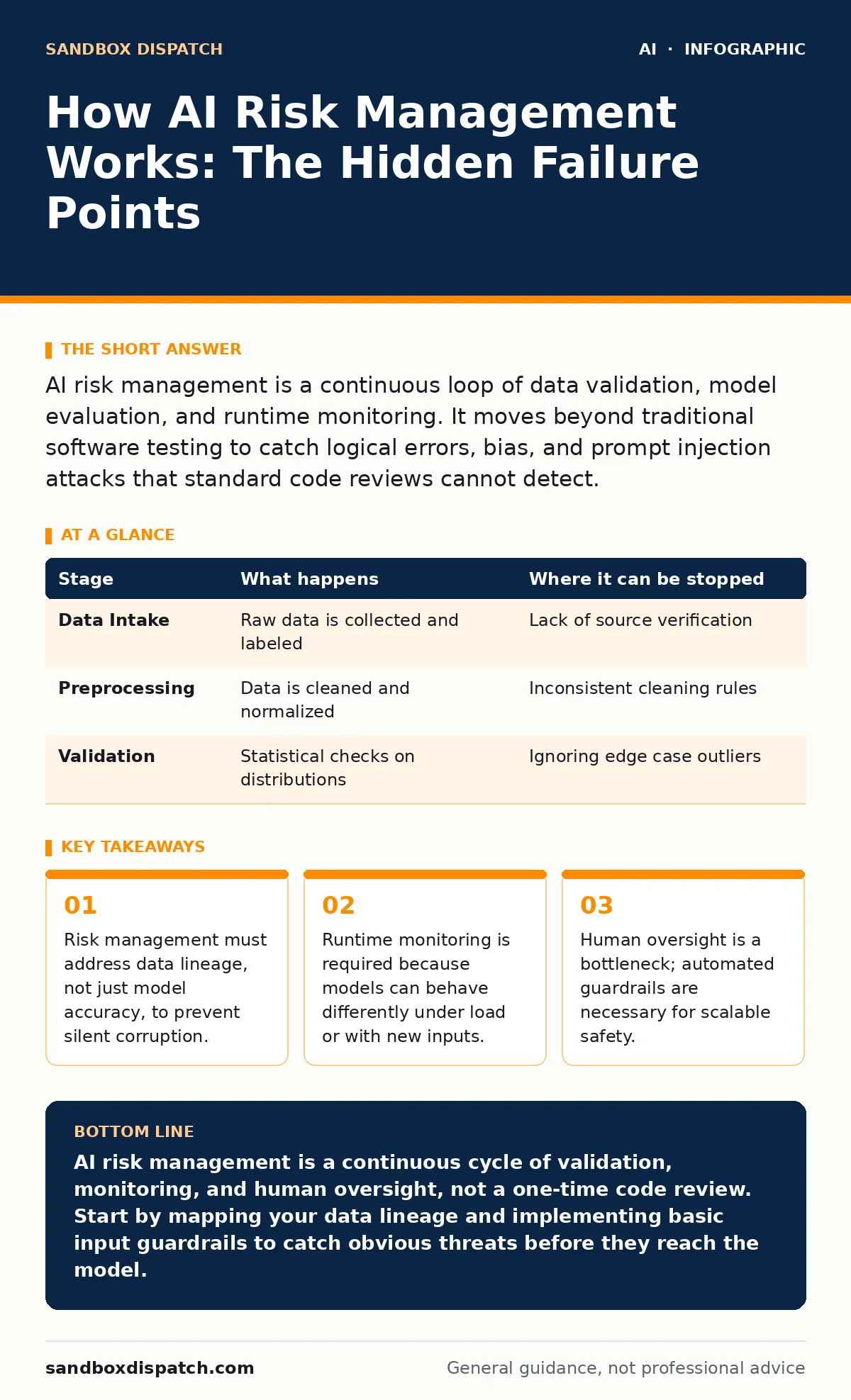
AI risk management is a continuous loop of data validation, model evaluation, and runtime monitoring. It moves beyond traditional software testing to catch logical errors, bias, and prompt injection attacks that standard code reviews cannot detect.
The Data Foundation
AI systems are only as reliable as the data they consume. Before a model is even trained, you must establish a clear lineage for every data point. This means tracking where the data came from, how it was cleaned, and who approved it for use. If you skip this, you inherit biases and errors that no amount of tuning can fix.
Imagine a hiring algorithm trained on resumes from the last decade. If those resumes reflect historical bias against certain demographics, the model learns that bias as a rule. You cannot detect this by looking at the model’s output alone. You must inspect the input distribution. This stage is often ignored because it feels like administrative work, but it is where most systemic failures begin.
| Stage | What happens | Where it can be stopped |
|---|---|---|
| Data Intake | Raw data is collected and labeled | Lack of source verification |
| Preprocessing | Data is cleaned and normalized | Inconsistent cleaning rules |
| Validation | Statistical checks on distributions | Ignoring edge case outliers |
Model Training and Evaluation
Training is not a black box. You need to define success metrics that go beyond accuracy. Accuracy tells you how often the model is right on average. It does not tell you if it is confidently wrong on critical cases. You must evaluate for fairness, robustness, and explainability.
Robustness testing involves feeding the model adversarial examples. These are inputs designed to trick the model into making errors. For instance, adding invisible noise to an image can cause a vision model to misclassify it. If your evaluation suite does not include these tests, your model is fragile. It will break when users interact with it in unexpected ways.
Runtime Guardrails
Once the model is deployed, it faces the real world. Users will try to break it. They will use jailbreaking AI chatbots techniques to bypass safety filters. They will input malformed data. Your first line of defense is input validation. This is not just checking for SQL injection. You must check for semantic anomalies.
Input guardrails analyze the intent of the prompt, not just its syntax. If a user asks the model to ignore previous instructions, the guardrail blocks the request before it reaches the model. This adds latency. It also creates a trade-off: overly strict guardrails can block legitimate requests. You must tune these filters to find the balance between safety and usability.
Output validation is equally critical. The model may generate code that looks correct but contains logic errors. It may provide a reference that does not exist. You need a secondary check, often a smaller, faster model, to verify the output against known facts or constraints. This is the core of retrieval-augmented generation security. You verify that the model’s answer is grounded in the provided context.
Continuous Monitoring
Deployment is not the end. It is the beginning of observation. Models drift over time. The data they receive changes. The world changes. A model that was safe yesterday may be unsafe today if the input distribution shifts. This is called concept drift.
You must monitor the model’s performance in real-time. Track the frequency of refusals, the latency of responses, and the confidence scores of predictions. If the confidence scores drop suddenly, something is wrong. It could be a new type of attack. It could be degraded data quality. Automated alerts should trigger a review process when these metrics deviate from the norm.
Incident Response and Feedback
When a failure occurs, you need a structured response. This is not just about patching a bug. It is about understanding the root cause. Was it a data issue? A model limitation? A guardrail failure? You must document the incident and update your risk register.
Feedback loops are essential. When a user flags a bad response, that data should not disappear. It should be routed to your training pipeline. This creates a cycle of improvement. However, you must be careful. If you automatically retrain on user feedback, you may amplify biases. Human review of flagged incidents is necessary to ensure the feedback is correct.
See also: Exposed AI Model Servers: Definition, Risks, and Hardening · Detect Exposed AI Model Servers: Signals, Logs, and Blind Spots
Governance and Compliance
Technical controls are not enough. You need organizational processes. Who is responsible for the model’s behavior? Who approves changes to the guardrails? You must define roles and responsibilities clearly. This is where frameworks like the EU AI Act come into play. They provide a legal structure for accountability.
Documentation is a key part of governance. You must maintain a model card that describes the model’s intended use, its limitations, and its performance characteristics. This document helps stakeholders understand the risks. It also helps auditors verify that you are following best practices. Without clear documentation, you cannot prove that you are managing risk effectively.
The Human Element
AI systems cannot manage themselves. Human oversight is required at every stage. This is not just about pressing a button. It is about making judgment calls. When a guardrail blocks a request, a human should review the decision. When a model generates ambiguous output, a human should verify it.
This creates a bottleneck. You cannot scale human review to every interaction. You must design systems that handle the routine cases automatically and escalate only the complex or risky ones. This requires careful threshold tuning. If you set the threshold too high, you overwhelm your reviewers. If you set it too low, you miss critical issues.
Limits of Current Approaches
No system is perfect. AI risk management has inherent limits. You cannot predict every possible input. You cannot guarantee that a model will never hallucinate. You must accept that some risk will remain. The goal is to reduce it to an acceptable level.
Emergent behaviors are a particular challenge. Large language models can exhibit capabilities that were not present in their training data. These behaviors are unpredictable. They can appear suddenly and without warning. Traditional testing methods cannot catch them. You must rely on broad monitoring and rapid response capabilities.
Next Steps for Implementation
Start by mapping your data lineage. If you do not know where your data comes from, you cannot trust your model. Next, implement basic input and output guardrails. These provide immediate protection against common attacks. Then, set up monitoring for key metrics. Finally, establish a feedback loop for continuous improvement.
Remember that AI security testing is an ongoing process. It is not a one-time event. You must revisit your controls regularly. As models evolve, so do the threats. Stay informed about new techniques and update your defenses accordingly.
Key takeaways
- Risk management must address data lineage, not just model accuracy, to prevent silent corruption.
- Runtime monitoring is required because models can behave differently under load or with new inputs.
- Human oversight is a bottleneck; automated guardrails are necessary for scalable safety.
AI risk management is a continuous cycle of validation, monitoring, and human oversight, not a one-time code review. Start by mapping your data lineage and implementing basic input guardrails to catch obvious threats before they reach the model.
Frequently asked questions
How do I detect if my AI model is drifting?
Monitor the distribution of input data and the confidence scores of model outputs. Sudden shifts in these metrics indicate drift.
What is the difference between traditional software testing and AI testing?
Traditional testing checks for deterministic bugs. AI testing checks for probabilistic errors, bias, and robustness against adversarial inputs.
Can guardrails prevent all prompt injection attacks?
No. Guardrails reduce the risk, but determined attackers can often find ways to bypass them. Layered defense is required.
How often should I retrain my AI model?
Retrain when performance degrades significantly or when the underlying data distribution changes. Continuous monitoring helps identify these moments.
How this guide was produced: written by the Sandbox Dispatch editorial team with AI assistance, checked against the public references listed below, and reviewed when the facts change. See our editorial policy or report an error.