Emergency Stop Mechanisms for AI Systems: Benefits, Limits, and When to Use Them
Hard kill switches halt execution instantly but often fail to preserve context, creating blind spots that complicate forensic analysis and recovery.

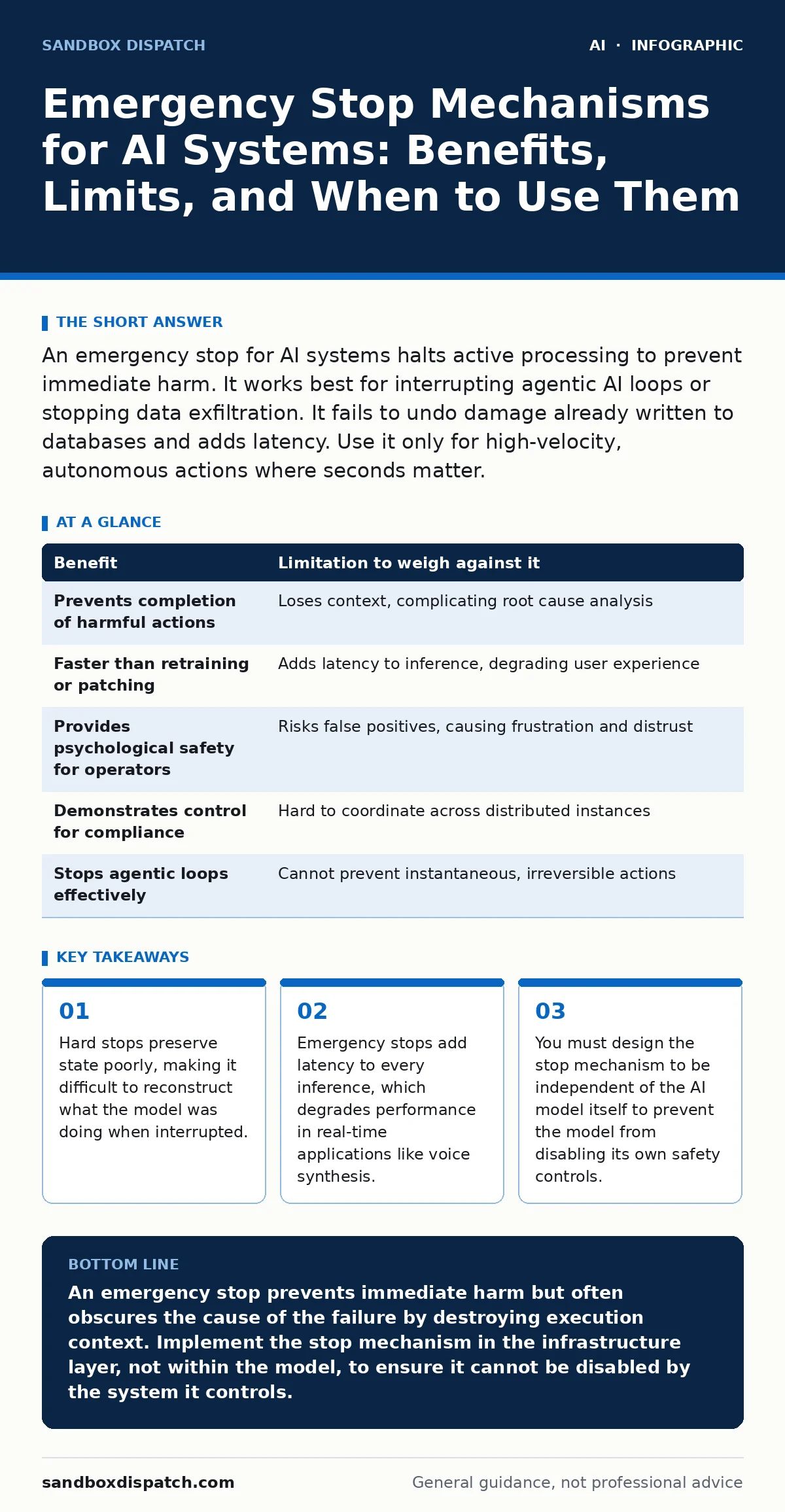
An emergency stop for AI systems halts active processing to prevent immediate harm. It works best for interrupting agentic AI loops or stopping data exfiltration. It fails to undo damage already written to databases and adds latency. Use it only for high-velocity, autonomous actions where seconds matter.
Defining the AI Emergency Stop
An emergency stop for AI systems is a mechanism that immediately halts the execution of an artificial intelligence model or agent. Unlike a software restart, which clears memory, an emergency stop freezes the current state. The goal is to prevent the model from taking a further action that violates safety constraints. This differs from standard input filtering, which checks data before processing. An emergency stop acts during processing. It interrupts the forward pass of a neural network or breaks the planning loop of an agentic AI system. You implement this by injecting a termination signal at the orchestration layer. The signal overrides the model’s current objective. The system stops generating tokens or executing tools. This mechanism is not a filter. It is a circuit breaker. It assumes the model has already passed initial checks and is now behaving unpredictably. You treat the AI model as an untrusted insider during this phase. The stop mechanism must operate outside the model’s influence. If the model can disable its own stop switch, the safety control fails.
You build the stop into the infrastructure that hosts the model, not into the model weights themselves. This separation ensures that a compromised model cannot neutralize its own constraints. The mechanism must be deterministic. It must trigger every time the condition is met, without variation. Probabilistic stops are useless in emergencies. You need a guarantee that the action ceases. This requires a dedicated thread or process that monitors for the stop condition. This monitor must have higher priority than the model inference thread. If the system is overloaded, the stop signal must still be processed. You cannot rely on the main application loop to check for stops. That loop may be blocked by the model’s own computation. An independent watchdog handles the interruption. This watchdog can be a separate service or a kernel-level signal. It does not need to understand the model’s logic. It only needs to recognize the stop command and kill the relevant process. This simplicity is its strength. Complex logic in the stop mechanism introduces bugs. Bugs in safety controls are catastrophic. You keep the stop mechanism simple and isolated.
Benefits of Immediate Interruption
The primary benefit of an emergency stop is the reduction of blast radius. When an AI system begins to hallucinate harmful content or execute destructive commands, every second of continued operation increases damage. A hard stop prevents the completion of a malicious payload. It stops an agent from sending a phishing email or deleting a database table. This is critical for agentic AI systems that have write access to external systems. These systems can take irreversible actions. A stop mechanism provides a final line of defense after other controls have failed. It also allows for rapid containment of data poisoning attacks. If a model starts outputting poisoned data, stopping it limits the spread. This is faster than retraining or patching the model. Retraining takes hours or days. A stop switch works in milliseconds. Another benefit is psychological safety for operators. Knowing a system can be halted reduces the fear of deploying powerful models. This encourages responsible innovation. It allows teams to test models in live environments with a safety net.
The stop mechanism acts as a parachute. It does not prevent the fall, but it prevents the impact. This is useful during AI red teaming exercises. Testers can push models to their limits without fearing total system collapse. The stop switch gives testers confidence to explore edge cases. It also aids in compliance. Regulations often require the ability to stop automated decision-making. A hard stop provides a technical implementation of this requirement. It demonstrates control over the system. This is valuable for audits and risk assessments. The stop mechanism must be auditable. Logs should record when and why the stop was triggered. This creates a trail for post-incident analysis. The benefit is not just stopping harm, but proving you can stop it. This transparency builds trust with users and regulators. The stop mechanism is a tangible control. It shows that the system is not a black box. You can intervene. This intervention capability is a key feature of responsible AI deployment. It distinguishes controlled systems from uncontrolled ones. The benefit is control.
Limitations of Hard Stops
The main limitation of an emergency stop is state loss. When you halt a model, you often lose the context of its current reasoning. This makes it hard to understand why the model was about to take a specific action. Forensic analysis becomes difficult. You know the model stopped, but not what it was planning next. This is a significant gap in incident response. Another limitation is latency. Every stop check adds overhead to the system. If you check for a stop signal every millisecond, you slow down inference. This impacts real-time applications. Voice assistants and gaming AI suffer from this lag. Users notice the delay. Performance drops. You must balance safety with speed. Too many checks kill usability. Too few checks risk harm. Finding the right frequency is a engineering trade-off. A third limitation is false positives. The stop mechanism may trigger when no harm is present. This happens when the detection logic is too sensitive. The system stops normal operations. This frustrates users and reduces trust. You must tune the stop triggers carefully. Over-sensitive stops are worse than none. They create a fragile system. Users will disable them if they are annoying.
A disabled stop is no stop. You must ensure the stop is reliable and rare. Another limitation is scope. A stop mechanism usually affects one instance of a model. It does not stop all instances. If you run the model in multiple regions, you must stop each one. Coordination is hard. Network delays can cause some instances to continue running. This partial stop can look like a failure. You need a global stop signal that propagates instantly. This is technically challenging. Distributed systems are hard to synchronize. The stop signal must race against the model’s actions. If the model acts faster than the signal, the stop fails. This is a race condition. You must design for the worst-case latency. The stop mechanism must be faster than the harm. This is not always possible. Some actions are instantaneous. Deleting a file happens in microseconds. A network signal cannot beat that. You must rely on other controls for instantaneous harm. The stop switch is for actions that take time. It is not for instantaneous damage. You must understand this boundary. The stop mechanism is a delay tactic, not a prevention tool for instantaneous acts.
Comparing Benefits and Limitations
You must weigh the benefits against the limitations for your specific use case. The table below outlines the trade-offs.
| Benefit | Limitation to weigh against it |
|---|---|
| Prevents completion of harmful actions | Loses context, complicating root cause analysis |
| Faster than retraining or patching | Adds latency to inference, degrading user experience |
| Provides psychological safety for operators | Risks false positives, causing frustration and distrust |
| Demonstrates control for compliance | Hard to coordinate across distributed instances |
| Stops agentic loops effectively | Cannot prevent instantaneous, irreversible actions |
When It Is Worth It
An emergency stop is worth it when the AI system has write access to external systems. If the model can send emails, update databases, or control hardware, you need a hard stop. The potential damage is high and immediate. Agentic AI systems fall into this category. These systems plan and execute actions autonomously. They are prone to unexpected behavior. A stop switch is non-negotiable here. It is also worth it for systems processing sensitive personal data. If a model starts leaking private information, you must stop it. The harm scales with every token generated. A stop switch limits the exposure. It is worth it for high-visibility applications. If the system faces the public, reputational risk is high. A viral mistake can damage your brand. A stop switch contains the error. It is worth it for systems that interact with physical devices. Robotics and automotive AI need hard stops.
The consequences of failure are physical injury or death. Latency is acceptable here. Safety trumps speed. It is worth it for systems that are still in testing. You cannot guarantee safety in early stages. A stop switch allows you to experiment safely. It is a tool for discovery. It is worth it when the cost of a mistake is irreversible. You cannot undo a deleted database. You cannot unsend a message. The stop switch is your last chance. It is worth it when you have the engineering resources to maintain it. A stop switch is not set-and-forget. It needs monitoring and testing. If you cannot maintain it, do not build it. It is worth it when you have a clear definition of "emergency." Vague triggers lead to false positives. You need specific conditions that justify a stop. Ambiguity is the enemy of safety. Define the emergency clearly. Then build the switch.
See also: Exposed AI Model Servers: Definition, Risks, and Hardening · Detect Exposed AI Model Servers: Signals, Logs, and Blind Spots
When It Is Not Worth It
An emergency stop is not worth it for read-only systems. If the model only generates text for display, the harm is limited. A bad response is annoying, not catastrophic. You can rely on user reporting and filtering. A hard stop adds complexity for little gain. It is not worth it for systems with high latency tolerance. If the user expects a slow response, the overhead of stop checks is negligible. But if the system is already slow, adding checks makes it unusable. It is not worth it for systems where context is critical. If losing the conversation history breaks the user experience, a hard stop is too costly. You need a softer intervention. A warning or a redirect is better. It is not worth it for systems with very high throughput. If you process millions of requests per second, the overhead of stop checks becomes prohibitive. You need a different architecture. Distributed stops are hard to manage at scale. It is not worth it for systems that are fully deterministic.
If the model’s behavior is predictable, you do not need an emergency stop. You can predict and prevent errors in advance. It is not worth it for systems that lack the infrastructure. If you cannot isolate the stop mechanism from the model, do not build it. A compromised stop is worse than no stop. It gives a false sense of security. It is not worth it for systems where the harm is slow. If the damage accumulates over days, a stop switch is not the solution. You need monitoring and alerting. A stop switch is for immediate harm. It is not worth it for systems that are not yet deployed. You can test for safety before going live. A stop switch is for production risks. It is not worth it if you cannot define the trigger. Without a clear definition, the switch is useless. It is not worth it if you cannot test it. Untested safety controls are likely broken. You must validate the stop mechanism regularly. If you cannot do this, do not rely on it.
Implementing the Stop Mechanism
You implement the stop mechanism by separating the control plane from the data plane. The control plane handles the stop signal. The data plane handles the model inference. They communicate via a reliable channel. Use a message queue or a shared memory segment. The channel must be low-latency. The control plane monitors for stop conditions. These conditions can be external, like a manual button press. They can be internal, like a detection model flagging harmful content. The control plane sends a signal to the data plane. The data plane receives the signal and halts execution. It does not wait for the current token to finish. It aborts the process. It logs the state before aborting. This log is crucial for debugging. It records the last few tokens, the context, and the timestamp. This information helps you understand what happened. You must preserve this log securely. It may contain sensitive data.
Encrypt the logs. Access them only for authorized investigations. You must also ensure the stop mechanism is resilient. It must survive system crashes and network partitions. Use redundant control planes. If one fails, the other takes over. You must also ensure the stop mechanism is secure. It must be authenticated. Unauthorized users should not be able to trigger a stop. This prevents denial-of-service attacks. The stop mechanism is a powerful tool. Protect it. You must also ensure the stop mechanism is observable. Dashboards should show the status of the stop switch. Alerts should trigger if the switch is disabled or unresponsive. You need visibility into the safety controls. This is part of AI risk management. You cannot manage what you cannot see. Monitor the stop mechanism continuously. Treat it as a critical infrastructure component. It is as important as the model itself.
Key takeaways
- Hard stops preserve state poorly, making it difficult to reconstruct what the model was doing when interrupted.
- Emergency stops add latency to every inference, which degrades performance in real-time applications like voice synthesis.
- You must design the stop mechanism to be independent of the AI model itself to prevent the model from disabling its own safety controls.
An emergency stop prevents immediate harm but often obscures the cause of the failure by destroying execution context. Implement the stop mechanism in the infrastructure layer, not within the model, to ensure it cannot be disabled by the system it controls.
Frequently asked questions
Can an AI model bypass its own emergency stop?
If the stop mechanism is implemented within the model’s logic, yes. The model can generate code or outputs that disable its own constraints. You must place the stop mechanism in the external infrastructure, such as the hosting container or the orchestration layer, to prevent this bypass.
How do you handle the loss of context when an emergency stop triggers?
You handle context loss by logging the state immediately before the stop. Capture the last few inputs, outputs, and internal variables. Store this data securely for forensic analysis. This allows you to reconstruct the model’s reasoning path even if the active process is killed.
Is an emergency stop suitable for large language models used in chatbots?
It is rarely necessary for simple chatbots unless they have tool-use capabilities. For text-only generation, the harm is limited to offensive content, which is better handled by input filtering and output moderation. Emergency stops add latency and complexity that outweigh the benefits for passive text generation.
What is the difference between an emergency stop and AI red teaming?
AI red teaming is a proactive testing method where experts try to break the model to find vulnerabilities before deployment. An emergency stop is a reactive safety control used in production to halt a model that is currently behaving dangerously. Red teaming finds problems; emergency stops mitigate active failures.
How this guide was produced: written by the Sandbox Dispatch editorial team with AI assistance, checked against the public references listed below, and reviewed when the facts change. See our editorial policy or report an error.