Difference between generative AI and agentic AI explained clearly
Generative models merely synthesize plausible text from patterns, whereas agentic systems autonomously plan and execute multi-step workflows.

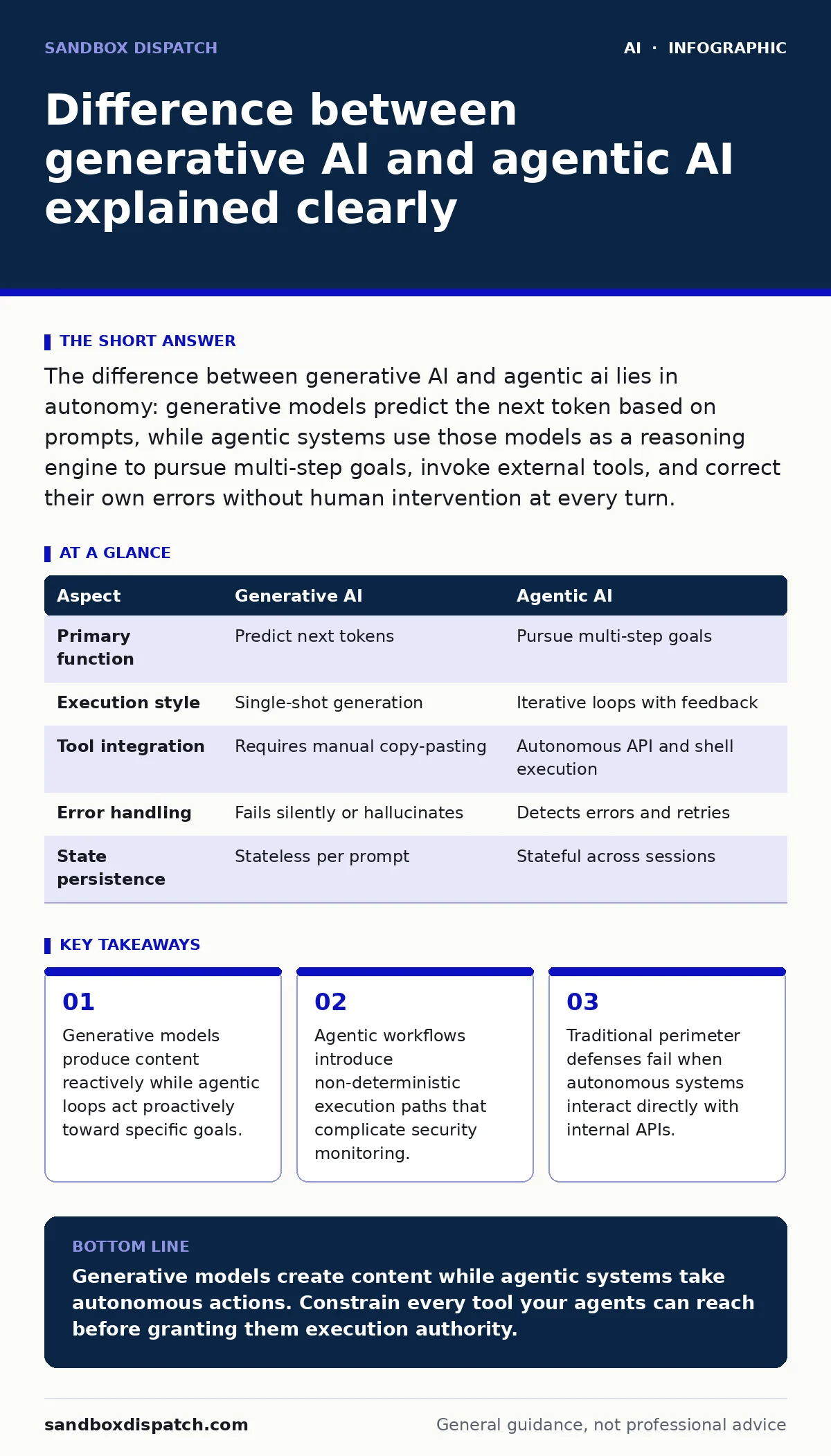
The difference between generative AI and agentic ai lies in autonomy: generative models predict the next token based on prompts, while agentic systems use those models as a reasoning engine to pursue multi-step goals, invoke external tools, and correct their own errors without human intervention at every turn.
Understanding the core machinery behind both systems
Generative artificial intelligence functions as a sophisticated pattern-matching engine that predicts the most probable next word or pixel based on statistical weights learned during training. Large language models process an input prompt and stream a single, continuous response without internal reflection or course correction. This reactive token generation treats every interaction as an isolated event, lacking the persistent state required for long-term task management.
Agentic systems wrap these generative models in an architectural loop consisting of planning, memory, and tool use. An agent receives a high-level objective, breaks that objective down into 3 distinct sub-tasks, and decides which external tools to call. The system executes an action, observes the output, and feeds that result back into the reasoning engine to determine the next step. This feedback loop transforms a static text generator into an active participant in software workflows.
Structural differences in autonomy and execution
| Aspect | Generative AI | Agentic AI |
|---|---|---|
| Primary function | Predict next tokens | Pursue multi-step goals |
| Execution style | Single-shot generation | Iterative loops with feedback |
| Tool integration | Requires manual copy-pasting | Autonomous API and shell execution |
| Error handling | Fails silently or hallucinates | Detects errors and retries |
| State persistence | Stateless per prompt | Stateful across sessions |
Hidden operational costs of autonomous loops
Agentic loops consume significantly more computational resources because a single user request can trigger dozens of recursive model calls and tool executions behind the scenes. This multiplicative scaling makes cost forecasting nearly impossible when loops run unchecked against unpredictable inputs. Furthermore, infinite recursion bugs emerge when an agent fails to recognize that its corrective strategy is repeating the same failing action, draining token budgets in minutes.
Autonomous execution also expands the blast radius of security incidents because agents possess the authority to modify files, send network requests, and execute database queries. When an agent misinterprets a malicious instruction hidden in a data source, it treats the injection as a legitimate operational command. Teams deploying these systems often overlook the risks detailed in sensitive data leaks through AI chatbots, multiplied exponentially by autonomous tool access.
What people usually get wrong about architectural boundaries
Developers frequently assume that upgrading the underlying model automatically transforms a reactive pipeline into a secure, reliable agentic workflow. Better reasoning capabilities do not solve the fundamental challenge of unbounded execution paths and ambiguous state management. Adding autonomy without strict guardrails creates systems that wander off-task, execute unintended database modifications, and drain financial accounts through excessive API calls.
Another common misconception treats agentic loops as deterministic software scripts that follow rigid logical branches. Autonomous systems evaluate natural language instructions to decide their next action, meaning identical inputs can trigger entirely different execution traces depending on context window history. This non-deterministic behavior breaks traditional unit testing frameworks designed for predictable code paths.
What to do about autonomous risk in production
Implement strict execution boundaries by wrapping every tool available to an agent in a least-privilege permission model. Restrict network access to whitelisted internal services and enforce strict rate limits on recursive model calls to prevent runaway loops. You must also maintain immutable audit logs of every decision step, tool invocation, and raw output generated during an agentic session to trace the root cause of unexpected behavior.
Design human-in-the-loop checkpoints for irreversible actions such as database deletions, financial transactions, or code deployments to external repositories. These intervention gates require explicit cryptographic approval from an authorized operator before the agent can proceed past high-risk states. Pair these operational controls with rigorous input sanitization to prevent external data from altering the agent's core instructions.
Key takeaways
- Generative models produce content reactively while agentic loops act proactively toward specific goals.
- Agentic workflows introduce non-deterministic execution paths that complicate security monitoring.
- Traditional perimeter defenses fail when autonomous systems interact directly with internal APIs.
Generative models create content while agentic systems take autonomous actions. Constrain every tool your agents can reach before granting them execution authority.
Frequently asked questions
Can generative AI become agentic on its own?
No, a standalone generative model lacks the persistent memory, planning framework, and tool-calling mechanisms required to act as an autonomous agent.
Why do agentic systems fail more unpredictably than traditional code?
Agentic systems rely on probabilistic natural language reasoning to determine their next execution step rather than hardcoded conditional logic.
How do agentic systems interact with external databases?
Agents translate natural language goals into database queries or API calls, execute them, and interpret the returned results to decide subsequent actions.
What stops an agent from running in an infinite loop?
Developers must program explicit step limits, timeout thresholds, and goal-validation checks that force the agent to halt or request human assistance.
How this guide was produced: written by the Sandbox Dispatch editorial team with AI assistance, checked against the public references listed below, and reviewed when the facts change. See our editorial policy or report an error.