AI coding assistant supply-chain risks and how to spot them
Artificial intelligence coding tools import phantom packages into your software supply chain through generated hallucinated dependencies.

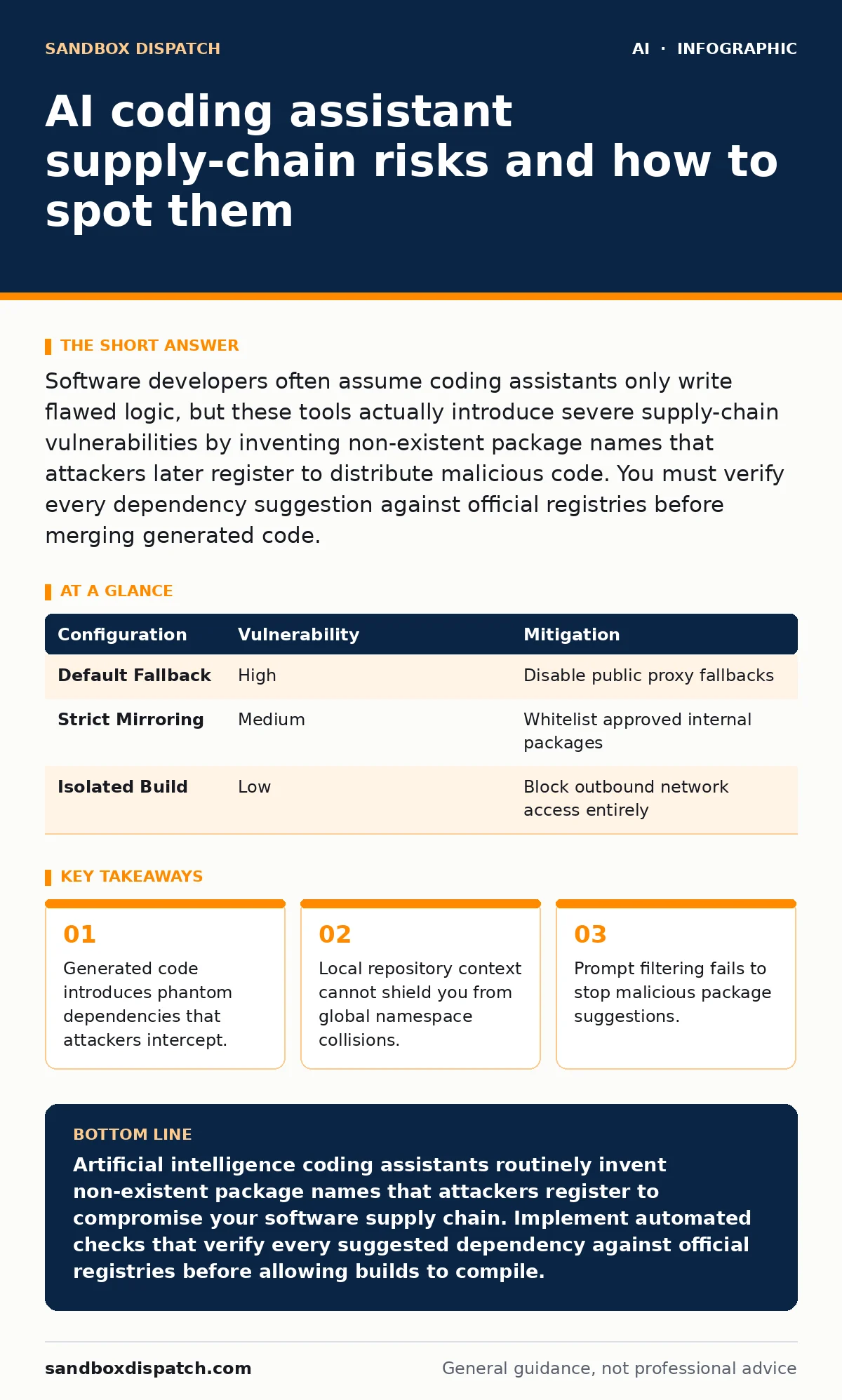
Software developers often assume coding assistants only write flawed logic, but these tools actually introduce severe supply-chain vulnerabilities by inventing non-existent package names that attackers later register to distribute malicious code. You must verify every dependency suggestion against official registries before merging generated code.
Myth: AI assistants only introduce logic bugs
Reality: Logic errors represent only a fraction of the danger because large language models actively invent dependencies that alter your entire software supply chain. When an assistant generates an import statement for a library that does not exist, it creates an invitation for malicious actors to claim that namespace on public package registries. Attackers monitor common naming patterns used by artificial intelligence tools to harvest these unassigned names.
Namespace squatting on public repositories turns a harmless autocomplete suggestion into a remote access vector for external adversaries. Software systems inherit these vulnerabilities silently because static analysis tools often treat newly added dependencies as trusted components. Treating AI models as untrusted insiders helps teams establish the necessary boundaries to prevent silent supply-chain compromise.
Myth: Local repository context prevents fake package names
Reality: Local context windows fail to prevent hallucinations because statistical models optimize for plausible syntax rather than real-world existence. An assistant evaluates token probabilities across vast training corpora, prioritizing names that sound correct over names that are actually published in your target ecosystem.
Developers routinely trust the aesthetic familiarity of a generated import path without checking if the package was ever published. This cognitive bias allows attackers to weaponize names that look idiomatic for specific programming languages or frameworks. Generative AI models lack any mechanism to check real-time registry availability before recommending a module.
Myth: Prompt filtering stops malicious package suggestions
Reality: Prompt filters fail to block supply-chain risks because the malicious package name is rarely present in the input prompt you type. The vulnerability emerges dynamically during generation when the model synthesizes a novel combination of characters to solve your specific coding problem.
- Guardrails restrict known bad inputs but remain blind to newly minted hallucinatory strings.
- System prompts cannot enumerate every non-existent namespace across every public repository.
- Model weights encode associations that override negative constraints when complex syntax is requested.
Defensive prompt engineering creates a false sense of security while leaving the underlying probabilistic generation entirely unchecked. Adversaries understand this limitation and focus their efforts on registering the most frequent outputs produced by popular coding assistants.
Myth: Code reviews catch invalid dependency imports
Reality: Manual code reviews miss invalid dependencies because human reviewers suffer from the same familiarity bias as the generation tools. A well-formatted import statement with descriptive naming conventions blends seamlessly into a pull request, masking the fact that the underlying module does not exist in your authorized dependency tree.
- Reviewers focus on algorithmic correctness rather than registry verification.
- Typosquatting variations look nearly identical to legitimate enterprise libraries.
- Review fatigue causes approvers to skip manual lookups on minor utility imports.
Attackers exploit this review blind spot by ensuring their registered malicious packages match the exact functionality promised by the generated code comment. The code works as expected while executing hidden malicious routines during the build lifecycle.
Myth: Private registries protect against generated supply-chain threats
Reality: Private package registries fail to stop these attacks unless configured with strict upstream proxy controls and namespace isolation. When a build system encounters an unknown dependency imported by generated code, default configurations often reach out to public fallback repositories to resolve the missing module.
| Configuration | Vulnerability | Mitigation |
|---|---|---|
| Default Fallback | High | Disable public proxy fallbacks |
| Strict Mirroring | Medium | Whitelist approved internal packages |
| Isolated Build | Low | Block outbound network access entirely |
This automatic fallback behavior bridges the gap between public namespace squatting and your private build infrastructure. Attackers rely on build systems eagerly querying public registries for missing dependencies introduced by automated tools.
See also: Spot npm Package Vulnerabilities Before They Break Production
Myth: Security scanners flag non-existent dependencies immediately
Reality: Traditional vulnerability scanners miss hallucinatory dependencies because they evaluate known CVE databases rather than checking if a package actually belongs to a legitimate author. A newly registered package containing malicious code has no vulnerability history, allowing it to bypass signature-based detection mechanisms entirely.
- Software composition analysis tools require a known identifier to trigger an alert.
- Malicious packages registered yesterday possess clean reputations in automated scanners.
- Supply chain monitoring solutions often focus on outdated versions rather than newly claimed namespaces.
Effective risk mitigation requires behavioral analysis of build processes rather than relying solely on static dependency manifests. AI supply chain risks demand continuous verification of every external component introduced into your deployment pipeline.
Key takeaways
- Generated code introduces phantom dependencies that attackers intercept.
- Local repository context cannot shield you from global namespace collisions.
- Prompt filtering fails to stop malicious package suggestions.
Artificial intelligence coding assistants routinely invent non-existent package names that attackers register to compromise your software supply chain. Implement automated checks that verify every suggested dependency against official registries before allowing builds to compile.
Frequently asked questions
How do attackers find out which package names to register?
Attackers analyze common training datasets and query popular coding models repeatedly to discover the most frequent hallucinatory package names.
Do enterprise coding assistant licenses prevent supply-chain vulnerabilities?
Commercial licenses govern data privacy and model training rights, but they do not alter the probabilistic nature of text generation that causes hallucinations.
Should developers disable autocomplete features entirely to stay safe?
Disabling autocomplete is unnecessary if you adopt strict verification workflows that treat all generated dependency names as untrusted input.
Can lockfiles prevent the inclusion of malicious packages?
Lockfiles only protect against changes to existing dependencies, offering no defense when a generated import references a brand-new, unpinned dependency name.
How this guide was produced: written by the Sandbox Dispatch editorial team with AI assistance, checked against the public references listed below, and reviewed when the facts change. See our editorial policy or report an error.