Sensitive Data Leaks Through AI Chatbots: Checklist
Outbound network filters miss text-based chatbot leaks because serialized tokens and plain-text prompts easily bypass traditional DLP pattern rules.

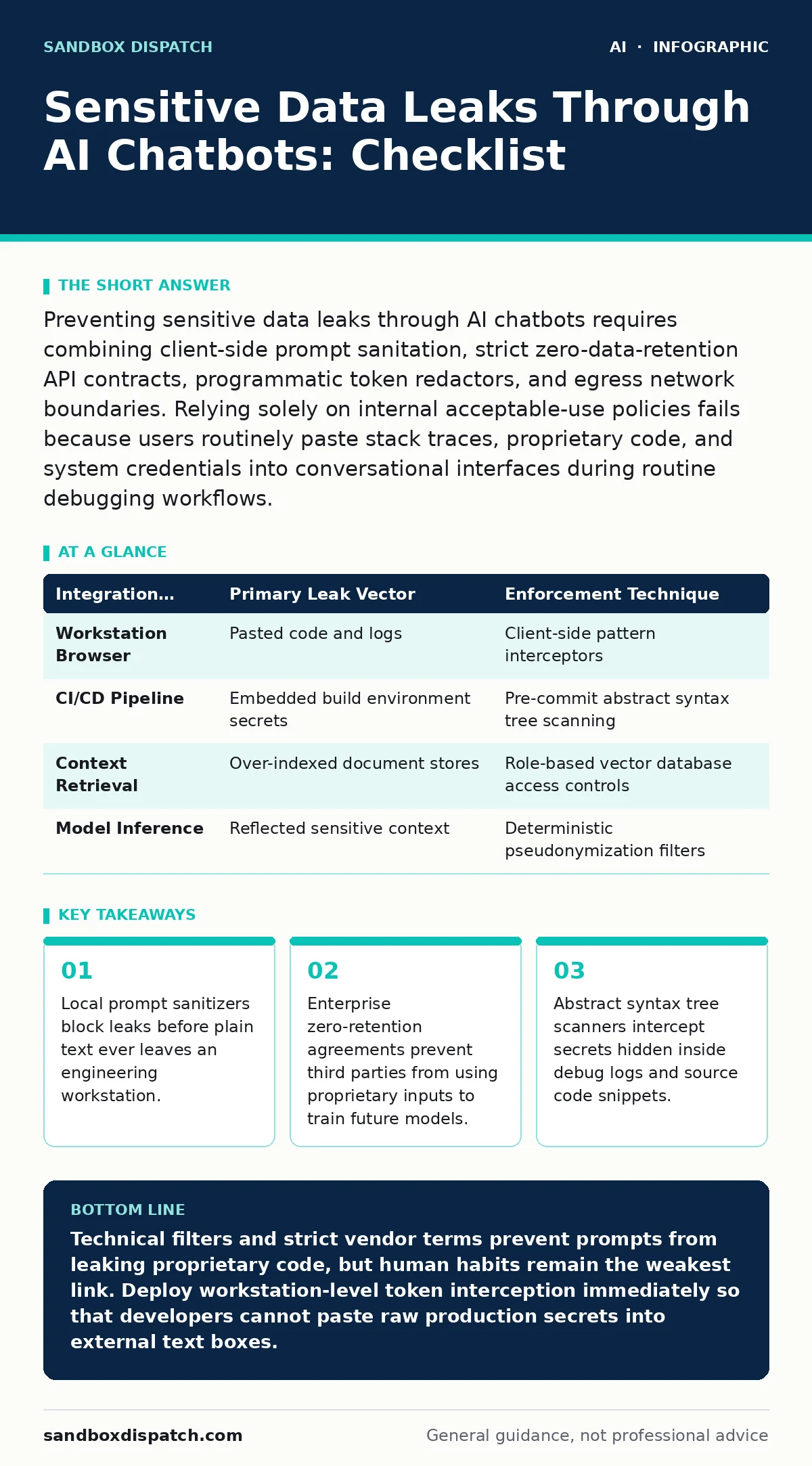
Preventing sensitive data leaks through AI chatbots requires combining client-side prompt sanitation, strict zero-data-retention API contracts, programmatic token redactors, and egress network boundaries. Relying solely on internal acceptable-use policies fails because users routinely paste stack traces, proprietary code, and system credentials into conversational interfaces during routine debugging workflows.
Deploying the AI Chatbot Leak Prevention Checklist
Engineering teams handling proprietary codebases, customer records, and internal credentials need structured guardrails against accidental disclosure. Generative utilities powered by large language models (deep learning algorithms trained on massive text corpora to predict and generate natural language) accept arbitrary text strings, creating direct conduits for exfiltration. Use this grouped checklist as an enforcement baseline across your workstations, continuous integration pipelines, and local network gateways.
Review the checklist items during architecture design sessions and periodic access reviews. Check every box that corresponds to an active control, verify its enforcement mechanism, and assign clear ownership for any remaining gaps.
Client-Side and Workstation Controls
Direct human interaction with conversational interfaces represents the primary point of failure. Engineers frequently paste diagnostic logs, error dumps, and configuration files into external windows to speed up triage.
- Install local browser extensions with pattern matching: Blocks outbound submissions containing recognized credit card formats, social security patterns, or internal server domain structures.
- Implement local clipboard sanitizers: Strips proprietary syntax and environmental variables whenever text moves into browser-based input fields.
- Configure workstation abstract syntax tree parsers: Detects uncompiled source code structures before workers paste raw logic into third-party windows.
- Restrict unsanctioned conversational interface domains via network policy: Eliminates employee access to external consumer chatbots that reserve the right to retain training prompts.
Relying on human memory during high-pressure troubleshooting inevitably fails. Workstation controls establish immediate friction, forcing the user to reconsider what text enters the prompt field. Our coverage of AI risk management details how to weigh these endpoint interventions against developer velocity.
Application and Integration Pipeline Guardrails
Programmatic API integrations introduce autonomous data flows that bypass manual browser controls. Applications feeding user context directly into external backends can inadvertently leak metadata, authentication headers, and database connection strings.
- Strip session tokens and authorization headers before payload formatting: Prevents administrative privileges from leaking into downstream conversation history stores.
- Run automated secret scanners on all retrieval augmented generation inputs: Stops indexing engines from pulling internal keys into dynamic context windows.
- Enforce context window trimming policies: Discards historical conversational turns after inference to prevent prolonged retention of dynamic secrets.
- Mask personal data using deterministic token replacement: Swaps real identifiers with synthetic placeholders while preserving prompt semantics for the model.
| Integration Layer | Primary Leak Vector | Enforcement Technique |
|---|---|---|
| Workstation Browser | Pasted code and logs | Client-side pattern interceptors |
| CI/CD Pipeline | Embedded build environment secrets | Pre-commit abstract syntax tree scanning |
| Context Retrieval | Over-indexed document stores | Role-based vector database access controls |
| Model Inference | Reflected sensitive context | Deterministic pseudonymization filters |
Network Egress and Model Routing Rules
Traditional perimeter controls struggle with modern encrypted conversational traffic. Deep packet inspection often fails to distinguish an innocent programming inquiry from an exfiltration event containing proprietary logic.
- Route all model traffic through an internal forward proxy: Enables centralized decryption, auditing, and real-time redaction of enterprise prompts.
- Terminate connections that omit cryptographic tenant headers: Ensures calls only reach designated enterprise endpoints governed by commercial non-disclosure terms.
- Block outbound transmission of raw document formats to AI endpoints: Stops whole-file uploads of proprietary architecture diagrams, PDFs, and spreadsheets.
- Rate-limit high-volume prompt transmission per endpoint: Restricts the damage if automated scripts attempt bulk database extraction through dynamic prompts.
Directing all calls through a secured reverse proxy gives security teams a single enforcement choke point. This pipeline must decrypt the payload, evaluate it against regular expression rules and lexical analyzers, and re-encrypt the data before forwarding it to the model provider.
Vendor Governance and Contractual Terms
Technical controls cannot protect data once it resides on remote hardware. The operational terms governing your external model provider determine whether raw inputs become part of future training data.
- Enforce zero-data-retention API contracts across all accounts: Guarantees the service provider discards prompt logs immediately after computing inference tokens.
- Disable human review provisions in service agreements: Forbids vendor contractor teams from manually reading anomalous or flagged prompts.
- Require dedicated private networking or VPC endpoints: Isolates prompt traffic from public transit networks via private cloud peering.
- Audit vendor compliance with third-party attestations: Validates that hosting providers meet operational security standards through independent verification.
Consumer-tier subscriptions routinely treat user interactions as training fodder. Enterprise agreements must explicitly prohibit the vendor from using your inputs to update weights, generate synthetic tuning pairs, or serve downstream users.
See also: Endpoint Protection: How It Stops Attacks Beyond the Firewall · AI supply chain security: block backdoors in open weights
Data Pseudonymization and Sanitization Mechanics
Token replacement alters the raw text without breaking the semantic meaning needed for code completion or text analysis. If you replace an internal database host address with a generic placeholder, the language model still understands the configuration structure without learning your actual production topologies.
- Replace real IP addresses with reserved private ranges: Obscures internal network layouts while allowing the model to analyze routing logic.
- Convert database connection strings to generic templates: Removes embedded usernames, cleartext passwords, and hostnames prior to debugging tasks.
- Standardize synthetic entity mapping across conversational sessions: Keeps model responses coherent without exposing genuine identity sets.
Pseudonymization introduces modest operational friction because returning outputs must be mapped back to their original values. The trade-off protects your most sensitive architectural secrets even if an upstream provider suffers a memory dump or unauthorized access event.
Key takeaways
- Local prompt sanitizers block leaks before plain text ever leaves an engineering workstation.
- Enterprise zero-retention agreements prevent third parties from using proprietary inputs to train future models.
- Abstract syntax tree scanners intercept secrets hidden inside debug logs and source code snippets.
Technical filters and strict vendor terms prevent prompts from leaking proprietary code, but human habits remain the weakest link. Deploy workstation-level token interception immediately so that developers cannot paste raw production secrets into external text boxes.
Frequently asked questions
Can an external language model accidentally output my proprietary code to another user?
An external model can reproduce your proprietary code only if the vendor used your prompt inputs to train the underlying model weights. Opting out of data training agreements and using enterprise zero-retention APIs eliminates this specific exposure mechanism.
Why do traditional DLP tools fail to detect chatbot prompt leaks?
Traditional data loss prevention tools fail because they scan for static files and standard financial or identity patterns rather than intellectual property expressed as plain text. Developers paste small snippets of logic, system logs, or environment fragments that evade regular expression alerts.
What is the difference between data retention and model training risks?
Model training risks involve your inputs becoming permanently encoded into the public model's parametric memory, where other users might extract them. Data retention risks mean the vendor saves your plain-text prompts on remote disk drives, where internal employees or attackers breaching the vendor can read them.
Does using an enterprise API prevent all prompt-based exfiltration?
Enterprise APIs prevent vendors from retraining their systems on your proprietary data, but they do not stop client-side credential leakage or interception during transit. Complete protection requires pairing contract agreements with local token redactors and egress proxy controls.
How this guide was produced: written by the Sandbox Dispatch editorial team with AI assistance, checked against the public references listed below, and reviewed when the facts change. See our editorial policy or report an error.