Voice Cloning Scans Explained: How Audio Spoofing Works
Modern voice cloning technology requires only seconds of recorded speech to generate convincing audio replicas of anyone.
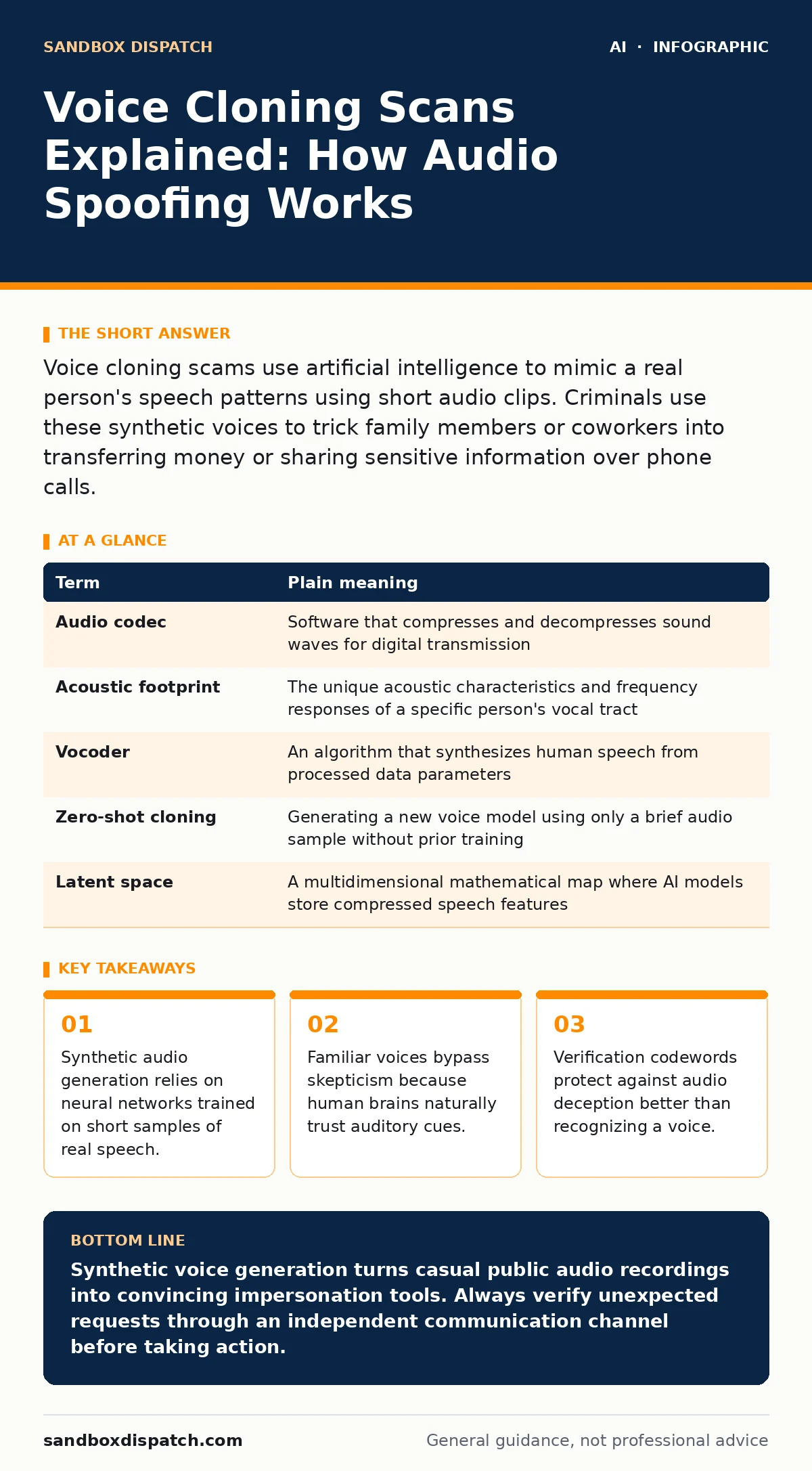
Voice cloning scams use artificial intelligence to mimic a real person's speech patterns using short audio clips. Criminals use these synthetic voices to trick family members or coworkers into transferring money or sharing sensitive information over phone calls.
The Puppet Master Analogy for Synthetic Audio
Voice cloning operates much like a master puppeteer studying a specific actor's movements to manipulate a wooden dummy. Instead of physical strings, software analyzes the acoustic properties of a target speaker from a short audio recording. The underlying engine maps out pitch, cadence, and regional accents to reconstruct entirely new sentences.
Neural networks process audio by breaking speech into tiny fragments called phonemes and predicting how those sounds connect. Traditional voice impersonators required extensive practice to mimic a specific dialect or tone. Automated tools now handle this mathematical mapping in seconds, producing realistic speech without human intervention.
Core Terminology of Audio Deception
Understanding technical jargon helps demystify how synthetic media targets everyday communication channels.
| Term | Plain meaning |
|---|---|
| Audio codec | Software that compresses and decompresses sound waves for digital transmission |
| Acoustic footprint | The unique acoustic characteristics and frequency responses of a specific person's vocal tract |
| Vocoder | An algorithm that synthesizes human speech from processed data parameters |
| Zero-shot cloning | Generating a new voice model using only a brief audio sample without prior training |
| Latent space | A multidimensional mathematical map where AI models store compressed speech features |
What Voice Cloning Means for Everyday Users
Ordinary individuals face risks when public social media videos or voicemail greetings provide clean audio samples. Criminals harvest these public recordings to train neural networks, which are computer architectures inspired by the human brain designed to recognize patterns. When you post videos online, you inadvertently donate the raw training data needed to replicate your speech.
People naturally rely on vocal familiarity to establish trust during phone conversations. Synthetic media exploits this evolutionary shortcut by manufacturing emotional distress or authority. Attackers often stage scenarios involving legal trouble or medical emergencies to induce panic, which short-circuits critical thinking and makes victims compliant.
Hidden Costs and Non-Obvious Consequences
Relying on audio verification introduces severe vulnerabilities into personal and professional security protocols. When organizations treat spoken confirmation as proof of identity, they create single points of failure that software can easily bypass.
Background noise reduction algorithms often improve synthetic audio quality by stripping away the static that traditionally unmasked fake recordings. As generation tools improve, detecting anomalies becomes difficult even for trained audio engineers. This erosion of auditory trust forces society to abandon voice authorization entirely for sensitive transactions.
Simple Safety Habits for Audio Security
Defending against synthetic audio requires adopting rigid communication policies that ignore how a speaker sounds.
- Hang up immediately when an incoming call demands urgent financial action or credential sharing.
- Dial the known, trusted phone number of the person or institution directly to verify the story independently.
- Ignore emotional pressure tactics designed to bypass established verification steps.
See also: Vishing Response: Secure Accounts and Stop Financial Loss · How Tailgating Works and Simple Ways to Stop It
The Broader AI Security Ecosystem
Voice cloning rarely occurs in isolation and often connects to broader automated attack campaigns. Malicious actors frequently combine synthetic audio with techniques explored in large language models to automate complex, multi-stage social engineering operations.
Developers building automated systems must account for these threats, much like teams working within the EU AI Act framework or studying agentic AI behavior. Securing modern communication channels requires assuming that sight and sound can no longer serve as standalone proof of identity.
Key takeaways
- Synthetic audio generation relies on neural networks trained on short samples of real speech.
- Familiar voices bypass skepticism because human brains naturally trust auditory cues.
- Verification codewords protect against audio deception better than recognizing a voice.
Synthetic voice generation turns casual public audio recordings into convincing impersonation tools. Always verify unexpected requests through an independent communication channel before taking action.
Frequently asked questions
Can caller ID spoofing hide the origin of a cloned voice call?
Criminals frequently combine audio synthesis with caller ID spoofing to make phone calls appear as though they originate from trusted local institutions or family members.
How much audio data do scammers need to create a clone?
Modern generation systems can produce a functional vocal replica using less than a minute of clean speech lifted from social media videos or voicemails.
Do standard phone calls sound worse than cloned audio?
Cellular compression algorithms often degrade audio quality, which ironically helps mask the digital artifacts present in artificially generated speech.
Can security software detect synthetic voices in real time?
Real-time detection remains unreliable because network compression and varying microphone qualities strip away the fine-grained data needed to spot anomalies.
How this guide was produced: written by the Sandbox Dispatch editorial team with AI assistance, checked against the public references listed below, and reviewed when the facts change. See our editorial policy or report an error.