The difference between AI and data governance and how to apply both
Data governance controls static storage and access rights, while artificial intelligence governance manages dynamic inference and behavioral drift.

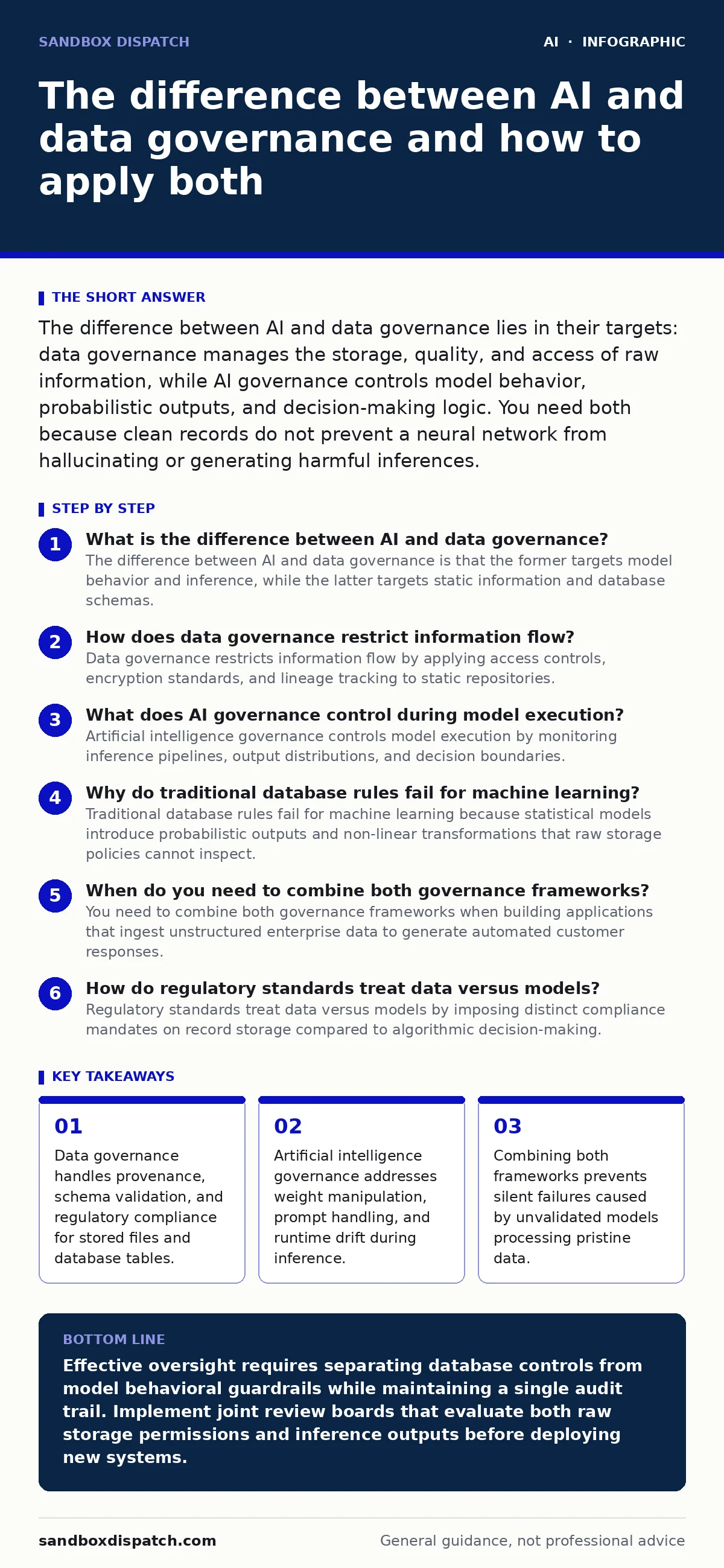
The difference between AI and data governance lies in their targets: data governance manages the storage, quality, and access of raw information, while AI governance controls model behavior, probabilistic outputs, and decision-making logic. You need both because clean records do not prevent a neural network from hallucinating or generating harmful inferences.
What is the difference between AI and data governance?
The difference between AI and data governance is that the former targets model behavior and inference, while the latter targets static information and database schemas. Data governance dictates who can read a table, how long records persist, and whether Personally Identifiable Information is masked at rest. Artificial intelligence governance dictates how a neural network weighs inputs, handles edge cases, and avoids generating hallucinations during runtime. You might have pristine data storage yet still experience catastrophic model failures if your weights degrade or if users exploit vulnerabilities like those covered in prompt injection in AI desktop apps.
How does data governance restrict information flow?
Data governance restricts information flow by applying access controls, encryption standards, and lineage tracking to static repositories. You define permissions at the column or row level to ensure unauthorized users cannot query sensitive records. Lineage tools trace an asset from its ingestion point through every transformation pipeline. This discipline stops unauthorized database reads, but it remains blind to how an analytics model interprets those records.
What does AI governance control during model execution?
Artificial intelligence governance controls model execution by monitoring inference pipelines, output distributions, and decision boundaries. 3 distinct mechanisms govern this phase: input sanitization filters, output validation bounds, and behavioral logging routines. Input filters block adversarial prompts before they reach the transformer layers. Output bounds truncate responses that exceed predefined confidence thresholds or violate safety policies. Logging routines capture every inference request to audit why a model made a specific prediction.
| Governance Type | Primary Target | Main Risk Managed | Typical Tooling |
|---|---|---|---|
| Data | Storage and tables | Unauthorized access | Access control lists |
| AI | Inference and weights | Behavioral drift | Guardrail frameworks |
Why do traditional database rules fail for machine learning?
Traditional database rules fail for machine learning because statistical models introduce probabilistic outputs and non-linear transformations that raw storage policies cannot inspect. A relational database enforces strict schemas and determinism, meaning a query always returns the exact matching rows. Neural networks accept fuzzy inputs and generate novel combinations that may introduce risks similar to those found in AI bias. You cannot write a standard access control policy to stop a trained network from leaking proprietary logic through subtle conversational cues.
When do you need to combine both governance frameworks?
You need to combine both governance frameworks when building applications that ingest unstructured enterprise data to generate automated customer responses. 3 conditions mandate this combination:
- The pipeline processes sensitive records requiring strict lifecycle management.
- The downstream application generates autonomous decisions affecting users.
- The deployment relies on third-party foundations that require continuous auditing.
Failing to link these layers often leads to incidents resembling sensitive data leaks through AI chatbots because the data was secured at rest but left exposed during vector embedding generation.
See also: AI Bias in Education: How Hidden Assumptions Distort Student Outcomes
How do regulatory standards treat data versus models?
Regulatory standards treat data versus models by imposing distinct compliance mandates on record storage compared to algorithmic decision-making. Data regulations focus on consent, retention limits, and right-to-be-forgotten requests for stored files. Algorithmic regulations, such as the frameworks outlined in the EU AI Act, mandate transparency reports, human oversight mechanisms, and rigorous bias testing for deployed networks. Compliance with database rules does not automatically satisfy algorithmic mandates because a compliant database can still feed a non-compliant inference engine.
What hidden costs emerge from misconfigured AI governance?
Misconfigured artificial intelligence governance produces hidden costs that manifest as silent model degradation and exorbitant compute overhead. 2 hidden consequences drain engineering resources:
- Continuous retraining cycles required to fix unchecked behavioral drift.
- Manual audit trails needed to reverse unlogged automated decisions.
Suppose your team deploys an update without validating weight changes. The system might slowly alter its output distribution over weeks, degrading user trust without throwing a single database error or crashing a server.
How can you implement a unified governance pipeline?
A unified governance pipeline can be implemented by establishing joint review boards that evaluate both database schemas and model weights simultaneously. 4 steps operationalize this integration:
- Tag every training dataset with unique lineage identifiers.
- Bind those identifiers directly to the resulting model checkpoints.
- Enforce runtime validation checks that verify input data matches the training distribution.
- Archive inference logs alongside the specific database snapshot used during training.
This synchronization ensures you can reproduce any past prediction and prove compliance across the entire information lifecycle.
Key takeaways
- Data governance handles provenance, schema validation, and regulatory compliance for stored files and database tables.
- Artificial intelligence governance addresses weight manipulation, prompt handling, and runtime drift during inference.
- Combining both frameworks prevents silent failures caused by unvalidated models processing pristine data.
Effective oversight requires separating database controls from model behavioral guardrails while maintaining a single audit trail. Implement joint review boards that evaluate both raw storage permissions and inference outputs before deploying new systems.
Frequently asked questions
Can data governance tools secure large language models?
Data governance tools secure storage layers but cannot prevent models from hallucinating or generating toxic text during inference.
Does data masking prevent machine learning privacy leaks?
Masking raw tables protects stored files, but models can still memorize and regurgitate sensitive information if trained on unmasked variants.
Who should own the artificial intelligence governance process?
Cross-functional teams comprising data engineers, security specialists, and compliance officers should jointly manage these policies.
Are open-source models harder to govern than proprietary ones?
Open-source models require independent weight inspection and infrastructure hardening, whereas proprietary application programming interfaces shift parts of that burden to vendors.
How this guide was produced: written by the Sandbox Dispatch editorial team with AI assistance, checked against the public references listed below, and reviewed when the facts change. See our editorial policy or report an error.