Stop Data Poisoning: Practical Defenses for AI Models
Most data poisoning attacks succeed not through volume, but by exploiting the model's trust in the statistical distribution of your training set.

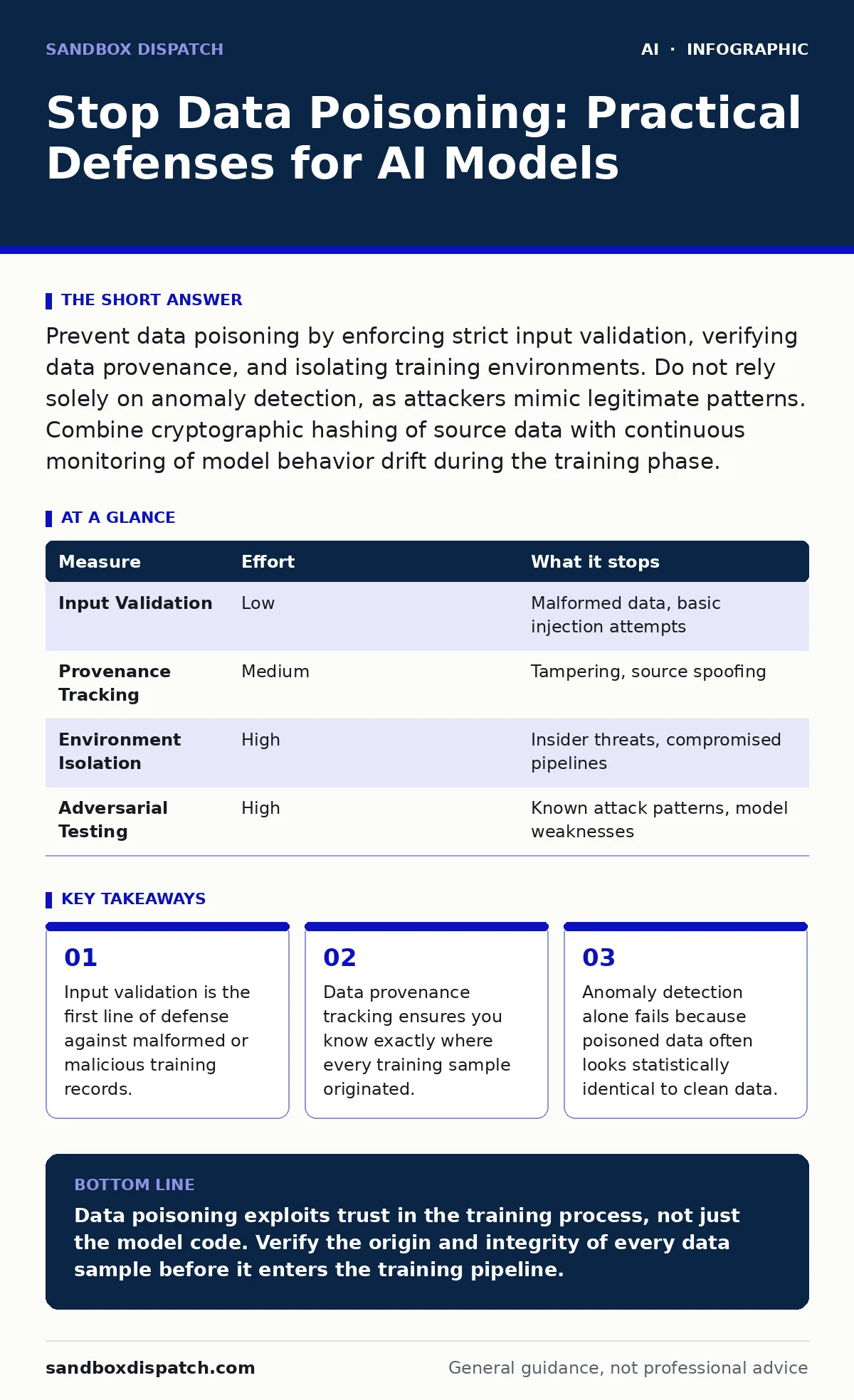
Prevent data poisoning by enforcing strict input validation, verifying data provenance, and isolating training environments. Do not rely solely on anomaly detection, as attackers mimic legitimate patterns. Combine cryptographic hashing of source data with continuous monitoring of model behavior drift during the training phase.
The Silent Corruption of Training Data
Data poisoning occurs when an attacker injects malicious samples into the dataset used to train a machine learning model. Unlike injection attacks that target a running application, poisoning targets the model's foundational understanding of reality. The model learns the poison as truth, embedding the bias or backdoor into its weights permanently. This makes the attack persistent and difficult to detect after deployment.
Imagine you are training a computer vision system to identify stop signs. An attacker adds thousands of images where a specific sticker pattern causes the model to classify the sign as a speed limit sign. The model never sees the attack during inference; it simply behaves incorrectly when the sticker is present. This is a backdoor trigger. The model appears normal on standard test sets but fails catastrophically when the trigger appears.
Why Volume Is Not the Threat
Most developers assume they need massive amounts of bad data to break a model. This is incorrect. Modern machine learning algorithms are highly sensitive to outliers, especially in high-dimensional spaces. A small number of carefully crafted samples can shift the decision boundary significantly. This is known as targeted poisoning.
The attacker does not need to flood your database. They need precision. By placing data points at the edge of the decision boundary, they force the model to adjust its logic to accommodate the error. This requires fewer resources and leaves less forensic evidence. Your defense cannot rely on filtering out "too much" bad data. You must filter out the right bad data.
The Failure of Anomaly Detection
Anomaly detection tools flag data that deviates from the norm. However, a skilled attacker ensures their poisoned data matches the statistical profile of your legitimate data. They match the mean, variance, and correlation structures. This is called stealthy poisoning.
If you trust your anomaly detection system to catch all bad inputs, you leave a wide gap in your security. The system sees normal data. The model learns malicious behavior. You must assume that some poisoned data will pass statistical checks. Your defense must lie elsewhere, in the origin and integrity of the data, not just its appearance.
Verify Data Provenance and Lineage
Provenance refers to the origin and history of a data asset. Without knowing where data comes from, you cannot trust it. You must implement a chain of custody for every training sample. This means recording who created the data, when it was created, and what transformations were applied.
Use cryptographic hashing to verify that the data has not been altered since ingestion. Store these hashes in an immutable log. If a hash mismatches during training, the record is rejected. This prevents tampering after the data enters your pipeline.
Consider the source of user-generated content. If your model learns from public forums or open datasets, the risk is higher. You cannot verify the intent of every contributor. You must treat all external data as untrusted until verified. Internal data, generated by your own systems, is easier to secure because you control the environment.
| Measure | Effort | What it stops |
|---|---|---|
| Input Validation | Low | Malformed data, basic injection attempts |
| Provenance Tracking | Medium | Tampering, source spoofing |
| Environment Isolation | High | Insider threats, compromised pipelines |
| Adversarial Testing | High | Known attack patterns, model weaknesses |
Isolate the Training Pipeline
Your training environment is often less secure than your production environment. Developers may use shared credentials, open ports, or permissive network rules to facilitate data movement. Attackers exploit this gap to inject data directly into the training queue.
Treat the training pipeline as a critical infrastructure component. Isolate it from general network access. Use private endpoints for data storage. Restrict access to the training scripts and data loaders. Only authorized processes should be able to write to the training dataset.
This isolation adds friction. Data scientists may complain about slower data access. This friction is a feature, not a bug. It prevents automated scripts from injecting data at scale. You can review data batches before they enter the isolated zone. This manual check is a powerful deterrent against large-scale poisoning.
See also: Treat AI Models as Untrusted Insiders: 6 Common Misunderstandings
Sanitize Inputs with Strict Schemas
Input validation is not just for web forms. It applies to training data as well. Define a strict schema for your data. Specify the allowed data types, ranges, and formats. Reject any record that does not match the schema exactly.
This prevents many common poisoning techniques. For example, if your model expects integers between 0 and 100, a record with a value of 1000 is rejected. This stops simple value manipulation. It does not stop sophisticated semantic attacks, but it removes the low-hanging fruit.
Be careful with automatic type conversion. Some systems will silently convert a string to a number, potentially hiding malicious content. Disable this behavior. Fail fast. If the data does not fit the schema, drop it. Log the rejection for audit purposes.
Monitor for Concept Drift
Concept drift occurs when the statistical properties of the target variable change over time. In a poisoning attack, the attacker may slowly introduce biased data to avoid detection. This gradual shift can look like natural drift.
Monitor your model's performance on a holdout set that was never used for training. If performance drops suddenly or shifts in a specific direction, investigate the recent training data. Look for correlations between the drop and specific data sources or time periods.
This monitoring does not prevent the attack, but it limits the damage. You can detect the poisoning before the model is deployed or before it causes significant harm. Combine this with regular retraining on clean, verified data to overwrite the poisoned weights.
What Does Not Work
Do not rely on data augmentation to fix poisoned data. Augmentation creates variations of existing data. If the original data is poisoned, the augmented data is also poisoned. You are simply multiplying the error.
Do not assume that larger datasets dilute the effect of poisoning. While volume helps, it does not eliminate the risk. Attackers scale their efforts to match your data volume. A larger dataset often means more diverse sources, which increases the attack surface.
Do not ignore the human element. Data annotators can be manipulated or coerced into labeling data incorrectly. This is label poisoning. You must verify the quality of human annotations through redundancy and consensus. Single-source annotations are vulnerable to individual error or malice.
Three Actions for Today
- Audit your data ingestion pipeline for unvalidated external sources.
- Implement cryptographic hashing for all training data files.
- Review access controls on your training environment.
Key takeaways
- Input validation is the first line of defense against malformed or malicious training records.
- Data provenance tracking ensures you know exactly where every training sample originated.
- Anomaly detection alone fails because poisoned data often looks statistically identical to clean data.
Data poisoning exploits trust in the training process, not just the model code. Verify the origin and integrity of every data sample before it enters the training pipeline.
Frequently asked questions
Can I detect data poisoning after the model is deployed?
It is difficult but possible by monitoring for unexpected behavior patterns or performance drops on specific input types.
Is synthetic data safe from poisoning?
Synthetic data is only as safe as the generator and the rules used to create it. If the generation logic is flawed, the synthetic data can be biased.
How often should I retrain my model to mitigate poisoning?
Retrain regularly using verified clean data. The frequency depends on your data update cycle and the criticality of the model.
Do LLM guardrails prevent data poisoning?
LLM guardrails protect against misuse at inference time. They do not prevent poisoning during the pre-training or fine-tuning phases.
How this guide was produced: written by the Sandbox Dispatch editorial team with AI assistance, checked against the public references listed below, and reviewed when the facts change. See our editorial policy or report an error.