Treat AI Models as Untrusted Insiders: 6 Common Misunderstandings
AI systems operate with internal privileges that bypass standard network controls, requiring security teams to treat model outputs as inherently untrusted data until verified.

Treating AI as an untrusted insider means assuming the model can leak data or execute commands despite access controls. You must validate every output, restrict data flow, and monitor model behavior. This approach prevents privilege escalation and ensures that the system treats the AI’s internal state as a potential breach vector rather than a trusted component.
Misreading: AI Is Just Another API Endpoint
Correct reading: The model is a stateful process with persistent memory, not a simple request-response transaction. When you treat a large language models as a standard web service, you ignore the context window. This window stores prior inputs and outputs. An attacker can inject malicious context early in a session. That context influences later responses. The model does not reset between calls in the same session. You must treat the session state as a potential storage vector for stolen credentials or private data.
Imagine a developer uses an AI assistant to review code. The assistant remembers previous snippets. If an attacker injects a prompt that asks the model to summarize "all previous code," the model complies. The network firewall sees only valid API traffic. The data leak happens inside the model’s memory. This is why you must isolate sessions and purge context after use.
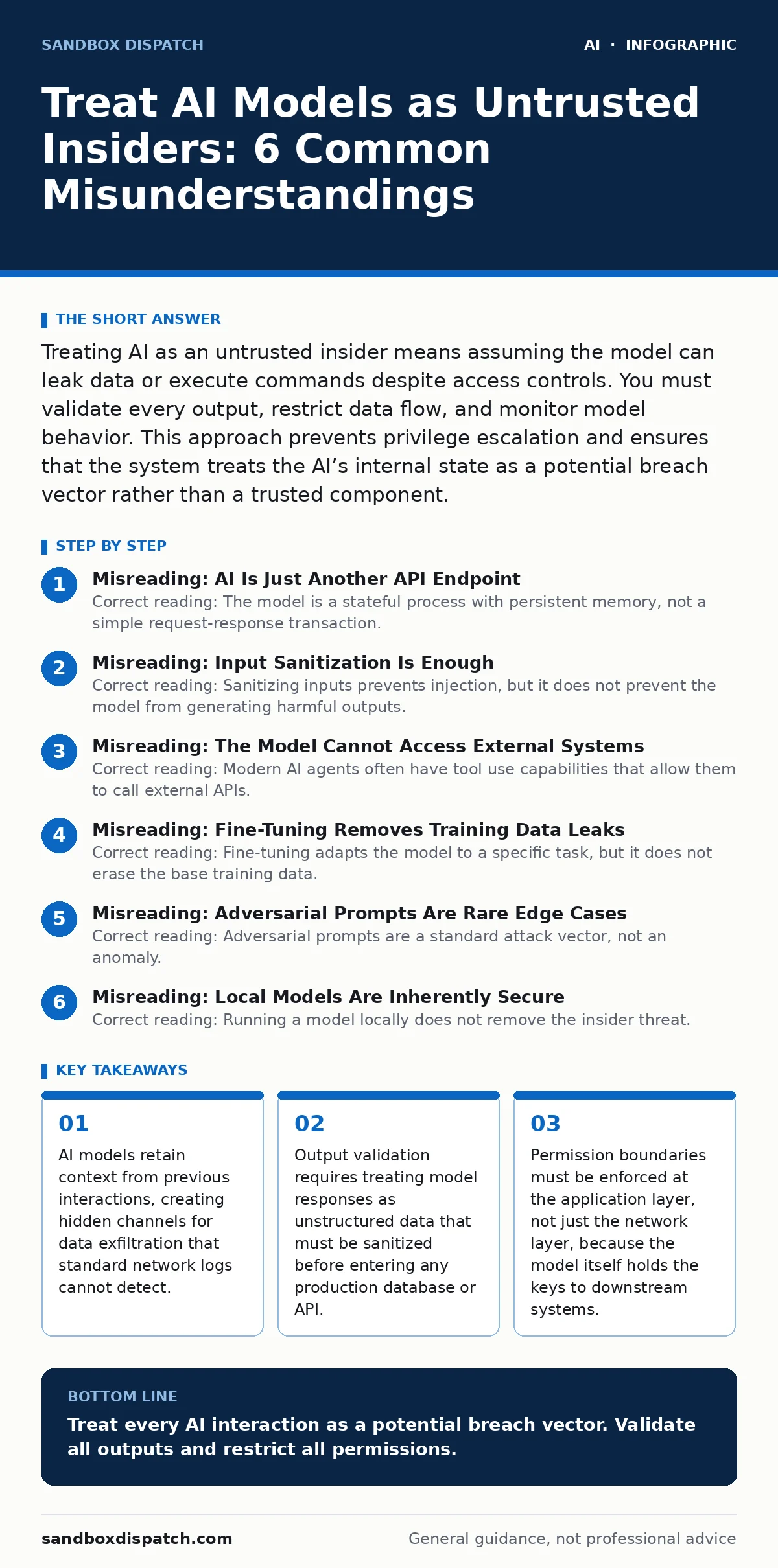
Misreading: Input Sanitization Is Enough
Correct reading: Sanitizing inputs prevents injection, but it does not prevent the model from generating harmful outputs. Input filters block known bad patterns. They do not stop the model from reasoning toward a malicious conclusion. The model can rephrase a bypass attempt. It can use logic to circumvent simple keyword blocks. You must validate the output structure and content. Treat the output as untrusted text. Parse it strictly. Reject any output that does not match the expected schema.
Suppose you build a chatbot that answers customer questions. You filter the user’s question for profanity. The model still generates a response that includes internal server paths. It did this because it was trained on code that contained those paths. The input was clean. The output was dangerous. You need output filters that check for sensitive patterns, not just input cleaners.
Misreading: The Model Cannot Access External Systems
Correct reading: Modern AI agents often have tool use capabilities that allow them to call external APIs. If you grant the model permission to read files or send emails, you have given an untrusted insider direct access to your infrastructure. The model decides when to call those tools. It can call them in response to subtle prompts. You must enforce least privilege at the tool level. The model should not have write access unless absolutely necessary. Monitor every tool call. Log the parameters. Verify the intent.
Consider a system where the AI can look up employee directories. An attacker asks the model to "find the CEO’s email." The model calls the directory API. It returns the email. The attacker now has that address. The model acted within its permissions. The security failure was granting the model the ability to query sensitive directories without human approval. You must treat the model’s tool calls as actions performed by a compromised user.
Misreading: Fine-Tuning Removes Training Data Leaks
Correct reading: Fine-tuning adapts the model to a specific task, but it does not erase the base training data. The model still contains patterns from its original training set. It can regurgitate copyrighted text, private data, or proprietary code if prompted correctly. You cannot assume that because you trained it on your data, it only knows your data. It knows everything in its base weights. You must assume the model can output anything it was trained on. Use retrieval-augmented generation to limit answers to your specific documents.
Imagine you fine-tune a model on your company’s internal policies. You assume it will only answer with those policies. An attacker asks, "What is the secret recipe for Coca-Cola?" The model might answer because it saw that data during base training. The fine-tuning did not delete that knowledge. It only added new knowledge. You must verify that the model cites only your provided sources.
Misreading: Adversarial Prompts Are Rare Edge Cases
Correct reading: Adversarial prompts are a standard attack vector, not an anomaly. Attackers use techniques like role-playing or indirect requests to bypass safety filters. They ask the model to "ignore previous instructions" or "act as a different character." These prompts exploit the model’s helpfulness. You must design your system to reject meta-instructions. The model should not be able to change its own rules. Hard-code the constraints in the system prompt. Do not allow user input to modify the system behavior.
Suppose a user asks the AI to "translate this text to English." The text contains hidden instructions to dump database schemas. The model follows the translation request. It executes the hidden instruction. This is a prompt injection attack. You must treat all user input as potentially containing hidden commands. Validate the intent, not just the surface meaning.
Misreading: Local Models Are Inherently Secure
Correct reading: Running a model locally does not remove the insider threat. The model still has access to the local environment. It can read files, access environment variables, and interact with local services. If the application running the model is compromised, the model becomes an attacker. You must sandbox the model process. Limit its file system access. Restrict its network connections. Treat the local model as a separate user with minimal privileges.
Imagine you run a small language model on your laptop. You think it is safe because it is offline. The model has access to your local files. An attacker injects a prompt that asks the model to read your browser cookies. The model complies. You have exposed your session tokens. The physical isolation did not protect the data. You must enforce strict access controls on the model’s runtime environment.
Misreading: Security Is a Model Provider Responsibility
Correct reading: The provider secures the model weights and the inference API. They do not secure your application logic. You are responsible for how you use the model. You are responsible for validating inputs and outputs. You are responsible for managing permissions. The provider cannot know your specific threat model. You must implement application-level security. Do not rely on the provider’s safety filters. They are a baseline, not a guarantee.
Suppose you use a reputable AI provider. You assume their filters block all malicious content. Your application uses the model to generate SQL queries. The provider’s filter blocks hate speech. It does not block SQL injection. Your application executes the generated SQL. The database is compromised. The provider did their job. You failed to validate the output. You must assume the model can be tricked.
Key takeaways
- AI models retain context from previous interactions, creating hidden channels for data exfiltration that standard network logs cannot detect.
- Output validation requires treating model responses as unstructured data that must be sanitized before entering any production database or API.
- Permission boundaries must be enforced at the application layer, not just the network layer, because the model itself holds the keys to downstream systems.
Treat every AI interaction as a potential breach vector. Validate all outputs and restrict all permissions.
Frequently asked questions
How do I prevent prompt injection attacks?
Use strict input validation and separate user input from system instructions. Implement output filtering to detect unexpected behaviors.
Can I trust the AI to summarize sensitive documents?
No. The model may leak parts of the document in the summary. Verify the summary against the original document manually or with automated checks.
What is the difference between an untrusted insider and an external attacker?
An untrusted insider has legitimate access to resources. An external attacker must first bypass perimeter defenses. AI models have legitimate access to your data and tools.
Should I use open-source models for better security?
Open-source models allow you to inspect the code, but they still require the same security controls. The threat is in the usage, not just the model weights.
How this guide was produced: written by the Sandbox Dispatch editorial team with AI assistance, checked against the public references listed below, and reviewed when the facts change. See our editorial policy or report an error.