CVSS Scores Explained: What Small Teams Must Know
High CVSS scores measure technical severity, not business risk, meaning a perfect score might be irrelevant to your specific infrastructure.
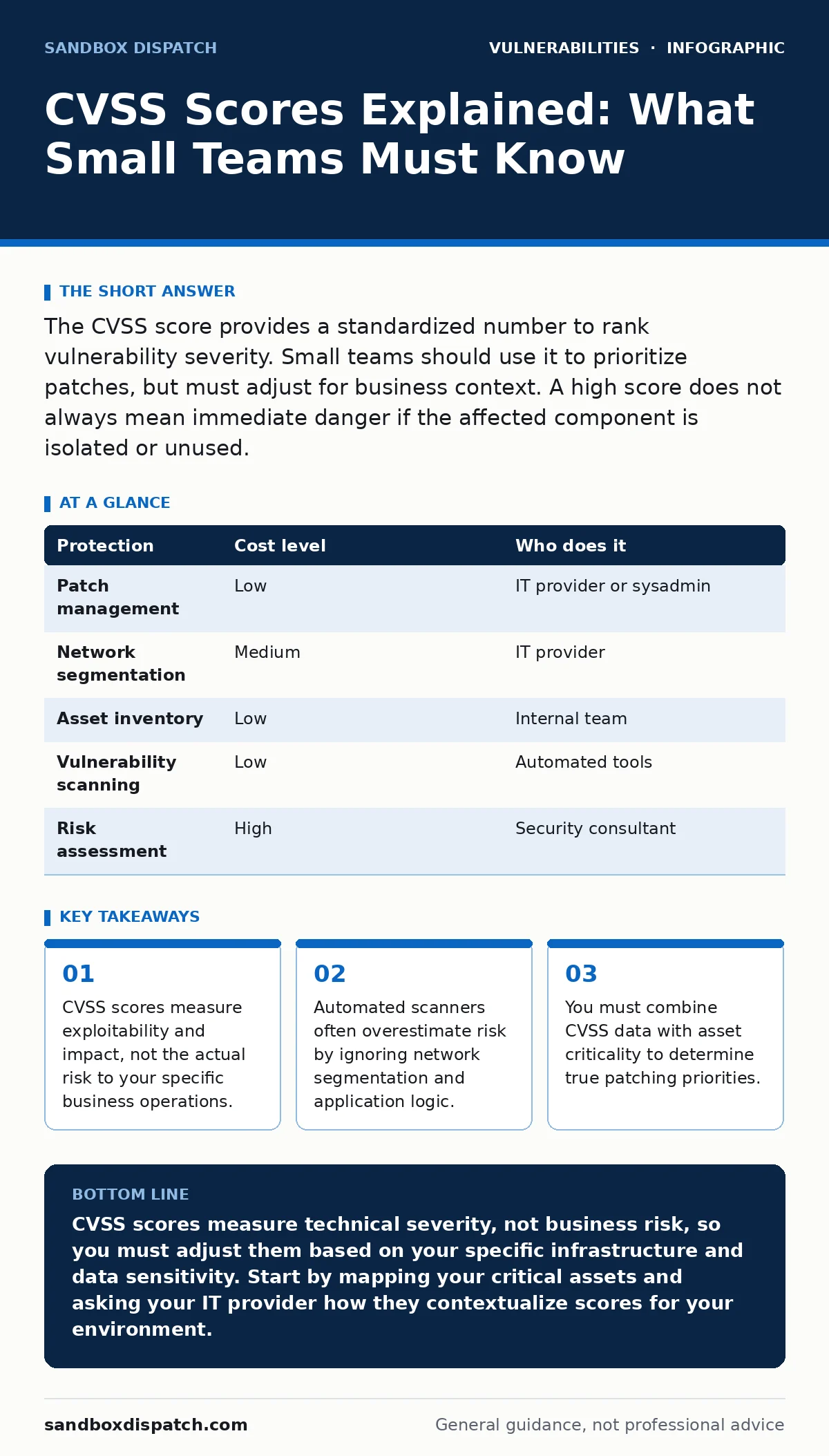
The CVSS score provides a standardized number to rank vulnerability severity. Small teams should use it to prioritize patches, but must adjust for business context. A high score does not always mean immediate danger if the affected component is isolated or unused.
What the CVSS Score Actually Measures
The Common Vulnerability Scoring System (CVSS) assigns a numerical value from 0.0 to 10.0 to software flaws. This number reflects how easy it is to exploit the flaw and how severe the consequences are. The score breaks down into three groups of metrics: base, temporal, and environmental. The base score is the most common number you see. It remains static for the vulnerability itself, regardless of where it exists.
The temporal score changes as patches become available or exploits spread. The environmental score adjusts the number for your specific setup. Most tools only show the base score. This creates a blind spot for small teams. You see a high number and assume immediate danger. You do not see that your environment might mitigate the risk entirely. Understanding the difference between base and environmental scores is the first step in accurate prioritization.
Why Base Scores Mislead Small Teams
Small organizations often lack the resources to patch everything immediately. They must choose what to fix first. Relying solely on the base CVSS score leads to wasted effort. A vulnerability with a score of 10.0 might require physical access to the server. If your server is in a locked data center, the risk is low. Another vulnerability might have a score of 4.0 but affects your public-facing login page.
This lower score poses a higher threat to your business. The base score ignores your network architecture. It ignores your user behavior. It ignores your data sensitivity. Treating the base score as the whole truth causes teams to chase technical perfection instead of business security. You end up patching obscure internal tools while leaving critical customer-facing applications exposed.
Moving Beyond the Number
You must contextualize every score. Ask yourself who can reach the vulnerable system. Ask what data the system holds. Ask if the vulnerability requires user interaction. Some flaws need a user to click a link. Others execute automatically. The CVSS metrics capture some of this, but not all. For example, the "User Interaction" metric notes if a user must do something.
But it does not tell you if your users are likely to click that link. You need to combine the CVSS score with your own knowledge. This approach is part of risk-based vulnerability management. It shifts the focus from the flaw to the impact. You prioritize fixes that protect your revenue and reputation. You delay fixes for systems that pose minimal threat. This method saves time and reduces burnout.
Practical Steps for Prioritization
Start by mapping your assets. Identify which systems handle customer data. Identify which systems are exposed to the internet. When a new vulnerability appears, check the CVSS score. Then check your asset map. If the vulnerable software is not on your critical systems, lower the priority. If it is on a critical system, raise the priority. Look at the "Attack Vector" metric.
A network-based attack is more dangerous than a local one. Look at the "Privileges Required" metric. An exploit that needs admin rights is harder to trigger than one that needs none. Use these details to refine your list. Do not just look at the final number. Break it down. This extra step takes minutes but prevents costly mistakes. It ensures you spend your limited resources on the threats that matter.
| Protection | Cost level | Who does it |
|---|---|---|
| Patch management | Low | IT provider or sysadmin |
| Network segmentation | Medium | IT provider |
| Asset inventory | Low | Internal team |
| Vulnerability scanning | Low | Automated tools |
| Risk assessment | High | Security consultant |
What to Ask Your IT Provider
Your IT provider should not just report scores. They should interpret them for you. If they only send a list of high scores, they are not doing their job. You need to understand the context. Ask specific questions about their process. This ensures they are thinking about your business, not just their tools. Here are the questions you should ask:
- How do you adjust CVSS scores for our specific environment?
- Can you explain why this high-score vulnerability is low priority?
- Do you track the temporal metrics as exploits become available?
- How do you distinguish between critical and non-critical assets?
- What is your process for validating that a patch fixes the issue?
These questions force a deeper conversation. They reveal whether the provider understands risk-based vulnerability management. They show if the provider is proactive or reactive. A good provider will have clear answers. A bad provider will stick to the numbers. You need a partner who helps you make decisions, not just a vendor who runs scans.
The Hidden Cost of False Positives
Automated scanners are imperfect. They often report vulnerabilities that do not exist. This happens because the scanner cannot see the full context. It sees a library file and assumes it is used. It sees a port open and assumes it is accessible. These false positives create noise. Your team wastes time investigating non-issues. This is known as alert fatigue. Over time, your team starts ignoring alerts.
This is dangerous. You might miss a real threat because you are tired of false alarms. The CVSS score does not help with false positives. A false positive can have a score of 10.0. You must validate every finding. Check the source code. Check the configuration. Verify the vulnerability exists before you panic. This verification step is critical for small teams with limited staff.
Integrating with Broader Security
CVSS is one tool in your toolkit. It should not be the only one. Combine it with other practices for better protection. For instance, threat modeling helps you identify risks before they become vulnerabilities. It allows you to design systems that are less vulnerable in the first place. Understanding exploit chains helps you see how multiple low-score vulnerabilities can combine to create a high-risk scenario.
A single low-score flaw might be harmless. But combined with another flaw, it can lead to full system compromise. You must look for these connections. Also, keep browser updates current. Many attacks target outdated browsers. This is a simple step that reduces the attack surface. Finally, consider unpatched software as a persistent risk. Some systems cannot be patched immediately. You must isolate them or monitor them closely.
Common Mistakes to Avoid
Do not ignore low scores. A score of 3.0 might be trivial in most cases. But if it affects your payment processing system, it is critical. Do not assume a high score means an active attack. It means the vulnerability is technically severe. It does not mean someone is exploiting it right now. Do not rely on one scanner. Different tools find different things. Use multiple sources to verify findings.
Do not forget about vulnerability disclosure policies. If you build software, you need a way for researchers to report flaws. This helps you find issues before attackers do. Finally, do not neglect PHP object injection or similar specific flaws if you use those technologies. Generic scores might not capture the specific danger of these complex vulnerabilities. You need to understand the code you run.
Final Thoughts on Score Usage
The CVSS score is a starting point, not an ending point. It gives you a common language to discuss risk. It helps you compare different vulnerabilities. But it does not make decisions for you. You must apply judgment. You must consider your business context. You must validate findings. Small teams can use CVSS effectively if they understand its limits. Focus on the environmental factors. Focus on your asset criticality. Focus on the real-world impact. This approach turns a confusing number into a useful tool. It helps you protect your business without wasting resources. It allows you to sleep at night knowing you addressed the real threats.
Key takeaways
- CVSS scores measure exploitability and impact, not the actual risk to your specific business operations.
- Automated scanners often overestimate risk by ignoring network segmentation and application logic.
- You must combine CVSS data with asset criticality to determine true patching priorities.
CVSS scores measure technical severity, not business risk, so you must adjust them based on your specific infrastructure and data sensitivity. Start by mapping your critical assets and asking your IT provider how they contextualize scores for your environment.
Frequently asked questions
Does a higher CVSS score mean I am being attacked?
No, a high score indicates the vulnerability is technically severe and easy to exploit, but it does not confirm active exploitation or targeting of your system.
How often should I check for new CVSS scores?
You should check for new scores regularly, ideally daily, as new vulnerabilities are discovered and existing scores are updated as more information becomes available.
Can I ignore vulnerabilities with low CVSS scores?
You should not ignore low scores blindly, as a low-score vulnerability on a critical
How this guide was produced: written by the Sandbox Dispatch editorial team with AI assistance, checked against the public references listed below, and reviewed when the facts change. See our editorial policy or report an error.