What Is a Risk Based Approach to Vulnerability Management
Fixing every bug at once wastes resources; prioritizing by actual business impact lets you sleep while ignoring low-impact flaws.

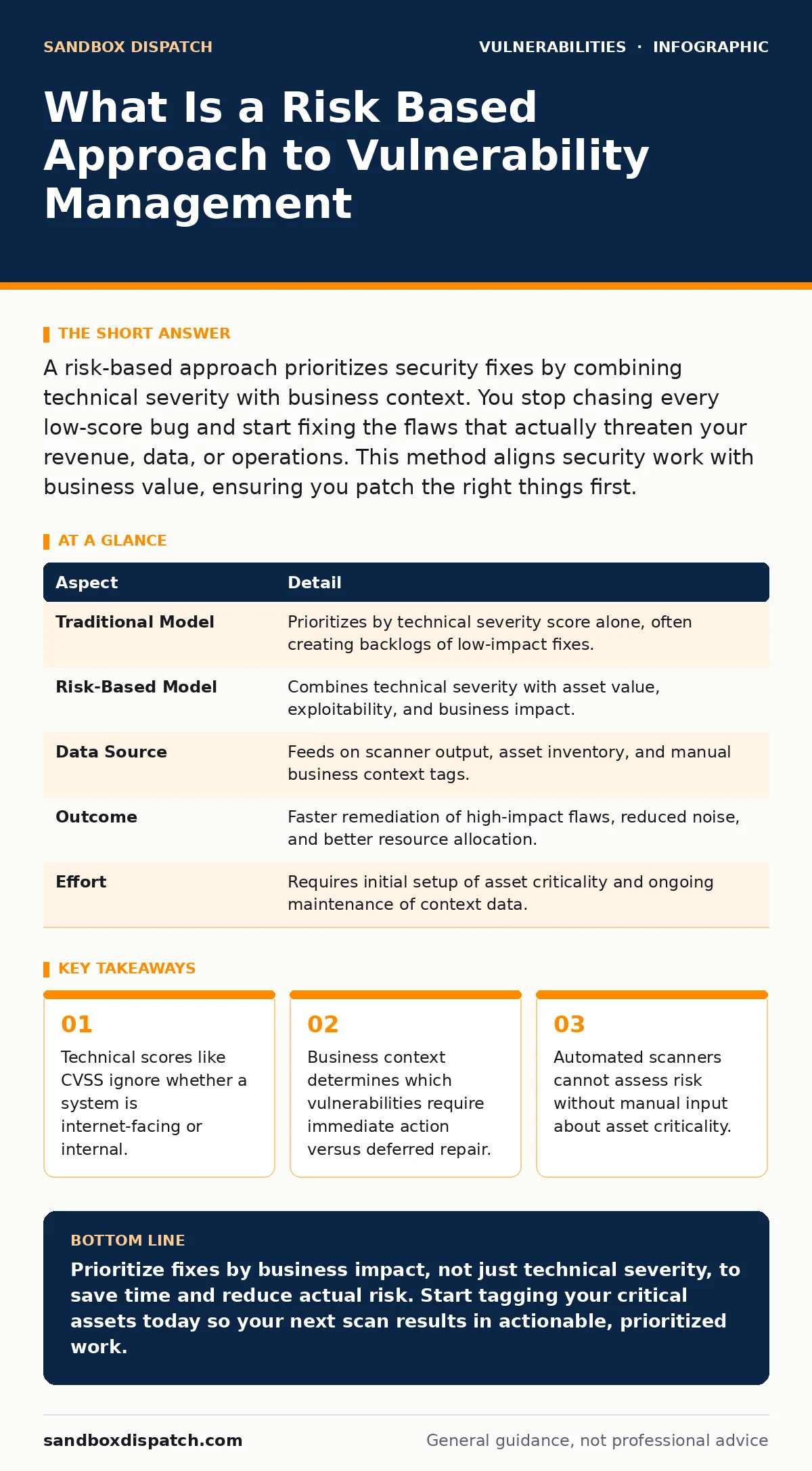
A risk-based approach prioritizes security fixes by combining technical severity with business context. You stop chasing every low-score bug and start fixing the flaws that actually threaten your revenue, data, or operations. This method aligns security work with business value, ensuring you patch the right things first.
What Is a Risk Based Approach
A risk-based approach to vulnerability management is a strategy that prioritizes security fixes based on the actual threat to your organization, not just the theoretical severity of the flaw. It answers the search query "what is a risk based approach" by replacing the chaotic "fix everything" mindset with a targeted "fix what matters" workflow. You combine technical data with business context to decide which vulnerabilities pose the greatest danger to your specific operations.
Imagine you are a homeowner with a leaky roof and a broken window. A traditional scanner sees both as "damage." A risk-based assessment asks if the roof is over your server room or the attic. If the roof leak threatens critical data, you fix it first. If the broken window is in a storage shed, you might wait. This analogy shows how context dictates priority. You do not treat all flaws as equal because your resources are finite.
| Aspect | Detail |
|---|---|
| Traditional Model | Prioritizes by technical severity score alone, often creating backlogs of low-impact fixes. |
| Risk-Based Model | Combines technical severity with asset value, exploitability, and business impact. |
| Data Source | Feeds on scanner output, asset inventory, and manual business context tags. |
| Outcome | Faster remediation of high-impact flaws, reduced noise, and better resource allocation. |
| Effort | Requires initial setup of asset criticality and ongoing maintenance of context data. |
How Context Changes Priority
Technical scanners output a CVSS score, which measures the potential impact of a vulnerability if exploited. This score is useful but incomplete. It assumes the vulnerability is reachable and that the asset is valuable. A high CVSS score on an internal, air-gapped printer is less dangerous than a moderate score on a public-facing login page. You must layer business context over technical data to see the true risk.
You start by classifying your assets. Is this server holding customer credit cards, or is it a development sandbox? Is this application accessible from the public internet, or only via VPN? These questions change the risk profile entirely. A vulnerability in a public-facing system has a lower barrier to exploitation because attackers can scan for it automatically. An internal system requires an attacker to already be inside your network, which is a higher hurdle.
The Mechanics of Risk Calculation
You calculate risk by multiplying likelihood by impact. Likelihood depends on exploitability, which includes whether a public exploit exists and how exposed the asset is. Impact depends on the data stored on the asset and the business function it supports. If a flaw allows remote code execution on a database holding personal data, the impact is high. If the same flaw exists on a static file server, the impact is lower.
This calculation is not purely mathematical. It requires judgment. You must decide what "high impact" means for your organization. Does losing a non-critical web server stop revenue? If yes, its impact is high. If no, you can defer the fix. This process forces you to understand your own infrastructure. You cannot manage risk for systems you do not understand. This is where threat modeling becomes relevant, as it helps you map out these dependencies before vulnerabilities appear.
Who Affected by This Shift
This approach changes the daily work of developers, security engineers, and IT operations. Developers stop receiving urgent tickets for low-impact bugs that distract from feature work. They focus on fixing flaws in critical paths. Security engineers stop acting as ticket generators and start acting as risk advisors. They provide the context that scanners cannot see. IT operations teams gain visibility into which systems require immediate patching and which can wait for the next maintenance window.
It also affects leadership. Executives get clearer reports on actual business risk rather than a growing list of open tickets. They can see that the number of critical risks is dropping, even if the total number of vulnerabilities remains high. This builds trust between security and business units. Security is no longer seen as a blocker, but as a partner in protecting revenue and reputation.
What People Usually Get Wrong
Many teams treat risk-based management as a one-time configuration. They set up asset tags and forget them. Business functions change. A development server becomes a production server. An internal tool gets exposed to the internet. If your context data is stale, your risk scores are wrong. You must treat asset context as a living dataset, not a static label.
Another common error is over-automating the decision. You cannot fully automate risk assessment. Machines can tell you a flaw exists and its technical score. They cannot tell you if the flaw affects a revenue-generating feature. Human judgment is required to interpret the business impact. Relying solely on automation leads to false confidence. You might defer a fix that turns out to be critical because the machine lacked the context to see the business value.
What To Do About It
Start by mapping your crown jewels. Identify the systems that hold your most sensitive data or drive your core revenue. Tag these assets as critical. Then, integrate your vulnerability scanner with your asset management system. Ensure every scan result includes the asset's business context. This allows you to sort vulnerabilities by risk, not just by score.
Review your patch management processes to align with this new priority. Do not patch all critical scores at once. Patch the critical scores on critical assets first. Defer the rest. This reduces the workload and speeds up response time for genuine emergencies. You also need to address unpatched software by understanding why it remains unpatched. Is it legacy? Is it incompatible? Document these exceptions so you know the residual risk.
Integrating With Existing Practices
Risk-based management works best when combined with other security practices. It complements vulnerability disclosure policies by helping you prioritize external reports based on the asset's criticality. It informs your approach to session fixation by highlighting which applications handle active user sessions on critical systems. You do not replace these practices; you enhance them with better prioritization.
You also need to communicate this shift clearly. Developers need to understand why some tickets are delayed. Security needs to explain the rationale behind deferring certain fixes. Transparency builds trust. Show that you are not ignoring vulnerabilities, but managing them intelligently. This reduces friction and ensures everyone is working toward the same goal: protecting the business from the most likely and damaging attacks.
Key takeaways
- Technical scores like CVSS ignore whether a system is internet-facing or internal.
- Business context determines which vulnerabilities require immediate action versus deferred repair.
- Automated scanners cannot assess risk without manual input about asset criticality.
Prioritize fixes by business impact, not just technical severity, to save time and reduce actual risk. Start tagging your critical assets today so your next scan results in actionable, prioritized work.
Frequently asked questions
Does risk-based management mean I ignore low-severity bugs?
No, it means you fix them later. Low-severity bugs on non-critical systems can wait until resources are available or a maintenance window opens.
How do I determine if an asset is critical?
Consult with business owners. Ask what happens if the system goes down or is compromised. If revenue stops or data leaks, it is critical.
Can I automate the entire risk assessment process?
You can automate the data collection and scoring, but you cannot automate the business context. Human judgment is required to validate asset criticality and impact.
What if my scanner does not support risk-based scoring?
You can build a custom workflow. Export scanner results, join them with your asset inventory data in a spreadsheet or database, and calculate a composite risk score manually.
How this guide was produced: written by the Sandbox Dispatch editorial team with AI assistance, checked against the public references listed below, and reviewed when the facts change. See our editorial policy or report an error.