PHP Object Injection Risks and Protection for Small Businesses
Small teams face PHP object injection because they trust deserialized data from sessions and cookies, allowing attackers to run code without traditional entry points.

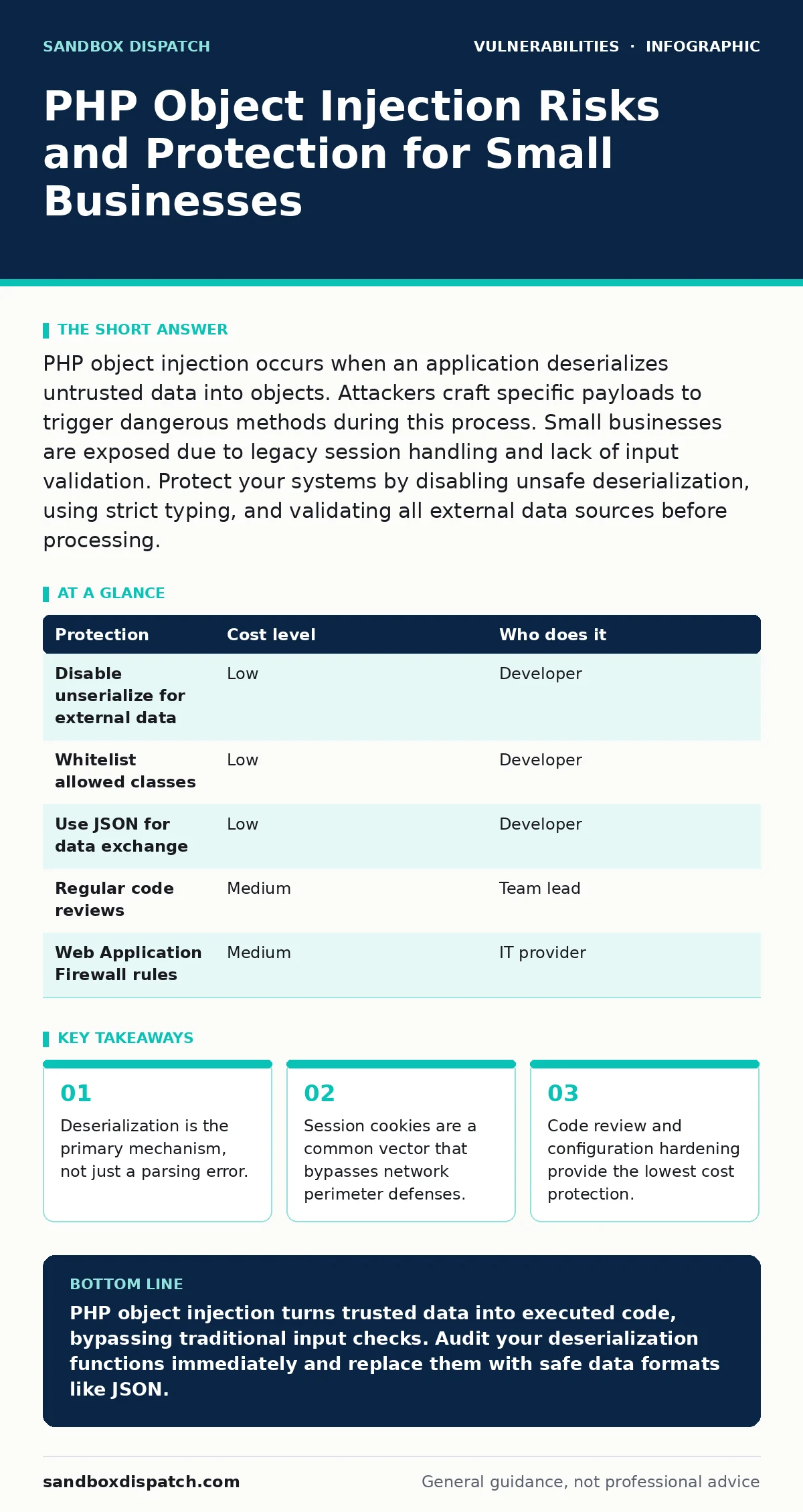
PHP object injection occurs when an application deserializes untrusted data into objects. Attackers craft specific payloads to trigger dangerous methods during this process. Small businesses are exposed due to legacy session handling and lack of input validation. Protect your systems by disabling unsafe deserialization, using strict typing, and validating all external data sources before processing.
The Hidden Cost of Trusting Data
PHP object injection exploits the way PHP handles data structures. When you save complex data, PHP converts it into a string format called serialization. This string contains the data values and the class definitions. When the application needs to use that data later, it converts the string back into an object. This process is deserialization. If the application deserializes data from an untrusted source, an attacker can inject a crafted string. The server then creates an object based on that string. The object may contain code that runs automatically during creation or destruction.
This vulnerability exists because developers often assume that internal data structures are safe. They forget that external inputs can mimic these structures. The attack does not require SQL injection or cross-site scripting. It requires only that the application accepts a serialized string and processes it. This makes it particularly dangerous for small organizations. They often reuse code snippets from online forums. These snippets frequently use the unserialize function without checking the source.
Why Small Organizations Are Exposed
Small teams often lack dedicated security engineers. They rely on generalist developers who prioritize feature delivery over security architecture. This leads to several common pitfalls. First, legacy code remains in production. Older PHP versions had weaker protections against type juggling and object injection. Second, session management is often misconfigured. PHP sessions store data on the server but send a session ID in a cookie. If the session data is serialized and stored in a way that users can influence, it becomes a vector.
Third, third-party libraries introduce risk. Small businesses use open-source components to save time. These components may contain vulnerable deserialization functions. If you do not audit these libraries, you inherit their flaws. Fourth, there is a lack of awareness. Many developers do not understand that deserialization is a code execution risk. They treat it as a data parsing task. This mindset gap allows vulnerabilities to persist for years.
The exposure is not just technical. It is organizational. Small teams often share credentials and deploy to production without rigorous testing. A single misconfigured setting can expose the entire stack. The attacker does not need to break into the server directly. They only need to convince the server to process their crafted data. This bypasses many traditional network defenses.
The Mechanics of the Attack
To understand the protection, you must understand the mechanism. PHP objects have magic methods. These are special functions that run automatically at specific times. For example, __destruct runs when an object is destroyed. __wakeup runs after deserialization. An attacker crafts a serialized string that represents an object with a dangerous __destruct method. When the server deserializes this string, it creates the object. Then, it runs the __destruct method. This method might execute a system command or read a sensitive file.
The attacker does not need to know the source code. They can often determine the class structure by observing error messages or using common patterns. They then craft the payload manually or use a tool. The payload is just a string. It looks like garbage data to a human. But to PHP, it is a blueprint for an object. The server follows the blueprint. It instantiates the object. It runs the code. The result is remote code execution.
This works because PHP trusts the structure of the serialized data. It does not validate whether the class being instantiated is safe. It assumes that if the data is well-formed, it is legitimate. This assumption is the core of the vulnerability. The attacker exploits this trust. They inject a class that should never be instantiated from external input. The server complies. The code runs.
Low-Cost Protections for Limited Budgets
You do not need expensive tools to mitigate this risk. The most effective protections are changes in code and configuration. These changes cost nothing but require discipline. Start by disabling unsafe deserialization. If you do not need to deserialize external data, do not use unserialize. Use JSON or XML instead. These formats are data-only. They do not execute code. They are safer by design.
If you must use serialization, restrict the classes that can be instantiated. PHP allows you to set a whitelist of allowed classes. Configure this setting to include only the classes you explicitly need. This prevents an attacker from injecting arbitrary objects. It limits the damage to a known set of safe classes. This is a form of configuration hardening that significantly reduces the attack surface.
Another low-cost measure is input validation. Validate all external data before processing it. Check the source of the data. If it comes from a user, treat it as hostile. Do not pass it directly to a deserialization function. Use a wrapper function that checks the data against a schema. This adds a layer of defense. It ensures that only expected data structures reach the core logic.
| Protection | Cost level | Who does it |
|---|---|---|
Disable unserialize for external data | Low | Developer |
| Whitelist allowed classes | Low | Developer |
| Use JSON for data exchange | Low | Developer |
| Regular code reviews | Medium | Team lead |
| Web Application Firewall rules | Medium | IT provider |
What to Ask an IT Provider
If you outsource your IT or development, you must verify their security practices. Do not assume they are secure. Ask specific questions. First, ask how they handle deserialization. Do they use it? If so, how do they validate the input? Do they whitelist classes? Second, ask about their testing process. Do they include security tests in their continuous integration pipeline? Do they scan for common vulnerabilities?
Third, ask about their update policy. How quickly do they patch PHP and dependencies? Small vulnerabilities often lead to larger ones. Timely updates are critical. Fourth, ask about their incident response plan. If an injection occurs, what do they do? Do they have a backup? Can they restore the system? These questions reveal their maturity. They show whether they prioritize security or just functionality.
You should also ask about their monitoring capabilities. Do they detect unusual behavior? Can they identify a compromised server? Monitoring is essential for early detection. It allows you to react before the attacker causes significant damage. Make sure they provide clear reports. You need to understand your risk profile.
Integrating with Broader Security Practices
PHP object injection is one piece of a larger puzzle. You must view it in the context of your overall security posture. Consider attack vectors in CVSS. This framework helps you prioritize vulnerabilities. Object injection often has a high score because it leads to code execution. Understanding this helps you allocate resources effectively. It shows why this issue deserves immediate attention.
You should also implement risk-based vulnerability management. Not all vulnerabilities are equal. Focus on those that are easily exploitable and have high impact. Object injection fits this category. By addressing it, you reduce your overall risk. This approach is more efficient than trying to fix everything at once. It allows you to manage limited resources wisely.
Configuration hardening is another key area. Secure your server settings. Disable unnecessary features. Limit the permissions of the web server user. These steps reduce the damage if an injection occurs. Even if an attacker gains access, they may not be able to do much. This is the principle of defense in depth. It adds layers of protection.
Finally, consider attack surface management. Identify all the points where an attacker can interact with your system. Reduce these points. Remove unused endpoints. Disable unnecessary ports. A smaller attack surface means fewer opportunities for injection. It makes your system easier to secure. This holistic approach ensures that you are not just fixing one bug, but improving your entire security posture.
Key takeaways
- Deserialization is the primary mechanism, not just a parsing error.
- Session cookies are a common vector that bypasses network perimeter defenses.
- Code review and configuration hardening provide the lowest cost protection.
PHP object injection turns trusted data into executed code, bypassing traditional input checks. Audit your deserialization functions immediately and replace them with safe data formats like JSON.
Frequently asked questions
Is PHP object injection only a server-side issue?
Yes, the execution happens on the server, but the trigger often comes from client-side data like cookies or form inputs.
Can a Web Application Firewall stop this attack?
A WAF can block known patterns, but it is not a substitute for secure coding. Attackers can create new payloads that bypass signature-based rules.
Does using a newer PHP version prevent this?
Newer versions offer better security features, but the fundamental risk of deserializing untrusted data remains if you do not validate inputs.
How do I know if I am vulnerable?
Search your codebase for the `unserialize` function. If it processes external data without validation or whitelisting, you are likely vulnerable.
How this guide was produced: written by the Sandbox Dispatch editorial team with AI assistance, checked against the public references listed below, and reviewed when the facts change. See our editorial policy or report an error.