Vulnerability Disclosure Policies: 9 FAQs Answered for Clear Coordination
Well-structured disclosure policies prevent legal retaliation and turn independent researchers into a coordinated extension of your security engineering team.

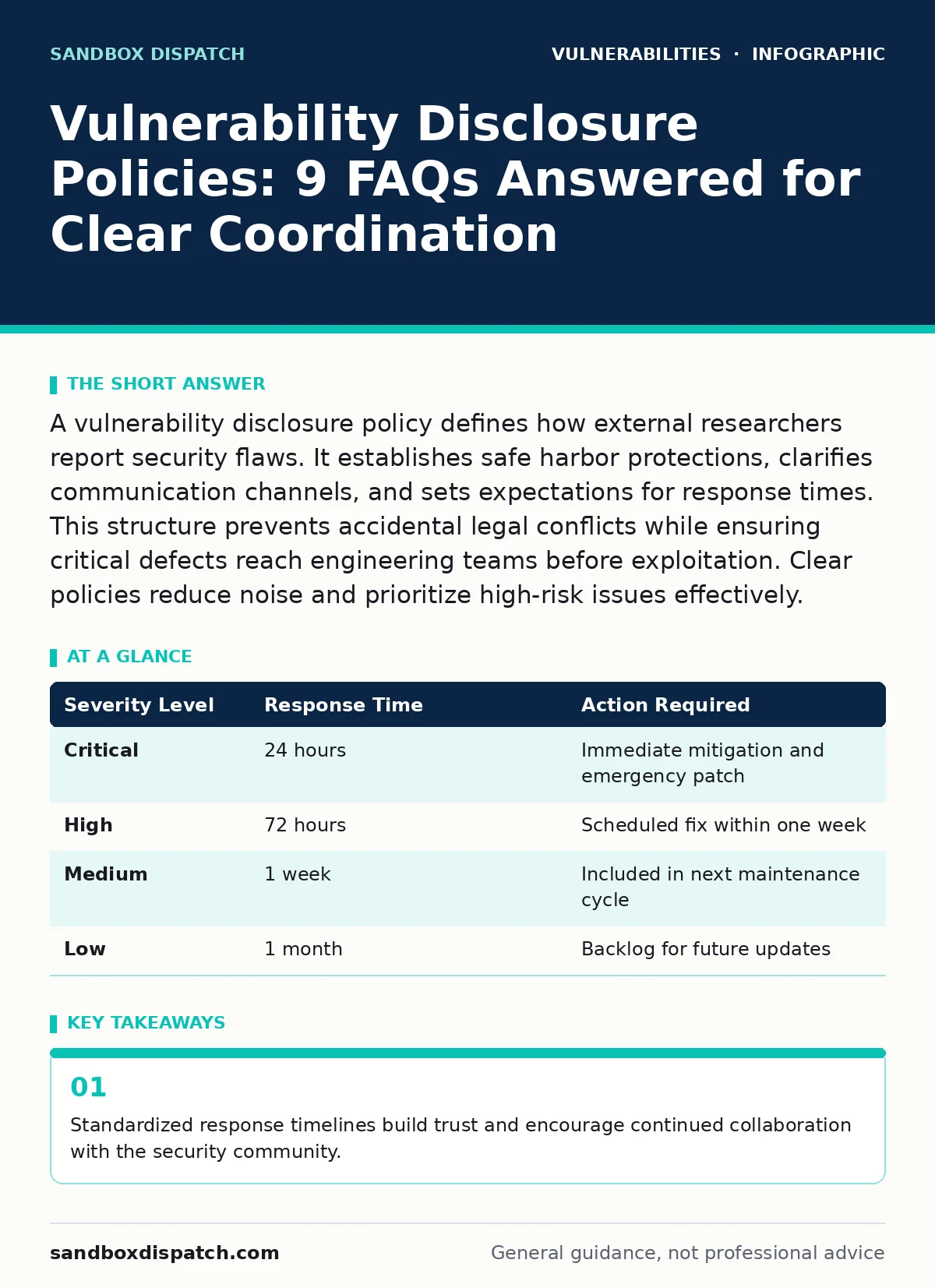
A vulnerability disclosure policy defines how external researchers report security flaws. It establishes safe harbor protections, clarifies communication channels, and sets expectations for response times. This structure prevents accidental legal conflicts while ensuring critical defects reach engineering teams before exploitation. Clear policies reduce noise and prioritize high-risk issues effectively.
What exactly is a vulnerability disclosure policy?
A vulnerability disclosure policy is a public document that defines how external security researchers should report security flaws they find in your systems. It serves as the primary interface between your engineering team and the global community of white-hat hackers. Without this document, researchers operate in a legal gray area, which often leads to ignored reports or hostile interactions.
The policy outlines acceptable testing methods, prohibited actions, and the expected workflow for reporting. It transforms a potential legal confrontation into a structured collaboration. This clarity ensures that valuable security intelligence reaches the right engineers without triggering unnecessary legal reviews.
Why should we publish one if we already have bug bounties?
Bug bounty programs are incentive-driven initiatives that pay for valid findings, whereas disclosure policies are foundational documents that protect both parties legally and operationally. A disclosure policy applies to all researchers, regardless of whether they are motivated by financial reward or ethical obligation. Bug bounties are expensive to maintain and often attract high-volume, lower-quality submissions that require significant triage resources.
A disclosure policy covers the entire attack surface, including systems that may not be eligible for bounty rewards. It establishes the baseline expectations for behavior and communication. This separation allows you to manage paid programs efficiently while maintaining a safety net for unsolicited reports.
How do we define the scope to avoid legal risks?
You must explicitly list which domains, IP addresses, and applications are in-scope for testing. Ambiguity in scope definitions is the leading cause of legal disputes between companies and security researchers. When boundaries are unclear, researchers may inadvertently test third-party infrastructure or production databases, causing damage that violates computer fraud laws.
Clearly mark out-of-scope items, such as physical security, social engineering targets, and third-party services you do not control. This protection shields your partners from unintended testing activities.
What is safe harbor and why does it matter?
Safe harbor is a legal commitment that you will not pursue legal action against researchers who follow your policy guidelines. This assurance is the single most effective tool for encouraging responsible disclosure. Researchers are unlikely to report critical vulnerabilities if they fear prosecution for unauthorized access.
The policy should state that good-faith efforts to report flaws will not be penalized. This does not grant permission to exploit data or disrupt services. It simply creates a protected channel for communication. Without this explicit promise, many skilled researchers will choose to remain silent or sell findings on the black market.
How should we handle the initial report?
Your security team must acknowledge receipt of the report within a short, defined timeframe, such as 48 hours. This acknowledgment confirms that the report was received and is being reviewed. Delaying this initial response signals to the researcher that their effort is ignored, which damages trust and may lead to public disclosure.
Do not provide detailed technical feedback in the initial acknowledgment. Keep the response generic to avoid confirming or denying the validity of the finding prematurely. It also protects internal investigation details from leaking during the triage phase.
What if the researcher refuses to provide proof?
You have the right to request minimal proof of concept to validate a claim, but you cannot demand full exploit code for high-severity issues. Researchers often withhold detailed exploit steps to prevent misuse by malicious actors before a patch is available. This caution is a standard practice in responsible disclosure.
Negotiate a compromise where the researcher provides enough information to reproduce the issue in a controlled environment. You may need to offer additional assurances about data handling and confidentiality. If the researcher remains unwilling to cooperate, you must still assess the risk based on the provided information. Ignoring a plausible report because proof is incomplete is a dangerous gamble.
How do we prioritize conflicting reports?
Prioritization should be based on the severity of the impact and the likelihood of exploitation, not the volume of reports. Use a standardized scoring system to evaluate each submission objectively. This ensures that critical defects receive immediate attention regardless of who reported them.
| Severity Level | Response Time | Action Required |
|---|---|---|
| Critical | 24 hours | Immediate mitigation and emergency patch |
| High | 72 hours | Scheduled fix within one week |
| Medium | 1 week | Included in next maintenance cycle |
| Low | 1 month | Backlog for future updates |
This table provides a clear framework for managing expectations. Researchers appreciate transparency about when they can expect a resolution. It also helps your engineering team allocate resources effectively.
When should we disclose the vulnerability publicly?
Public disclosure should occur only after a patch or mitigation is available for all affected users. Premature disclosure allows attackers to exploit the flaw before defenses are in place. This practice, known as coordinated disclosure, balances transparency with security.
Agree on a disclosure timeline with the researcher before beginning the fix. Typically, this window ranges from 30 to 90 days depending on the complexity of the patch. If the researcher threatens to disclose early, negotiate an extension by demonstrating progress on the fix. Maintaining this balance protects your users while respecting the researcher's contribution.
What happens if a researcher breaks the rules?
You must enforce the policy consistently, even if the researcher discovers a critical vulnerability. Allowing rule-breaking behavior sets a precedent that encourages reckless testing in the future. If a researcher causes damage or accesses unauthorized data, you must disengage and report the incident to legal counsel.
Document the violation clearly, including timestamps and evidence of unauthorized activity. Send a formal notice to the researcher detailing the breach of policy. This action preserves your legal standing and demonstrates to other researchers that boundaries are real. Consistency builds credibility in the security community.
How does this relate to other security practices?
A disclosure policy works best when integrated with broader security initiatives. For example, understanding exploit chains helps you prioritize reports that link multiple low-severity issues into a high-impact attack. Similarly, awareness of broken access control vulnerabilities ensures your team correctly identifies authorization flaws reported by researchers.
Researchers often focus on privilege escalation vulnerabilities because they offer high rewards in bounty programs. Your policy should clarify how these findings are evaluated relative to initial access points. Additionally, security misconfigurations are common findings that require quick remediation. A clear policy ensures these are triaged rapidly.
Can we change the policy later?
Yes, you can update the policy as your infrastructure and security posture evolve. However, you should give researchers advance notice of significant changes. Sudden changes to scope or safe harbor terms can damage trust and discourage future reports.
Maintain an archive of previous policy versions to avoid confusion. This practice ensures that researchers who reported under old terms understand the current expectations. Transparency in policy updates demonstrates respect for the research community. It also prevents legal ambiguity regarding reports submitted during transition periods.
How do we measure the success of our policy?
Success is measured by the quality of findings and the speed of remediation, not just the number of reports. Focus on metrics that reflect actual risk reduction.
Track the time from report receipt to patch deployment. This metric highlights bottlenecks in your engineering workflow. Also, monitor the rate of duplicate reports, which indicates whether your public advisories are effective. A healthy disclosure program results in fewer public exploits and faster patch cycles.
Key takeaways
- Standardized response timelines build trust and encourage continued collaboration with the security community.
Frequently asked questions
Do we need a lawyer to write our vulnerability disclosure policy?
While legal review is recommended, the policy should be drafted by security engineers who understand the technical realities. Lawyers can refine the language, but technical accuracy drives the policy's effectiveness.
Should we offer rewards for every reported bug?
No, rewards are optional and best reserved for a formal bug bounty program. A standard disclosure policy focuses on safe harbor and cooperation, not financial incentives.
What if a researcher claims we took too long to fix a bug?
Respond with data showing your remediation timeline and efforts. If the delay was due to complexity, explain the technical challenges. Transparency usually resolves these disputes.
Can researchers test our staging environments?
Only if explicitly stated in the policy. Staging environments often contain production data, making them high-risk targets. Clearly define which environments are safe for testing.
How this guide was produced: written by the Sandbox Dispatch editorial team with AI assistance, checked against the public references listed below, and reviewed when the facts change. See our editorial policy or report an error.