Null Pointer Dereference: How the Bug Works and Where It Breaks
A null pointer dereference crashes software by accessing invalid memory, but attackers repurpose this crash to execute arbitrary code when memory layouts allow.

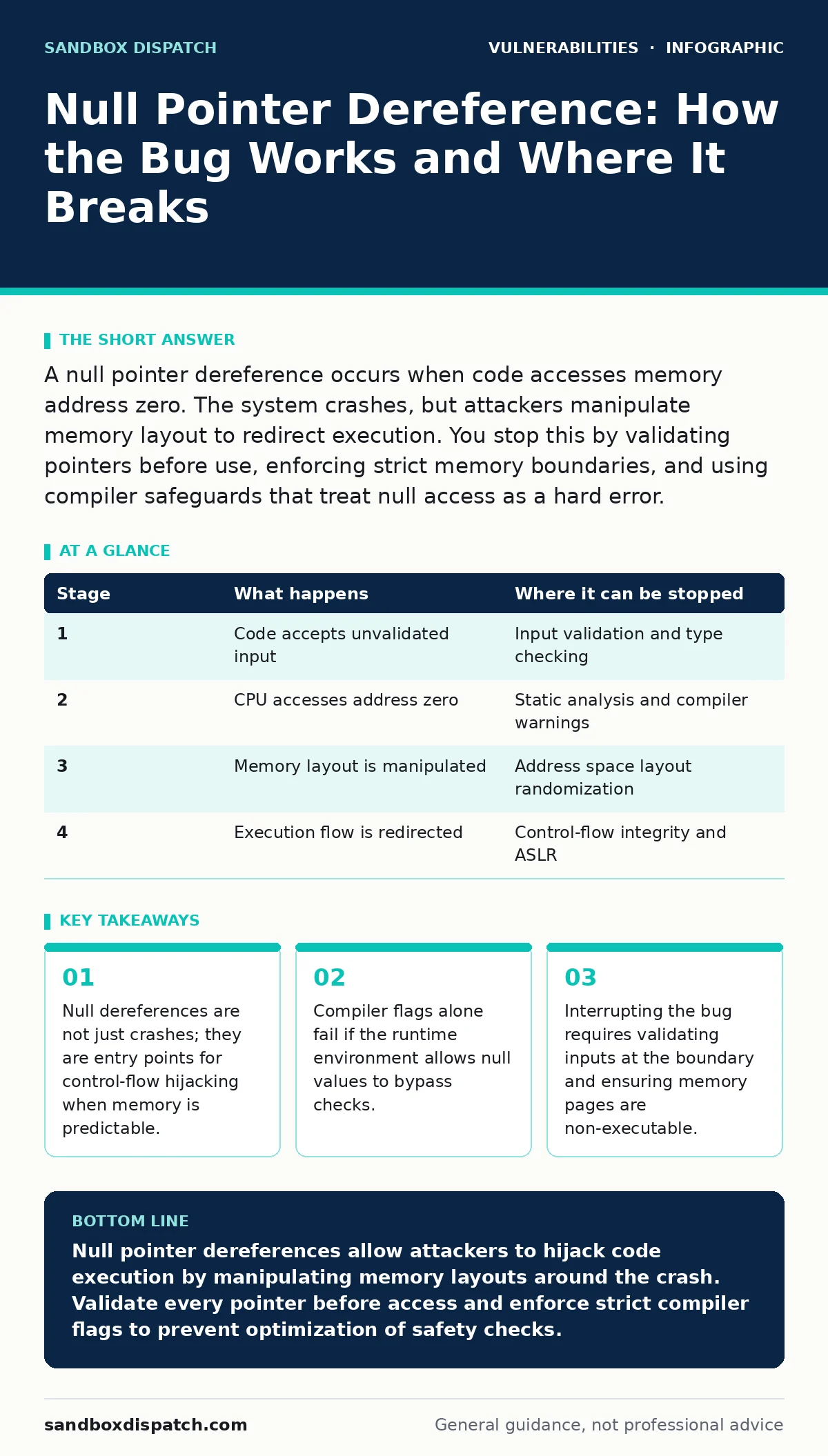
A null pointer dereference occurs when code accesses memory address zero. The system crashes, but attackers manipulate memory layout to redirect execution. You stop this by validating pointers before use, enforcing strict memory boundaries, and using compiler safeguards that treat null access as a hard error.
Understanding the Memory Model
Memory management relies on pointers, which are variables storing the address of another variable. A null pointer is a pointer that points to nothing, typically represented by the integer zero. The operating system reserves the lowest memory addresses to catch this exact error. When software attempts to read or write to address zero, the hardware raises a fault. The operating system catches this fault and terminates the process.
This protection mechanism exists to prevent software from corrupting critical system data. Developers often assume this termination is the end of the story. This assumption ignores how attackers manipulate the environment surrounding the crash. The crash itself is a symptom, not the vulnerability. The vulnerability lies in the lack of validation before the access occurs.
Stage 1: Input Validation Failure
The chain begins when software accepts data without verifying its structure. Imagine a function that processes a user profile. The function expects a pointer to a profile object. If the input is malformed, the pointer might be null. The code proceeds to access fields within that object. It does not check if the pointer is valid first. This step relies on the assumption that the caller always provides valid data.
In modular systems, this assumption is fragile. A library might pass null to indicate an error, but the calling code ignores this signal. The flaw is the missing guard clause. You can interrupt this stage by adding explicit null checks. These checks must occur before any dereference. Static analysis tools can flag these omissions, but they require correct configuration.
Stage 2: The Null Dereference Event
The code attempts to read or write to the memory address held by the null pointer. The CPU executes the instruction to access address zero. The memory management unit detects that this address is unmapped. It triggers a hardware exception. The operating system receives this exception and matches it to a signal handler. The process receives a termination signal.
The program stops executing immediately. This is the expected behavior for a bug. However, the timing of the crash matters. If the crash occurs in a multi-threaded environment, it might leave shared state in an inconsistent condition. This inconsistency can be exploited. The attacker relies on the crash to occur at a specific point. This point must be reachable and predictable.
Stage 3: Environment Manipulation
Attackers do not rely on the crash alone. They manipulate the memory layout to control what happens after the crash. Modern systems use address space layout randomization to make memory locations unpredictable. Attackers bypass this by exhausting memory or using side-channel leaks. They force the system to allocate data at known locations. Suppose the null pointer is not strictly zero but a small integer.
The attacker controls the data at that small address. They write shellcode or function pointers there. When the code dereferences the pointer, it executes their code. This step relies on the absence of data execution prevention. If the memory page is marked non-executable, the code cannot run. The attacker needs a way to jump to existing code.
Stage 4: Control Flow Hijacking
The final stage involves redirecting the program counter. The attacker uses the null dereference to overwrite a return address or function pointer. This is often done through a use-after-free bug combined with the null dereference. The null pointer might point to a freed object. The attacker reallocates that object with controlled data.
When the code accesses the null pointer, it reads the attacker's data. This data contains the address of malicious code. The program jumps to this address. The attacker now controls the execution flow. This step fails if the code uses control-flow integrity. This security feature ensures that jumps only go to valid targets. Without it, the hijack succeeds. The attacker gains a shell or executes commands.
| Stage | What happens | Where it can be stopped |
|---|---|---|
| 1 | Code accepts unvalidated input | Input validation and type checking |
| 2 | CPU accesses address zero | Static analysis and compiler warnings |
| 3 | Memory layout is manipulated | Address space layout randomization |
| 4 | Execution flow is redirected | Control-flow integrity and ASLR |
See also: Spot npm Package Vulnerabilities Before They Break Production · Zero-Click Exploits: Risks and Protection for Small Businesses
Compiler Safeguards and Limits
Compilers can help prevent null dereferences. Flags like -fno-delete-null-pointer-checks ensure that null checks are not optimized away. Some languages treat null access as a compile-time error. These measures reduce the surface area for bugs. They do not eliminate the risk entirely. Developers can disable these flags for performance reasons. They can also cast pointers to bypass checks. The trade-off is between safety and speed. In high-performance systems, developers often disable strict checking. This creates a hidden cost. The code becomes faster but more fragile. You must audit compiler settings regularly. Do not assume the default settings are safe.
Runtime Protection Mechanisms
Operating systems provide runtime protections. Address space layout randomization changes memory locations on every run. Data execution prevention marks memory as non-executable. These mechanisms make exploitation harder. They do not fix the underlying bug. The software still crashes. The crash might be converted into a denial-of-service attack. This is still a vulnerability. You need to combine runtime protections with code hygiene. Use libraries that handle null checks automatically. Avoid raw pointer arithmetic. Use smart pointers or references where possible. These abstractions reduce the chance of errors. They add a small performance overhead. This overhead is usually acceptable.
Integrating with Patch Cycles
Fixing null dereferences requires more than just adding a check. You must understand why the null occurred. Was it a missing initialization? A failed allocation? A logic error? The fix must address the root cause. Otherwise, the bug will reappear. This process fits into patch management cycles. You must prioritize fixes based on reachability. A null dereference in a rarely used function is less risky. One in a network handler is critical. You should coordinate fixes with vulnerability remediation SLAs. This ensures timely deployment. Delayed patches leave systems exposed. Attackers scan for known null dereference bugs. They exploit them quickly.
Edge Cases in Embedded Systems
Embedded systems often run without an operating system. They lack memory protection units. A null dereference might not crash the system. It might read from a hardware register. This register might control a physical device. The consequences are physical, not just digital. You must enforce strict memory bounds in firmware. Use hardware watchpoints if available. Test with fault injection. This simulates null pointers in real hardware. IoT device patching is often slow. Devices remain vulnerable for years. You must design for longevity. Assume the code will run for a decade. Validate pointers at every boundary. Do not rely on the system to catch errors.
Conclusion of the Analysis
Null pointer dereferences are fundamental bugs. They arise from poor input validation. They can be exploited to take control of software. You must validate pointers before use. Use compiler flags and runtime protections. Understand the memory model. Audit your code for missing checks. Coordinate fixes with your patch cycle. Do not ignore crashes. They are symptoms of deeper issues. Secure coding practices prevent these bugs. Regular testing catches them early. You can stop the attack at any stage. The best stage is the first one.
Key takeaways
- Null dereferences are not just crashes; they are entry points for control-flow hijacking when memory is predictable.
- Compiler flags alone fail if the runtime environment allows null values to bypass checks.
- Interrupting the bug requires validating inputs at the boundary and ensuring memory pages are non-executable.
Null pointer dereferences allow attackers to hijack code execution by manipulating memory layouts around the crash. Validate every pointer before access and enforce strict compiler flags to prevent optimization of safety checks.
Frequently asked questions
Can a null pointer dereference lead to remote code execution?
Yes, if the attacker can control the memory layout and bypass data execution prevention, they can redirect execution to malicious code.
How do I find null pointer dereference bugs in my code?
Use static analysis tools, enable compiler warnings for null dereferences, and perform dynamic testing with fault injection.
Are null pointer dereferences common in modern languages?
They are less common in languages with strong type systems, but still possible in unsafe code blocks or when interfacing with legacy libraries.
What is the difference between a null pointer and a dangling pointer?
A null pointer points to nothing, while a dangling pointer points to memory that has been freed or reallocated. Both are dangerous.
How this guide was produced: written by the Sandbox Dispatch editorial team with AI assistance, checked against the public references listed below, and reviewed when the facts change. See our editorial policy or report an error.