Vulnerability Remediation SLAs: Benefits, Limits, and When to Use Them
Strict remediation timelines reduce exposure windows but often trigger technical debt and false compliance signals that mask actual risk.
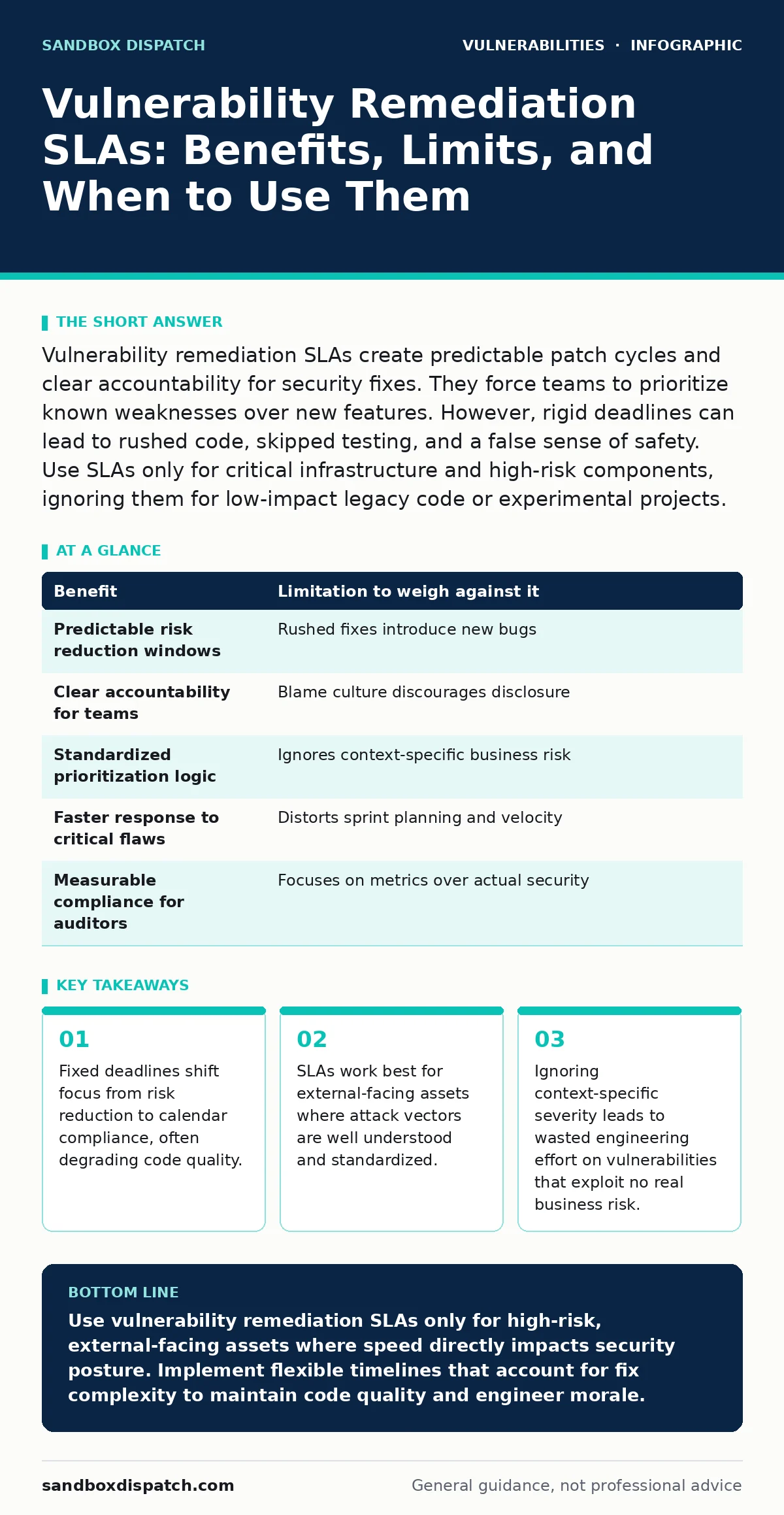
Vulnerability remediation SLAs create predictable patch cycles and clear accountability for security fixes. They force teams to prioritize known weaknesses over new features. However, rigid deadlines can lead to rushed code, skipped testing, and a false sense of safety. Use SLAs only for critical infrastructure and high-risk components, ignoring them for low-impact legacy code or experimental projects.
The Mechanics of Time-Bound Patching
Vulnerability remediation SLAs define specific time windows for fixing identified software weaknesses. These agreements bind development teams to resolve issues within days or weeks after discovery. The primary goal is to shrink the window of opportunity for attackers. A shorter exposure period reduces the probability of a successful breach. This mechanism transforms abstract security advice into measurable engineering tasks. Teams stop debating priority and start counting down. The clock becomes the primary driver of action.
Imagine a developer finds a flaw in a login module. Without an SLA, the fix waits behind feature requests. With an SLA, the fix moves to the top of the sprint queue. This urgency prevents issues from rotting in the backlog. It forces a triage process that aligns security with product velocity. The structure provides clarity for both security analysts and engineers. Everyone knows the deadline and the consequence of missing it.
The Hidden Cost of Speed
Speed introduces significant trade-offs in software stability. Rushing a fix often bypasses thorough testing procedures. Developers may apply a band-aid solution to meet the deadline rather than addressing the root cause. This creates technical debt that accumulates silently. The codebase becomes fragile as quick patches stack upon one another. Future developers inherit a tangled mess of workarounds. The initial security gain is offset by long-term maintenance costs.
Strict timelines also encourage superficial compliance. Teams may mark a vulnerability as resolved by disabling a feature rather than fixing it properly. This approach satisfies the SLA clock but leaves the underlying logic exposed. It creates a false sense of security for management. The dashboard shows green status, but the system remains vulnerable. This phenomenon is known as security theater. It wastes resources while providing no actual protection.
Comparing Benefits Against Limitations
Every advantage of an SLA has a corresponding drawback. You must weigh the predictability against the potential for degraded quality. The table below maps these trade-offs directly.
| Benefit | Limitation to weigh against it |
|---|---|
| Predictable risk reduction windows | Rushed fixes introduce new bugs |
| Clear accountability for teams | Blame culture discourages disclosure |
| Standardized prioritization logic | Ignores context-specific business risk |
| Faster response to critical flaws | Distorts sprint planning and velocity |
| Measurable compliance for auditors | Focuses on metrics over actual security |
The benefit of predictability helps operations teams plan for downtime. They know when patches will drop. This allows for better change management. However, the limitation of rushed fixes means those patches might break other functions. The cost of a hotfix can exceed the cost of the vulnerability itself. You must balance the need for speed with the need for stability.
When It Is Worth It
Implement strict SLAs for internet-facing applications. These systems face direct exposure to automated scanning and exploitation. The risk of compromise is high and immediate. Time is the only variable you can control. External services handle sensitive data or transaction logic. A delay here allows attackers to harvest credentials or manipulate records. The cost of inaction far exceeds the cost of rapid remediation.
Use SLAs for components with known exploit chains. If an attack vector is public and automated tools exist, the window for exploitation is narrow. You cannot wait for the next quarterly release. Immediate patching is the only viable defense. This aligns with the principles of attack surface management. Reducing the exposed surface requires rapid removal of known weaknesses. The SLA ensures that removal happens before the exploit matures.
Also consider SLAs for regulatory compliance requirements. Some industries mandate specific response times for critical vulnerabilities. Failing to meet these deadlines results in legal penalties. The SLA provides a documented trail of due diligence. It proves that the organization acted promptly. This documentation is vital during audits or incident investigations. The SLA becomes a legal shield as much as a technical tool.
When It Is Not
Ignore SLAs for internal tools with limited access. These systems are behind firewalls and network segmentation. The attack surface is small and controlled. The risk of external exploitation is negligible. Spending engineering hours on rapid fixes distracts from higher-value work. The return on investment is low. You should prioritize stability over speed for these components.
Do not enforce SLAs for legacy systems with no users. If the software is decommissioned or unused, the vulnerability poses no threat. Patching it wastes resources. The code may not even compile on modern systems. Forcing a fix can break the archive or documentation. It is better to isolate the system and monitor it. This approach mirrors the strategy for IoT device patching. You secure the network perimeter rather than chasing every endpoint flaw.
Avoid SLAs for experimental features. These components are under active development and change frequently. A vulnerability today may disappear in the next iteration. Allocating sprint capacity to fix transient issues reduces velocity. It slows down innovation. The uncertainty of the codebase makes accurate risk assessment difficult. You cannot set a meaningful deadline for something that is not yet defined.
See also: What Is a Risk Based Approach to Vulnerability Management · Threat Modeling STRIDE: How to Map Every Hidden Risk
Context Over Score
A CVSS score provides a standardized measure of severity. It helps compare vulnerabilities across different products. However, it does not account for your specific environment. A high score means little if the vulnerable component is unreachable. A low score can be critical if it affects a core authentication mechanism. You must contextualize every finding.
Imagine a buffer overflow in a rarely used API endpoint. The score is high, but the traffic is zero. An SLA might demand immediate action. A smarter approach evaluates the actual exploitability. You may choose to monitor instead of patch. This decision saves engineering time. It focuses effort where the risk is real. Contextual analysis prevents alert fatigue. It ensures that SLAs drive meaningful security improvements.
Balancing Accountability and Safety
SLAs must include escape clauses for complex fixes. Some vulnerabilities require architectural changes. They cannot be resolved with a simple patch. Forcing a deadline on these issues produces broken code. The SLA should allow for extended timelines when justified. This requires clear communication between security and engineering. Both teams must agree on the complexity.
Developers need psychological safety to report delays. If missing a deadline triggers punishment, they will hide problems. This creates a culture of fear. Hidden vulnerabilities are more dangerous than known ones. The SLA framework should encourage transparency. It should reward early detection and honest assessment. This aligns with effective vulnerability disclosure policies. Open communication leads to better outcomes.
Maintaining Long-Term Integrity
Regular reviews of SLA performance prevent stagnation. Metrics should track not just speed, but quality. Monitor post-fix defect rates. If patches break functionality, the SLA is failing. Adjust the timelines to reflect reality. The goal is sustainable security, not frantic patching. Continuous improvement ensures the process remains effective. It adapts to changing technology and threat models.
You should also review the SLA scope annually. New technologies change the risk profile. What was critical last year may be obsolete. What was minor may now be central. Keep the SLA aligned with current business priorities. This ensures that resources are allocated efficiently. It prevents the process from becoming a bureaucratic burden. The SLA should serve the business, not the other way around.
Key takeaways
- Fixed deadlines shift focus from risk reduction to calendar compliance, often degrading code quality.
- SLAs work best for external-facing assets where attack vectors are well understood and standardized.
- Ignoring context-specific severity leads to wasted engineering effort on vulnerabilities that exploit no real business risk.
Use vulnerability remediation SLAs only for high-risk, external-facing assets where speed directly impacts security posture. Implement flexible timelines that account for fix complexity to maintain code quality and engineer morale.
Frequently asked questions
How do SLAs affect developer productivity?
Strict deadlines can disrupt sprint planning and force rushed work, leading to technical debt and reduced morale if not balanced with realistic timelines.
Can SLAs replace a vulnerability disclosure policy?
No, SLAs manage internal fix times, while disclosure policies govern how external researchers report issues, serving different but complementary roles.
What happens if an SLA deadline is missed?
Missed deadlines should trigger a root cause analysis, not punishment, to identify systemic issues in the remediation workflow or risk assessment.
Do SLAs apply to third-party libraries?
You cannot enforce SLAs on vendors, but you can set internal SLAs for upgrading or replacing vulnerable third-party components in your stack.
How this guide was produced: written by the Sandbox Dispatch editorial team with AI assistance, checked against the public references listed below, and reviewed when the facts change. See our editorial policy or report an error.