AI Bias in Education: How Hidden Assumptions Distort Student Outcomes
Algorithms often replicate historical inequities by treating correlation as causation, creating feedback loops that disadvantage specific student groups without human intent.

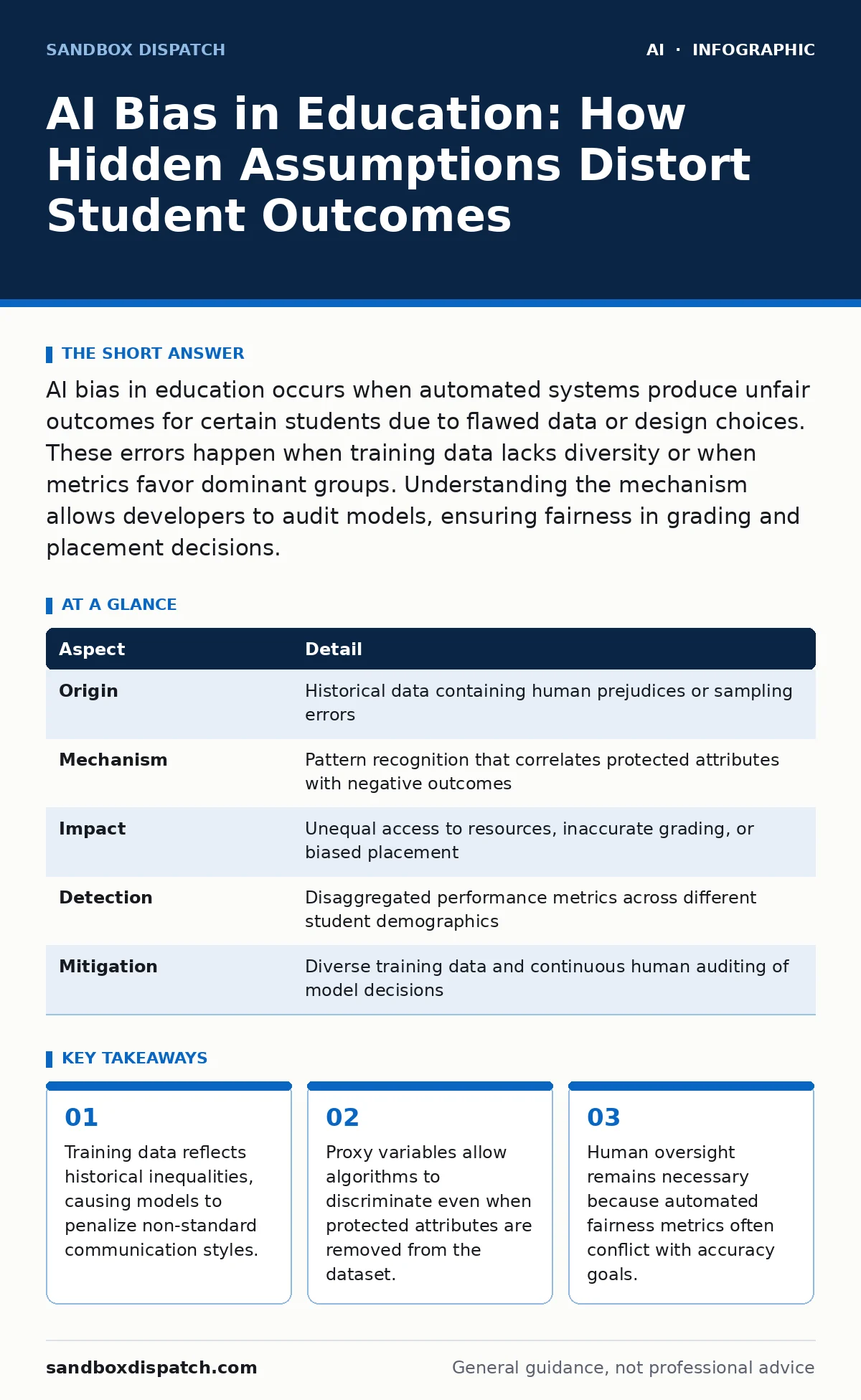
AI bias in education occurs when automated systems produce unfair outcomes for certain students due to flawed data or design choices. These errors happen when training data lacks diversity or when metrics favor dominant groups. Understanding the mechanism allows developers to audit models, ensuring fairness in grading and placement decisions.
Understanding AI Bias in Education
AI bias in education arises when automated systems produce systematically unfair outcomes for students belonging to specific demographic groups. This unfairness stems from the data used to train the model or the logic embedded in the algorithm. Imagine a hiring tool that rejects resumes containing the word "women's" because it was trained on male-dominated tech resumes. In education, the stakes are equally high but often less visible.
The system learns patterns from historical records. If those records contain human prejudices, the model learns to replicate them. The algorithm does not understand fairness. It optimizes for statistical likelihood based on the input provided. This creates a feedback loop where past mistakes become future rules. You must treat the model as a mirror of the data, not an objective truth.
| Aspect | Detail |
|---|---|
| Origin | Historical data containing human prejudices or sampling errors |
| Mechanism | Pattern recognition that correlates protected attributes with negative outcomes |
| Impact | Unequal access to resources, inaccurate grading, or biased placement |
| Detection | Disaggregated performance metrics across different student demographics |
| Mitigation | Diverse training data and continuous human auditing of model decisions |
How Hidden Assumptions Work
The core problem lies in proxy variables. A proxy variable is a feature that correlates with a protected attribute, such as race or gender, even if that attribute is not directly present in the data. Suppose you remove race from a dataset to ensure fairness. The model might still use zip code or school name as a proxy. These features often correlate strongly with socioeconomic status and race.
The algorithm identifies these proxies as predictive signals. It assigns weight to them during training. When the model predicts student success, it effectively uses the proxy to make decisions based on the protected attribute. This violates the principle of equal treatment. The model appears neutral because it never explicitly sees the protected attribute. The bias is hidden in the mathematical relationships between features.
Another issue is label bias. Labels are the correct answers the model learns from. If human graders historically rated certain dialects or writing styles as inferior, the model learns this preference. The model treats the grader's bias as ground truth. It then applies this standard to new inputs. The result is a system that penalizes students for linguistic diversity rather than assessing content quality.
Who Affected by Algorithmic Decisions
Students from underrepresented groups face the highest risk of adverse outcomes. These groups include students of color, low-income students, and those with disabilities. The bias manifests in various forms. Automated placement tests might place these students in lower-level classes, limiting their access to advanced coursework. This early divergence has long-term consequences for academic achievement and career opportunities.
Teachers and administrators are also affected. They rely on algorithmic recommendations for resource allocation. If the model suggests that certain students are unlikely to succeed, educators may unconsciously lower their expectations. This self-fulfilling prophecy reduces the support provided to those students. The bias shifts from the algorithm to human behavior. The system reinforces existing inequalities by directing attention and resources away from marginalized groups.
Parents and guardians suffer a lack of transparency. They often do not understand why their child received a specific grade or placement. The algorithm operates as a black box. Without clear explanations, families cannot challenge unfair decisions. This opacity erodes trust in the educational institution. It creates a barrier to accountability and redress.
What People Usually Get Wrong
Many assume that removing protected attributes solves bias. This is a common misconception. As discussed, proxy variables allow the model to infer these attributes indirectly. Removing race or gender from the dataset does not eliminate the historical correlations present in other features. The bias persists in the model's weights and predictions. True fairness requires more than data deletion.
Another error is assuming that accuracy equals fairness. A model can be highly accurate overall while performing poorly for specific subgroups. If the majority group dominates the dataset, the model optimizes for their patterns. The average accuracy looks good, but the minority group experiences high error rates. You must evaluate performance disaggregated by demographic groups. Average metrics hide systemic failures.
Auditing for Fairness
Auditing requires looking at model performance across different groups. You need disaggregated metrics. Calculate accuracy, false positive rates, and false negative rates for each subgroup. Compare these metrics. Significant disparities indicate bias. For example, if false negative rates are higher for one group, the model is missing positive cases more often for that group.
Use counterfactual testing. Change the protected attribute of a single input while keeping everything else constant. If the output changes significantly, the model is biased. This test isolates the impact of the protected attribute. It helps identify direct discrimination. Counterfactual testing is a powerful tool for debugging fairness issues.
Review the training data for representation. Ensure that all student groups are adequately represented. If one group is underrepresented, the model will not learn their patterns well. You may need to oversample minority groups or use synthetic data generation. However, synthetic data must be carefully validated to avoid introducing new biases.
See also: Explainable AI Misconceptions: Why Your Model’s Logic Is Not Trust
Mitigation Strategies
Data preprocessing can help reduce bias. You can reweight samples to give more importance to underrepresented groups. This balances the influence of each group during training. Another technique is feature selection. Remove features that act as strong proxies for protected attributes. This requires domain knowledge to identify which features are problematic.
Algorithmic fairness constraints can be added during training. These constraints limit the model's ability to use certain patterns. For instance, you can constrain the model to have equal false positive rates across groups. This forces the model to find other signals. However, this often reduces overall accuracy. You must accept this trade-off. Fairness and accuracy are often in tension.
Post-processing methods adjust the model's outputs. You can set different thresholds for different groups to equalize outcomes. For example, raise the threshold for the group with high false positives. This reduces errors but may lower true positives. Choose the method that aligns with your ethical priorities. There is no single correct solution.
Integrating Risk Management
Effective mitigation requires a structured approach. Refer to AI risk management frameworks to identify potential harms early. These frameworks help you assess the likelihood and impact of bias. They guide you in selecting appropriate mitigation strategies. Risk management is not a one-time activity. It is an ongoing process that adapts to new threats.
Consider explainable AI techniques to increase transparency. Explainable AI provides insights into how the model makes decisions. This helps you identify biased reasoning paths. If the model relies on a proxy variable, explainability tools can highlight it. This information is crucial for debugging and improving the model. Transparency builds trust with stakeholders.
For broader context on system safety, see emergency stop for AI systems. While not specific to bias, the ability to halt a system is critical when harm is detected. If bias causes significant adverse outcomes, you must have a mechanism to pause the system. This prevents further damage while you investigate and remediate the issue. Safety and fairness are interconnected goals.
Key takeaways
- Training data reflects historical inequalities, causing models to penalize non-standard communication styles.
- Proxy variables allow algorithms to discriminate even when protected attributes are removed from the dataset.
- Human oversight remains necessary because automated fairness metrics often conflict with accuracy goals.
Frequently asked questions
How do I know if my educational AI model is biased?
Compare performance metrics across different demographic groups. Look for significant disparities in accuracy, false positives, or false negatives. Disaggregated analysis reveals hidden biases that average metrics conceal.
Can removing sensitive data like race or gender fix bias?
No. Proxy variables such as zip code or school name can still correlate with protected attributes. The model may infer sensitive information from these proxies, perpetuating bias even if direct attributes are removed.
What is the trade-off between fairness and accuracy?
Improving fairness often reduces overall accuracy. Constraining the model to treat groups equally may force it to ignore useful predictive signals. You must decide which metric aligns with your ethical and operational goals.
How often should I audit an AI system for bias?
Audit continuously, especially after updates or data changes. Bias can emerge over time as data distributions shift. Regular monitoring ensures that the model remains fair throughout its lifecycle, not just at deployment. BOTTOM LINE: AI bias in education persists because algorithms learn from historical inequalities rather than objective truth. You must audit models with disaggregated metrics and accept the trade-off between fairness and accuracy to protect vulnerable students.
How this guide was produced: written by the Sandbox Dispatch editorial team with AI assistance, checked against the public references listed below, and reviewed when the facts change. See our editorial policy or report an error.