Explainable AI Misconceptions: Why Your Model’s Logic Is Not Trust
Explainability techniques often reveal how a model guesses rather than why it decides, creating a false sense of safety in production systems.

Explainable AI does not prove a model is correct or fair. It only highlights which input features influenced a specific prediction. These methods can be manipulated, misinterpreted, or applied incorrectly, leading to dangerous overconfidence in automated decisions.
Misreading: Feature Importance Equals Causal Reasoning
When you look at a feature importance plot, you assume the model uses that feature because it causes the outcome. This is rarely true. Most explainability tools, such as SHAP or LIME, measure how much a feature contributes to the prediction variance. They do not measure causal influence. If two features are highly correlated, the tool might assign importance to one and ignore the other, or split the importance between them arbitrarily. The model is using statistical shortcuts, not logical reasoning.
Correct reading: Treat feature importance as a measure of predictive reliance, not causal truth. If you remove the feature and the prediction changes, the model relied on it. This does not mean the feature is the root cause of the event you are predicting. To understand causality, you need controlled experiments or causal inference methods, not just post-hoc explanation tools.
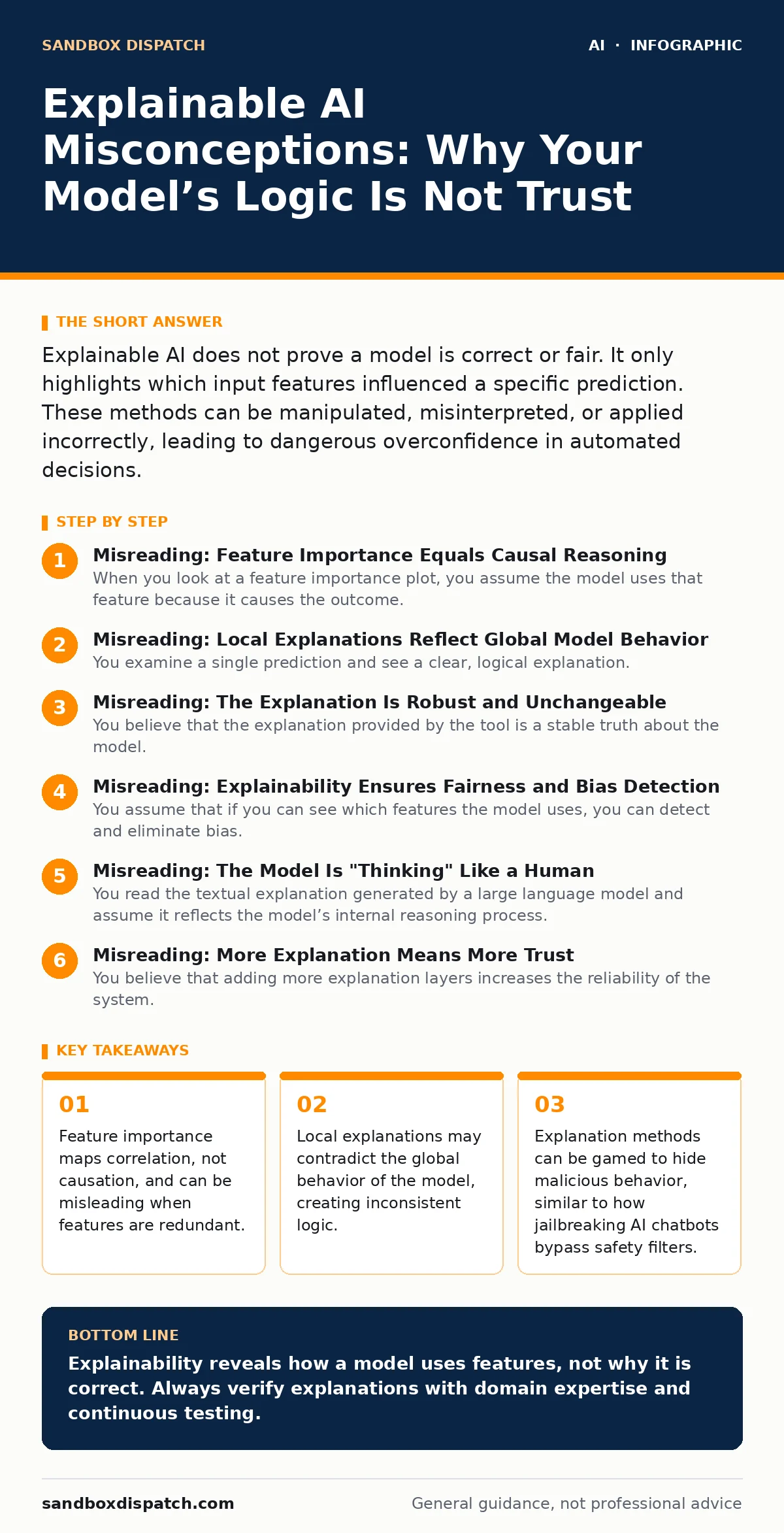
Misreading: Local Explanations Reflect Global Model Behavior
You examine a single prediction and see a clear, logical explanation. You then assume the entire model behaves this way. This is a dangerous assumption. Many models, especially large language models, are non-linear and context-dependent. The logic that explains one decision may be completely different for another decision, even with similar inputs. A model might use "age" to predict risk in one case and "income" in another, without any consistent global rule.
Correct reading: Local explanations are snapshots, not maps. They tell you why a specific instance was classified a certain way, but they do not guarantee that the model follows a consistent logic across the dataset. If you need to understand the model’s overall behavior, you must look at global metrics and aggregate patterns, not just individual case studies. Relying on local explanations for policy decisions can lead to inconsistent and unfair outcomes.
Misreading: The Explanation Is Robust and Unchangeable
You believe that the explanation provided by the tool is a stable truth about the model. In reality, many explanation methods are sensitive to small perturbations in the input data. A tiny change in the input, invisible to a human, can cause the explanation to flip completely. This instability means the explanation is not a reliable indicator of the model’s internal state. It is more like a shadow that changes shape depending on the light source.
Correct reading: Explanation stability is a metric you must test. If your explanation changes significantly with minor input variations, you cannot trust it to represent the model’s true logic. This is similar to how AI hallucinations can change with slight prompt modifications. You need to verify that your explanation method is robust across similar inputs before using it for debugging or compliance.
Misreading: Explainability Ensures Fairness and Bias Detection
You assume that if you can see which features the model uses, you can detect and eliminate bias. This is a common trap. A model can be fair in its feature usage but still produce biased outcomes due to historical data imbalances. Conversely, a model might appear to use a protected attribute, like race or gender, but only as a proxy for other legitimate factors. Removing the direct feature does not remove the bias if the proxy features remain.
Correct reading: Explainability helps you audit feature usage, but it does not guarantee fairness. You must combine explanation tools with fairness metrics and bias mitigation techniques. Look for disparate impact in the outcomes, not just in the feature attributions. This is where AI red teaming becomes valuable, as it actively tests for edge cases and biased behaviors that standard explanations might miss.
Misreading: The Model Is "Thinking" Like a Human
You read the textual explanation generated by a large language model and assume it reflects the model’s internal reasoning process. This is a projection of human cognition onto a statistical engine. The model generates text that is plausible and coherent, but it does not have a conscious reasoning process. The explanation is a post-hoc rationalization, not a transcript of thought. This is why LLM guardrails are necessary to prevent the model from generating convincing but false justifications.
Correct reading: Treat textual explanations as persuasive artifacts, not logical proofs. The model is optimizing for likelihood, not truth. When you see a clear, step-by-step explanation, remember that it is a reconstruction of the output, not a window into the model’s mind. Always verify the factual accuracy of the explanation independently, just as you would with any other generated content.
See also: Detect Exposed AI Model Servers: Signals, Logs, and Blind Spots
Misreading: More Explanation Means More Trust
You believe that adding more explanation layers increases the reliability of the system. In fact, excessive or poorly designed explanations can create a "trust illusion." Users may over-rely on the model because they feel they understand it, even when the explanation is misleading or incomplete. This can lead to automation bias, where humans stop critically evaluating the model’s outputs. The presence of an explanation is often mistaken for the presence of correctness.
Correct reading: Design explanations to support critical evaluation, not blind trust. Provide uncertainty estimates and highlight cases where the model is likely to be wrong. Encourage users to question the explanation, not just accept it. This approach aligns with best practices in retrieval-augmented generation security, where transparency about data sources helps users assess the reliability of the information.
Misreading: Explainability Is a One-Time Fix
You implement an explanation tool and consider the job done. Explainability is not a static feature; it is an ongoing process. As the model evolves, the data shifts, and the use case changes, the explanations must be re-evaluated. A model that was explainable at deployment may become opaque as it adapts to new data. Continuous monitoring is required to ensure that the explanations remain accurate and relevant.
Correct reading: Treat explainability as a dynamic component of your AI lifecycle. Regularly audit your explanations against new data and changing requirements. This is similar to how deepfake detection requires constant updates to counter new generation techniques. Static explanations quickly become obsolete and misleading.
Key takeaways
- Feature importance maps correlation, not causation, and can be misleading when features are redundant.
- Local explanations may contradict the global behavior of the model, creating inconsistent logic.
- Explanation methods can be gamed to hide malicious behavior, similar to how jailbreaking AI chatbots bypass safety filters.
- Human interpretability does not guarantee that the model’s reasoning aligns with human ethical standards.
Explainability reveals how a model uses features, not why it is correct. Always verify explanations with domain expertise and continuous testing.
Frequently asked questions
Can I use explainability to prove my model is unbiased?
No, explainability shows feature usage, not outcome fairness. You need separate bias metrics and audits to assess fairness.
Is SHAP more reliable than LIME for local explanations?
Both have limitations. SHAP is theoretically more consistent, but both can be unstable with correlated features or noisy data.
Do I need to explain every prediction?
No, focus on high-stakes decisions or cases where the model is uncertain. Over-explaining can lead to information overload and reduced trust.
How do I handle conflicting explanations?
Investigate the root cause. Check for data quality issues, model instability, or conflicting feature correlations. Consult domain experts to interpret the conflict.
How this guide was produced: written by the Sandbox Dispatch editorial team with AI assistance, checked against the public references listed below, and reviewed when the facts change. See our editorial policy or report an error.