What Is AI Transparency: The Mechanics Behind Model Decisions
AI transparency exposes the logic behind automated decisions, revealing how hidden data biases and model limitations create unpredictable outcomes in production environments.

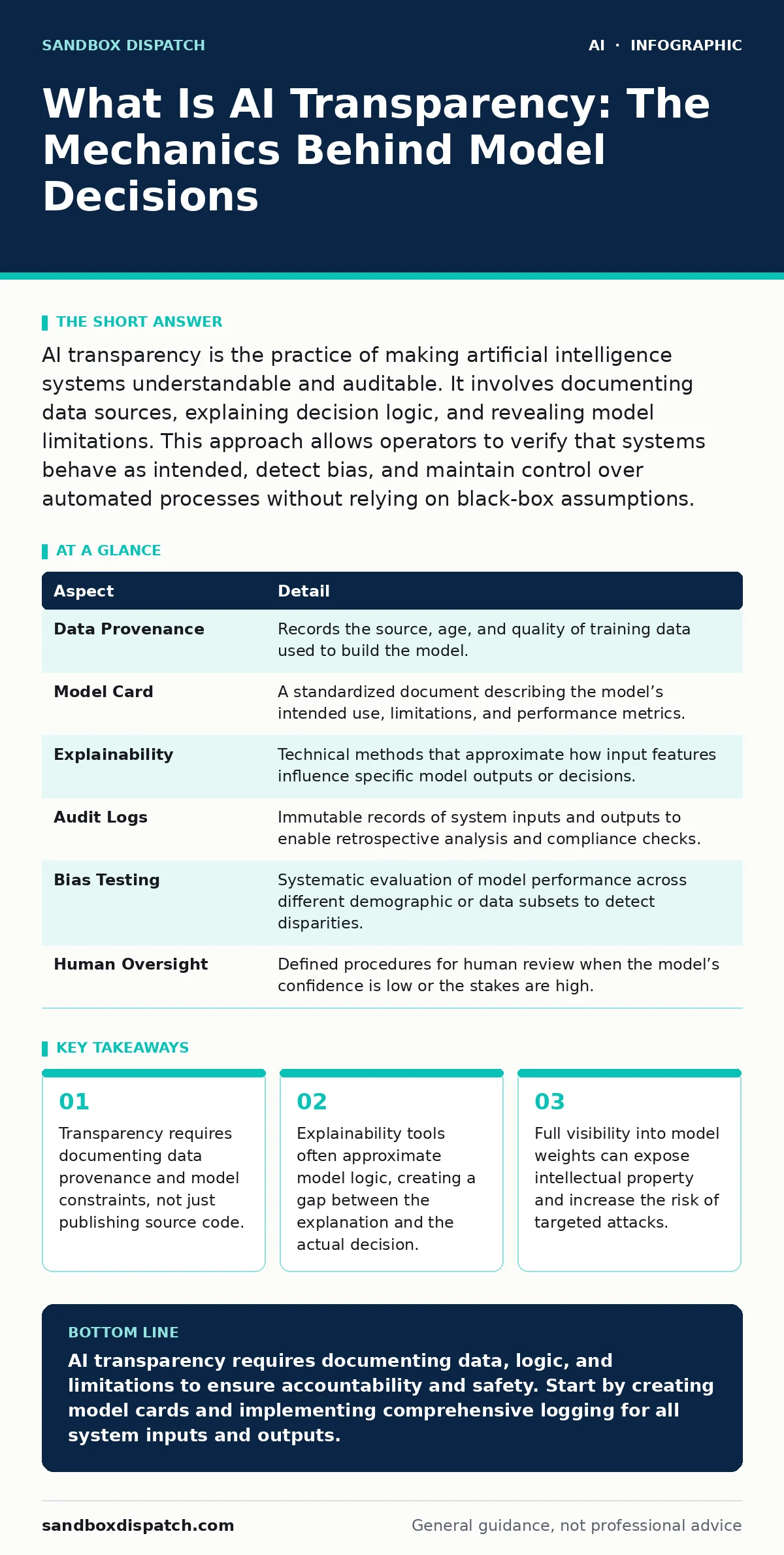
AI transparency is the practice of making artificial intelligence systems understandable and auditable. It involves documenting data sources, explaining decision logic, and revealing model limitations. This approach allows operators to verify that systems behave as intended, detect bias, and maintain control over automated processes without relying on black-box assumptions.
What is ai transparency
What is ai transparency? It is the systematic disclosure of how an artificial intelligence system makes decisions, including the data it uses, the logic it applies, and the limitations it possesses. Transparency turns a black box into a glass box, allowing operators to see the internal mechanisms rather than just the output. Without this clarity, operators cannot distinguish between a correct decision and a lucky guess. Transparency is not a single feature but a collection of practices that span the entire lifecycle of a model, from data collection to deployment and monitoring.
How transparency works in practice
Transparency operates through three distinct layers: documentation, explainability, and auditability. Documentation records the origin of training data, the preprocessing steps, and the intended use cases. This layer ensures that anyone reviewing the system understands the context in which it was built. Explainability provides technical methods to interpret model outputs.
Techniques like SHAP values or LIME approximations show which input features influenced a specific prediction. These tools do not reveal the internal weights but offer a post-hoc interpretation of the result. Auditability allows for the systematic review of system behavior over time. This includes logging inputs and outputs to detect drift or bias.
| Aspect | Detail |
|---|---|
| Data Provenance | Records the source, age, and quality of training data used to build the model. |
| Model Card | A standardized document describing the model’s intended use, limitations, and performance metrics. |
| Explainability | Technical methods that approximate how input features influence specific model outputs or decisions. |
| Audit Logs | Immutable records of system inputs and outputs to enable retrospective analysis and compliance checks. |
| Bias Testing | Systematic evaluation of model performance across different demographic or data subsets to detect disparities. |
| Human Oversight | Defined procedures for human review when the model’s confidence is low or the stakes are high. |
The hidden cost of visibility
Full transparency carries significant trade-offs that often go unmentioned. Revealing detailed information about model architecture and training data can expose intellectual property. Competitors can use this information to replicate the model or identify weaknesses. More critically, detailed transparency can aid attackers.
If an adversary knows exactly which features influence a decision, they can craft inputs that manipulate the model. This is known as adversarial attack. For example, adding invisible noise to an image can cause a classifier to misidentify it. Therefore, transparency must be balanced with security. You must decide what information is necessary for accountability and what information creates risk.
Common misconceptions about transparency
Many organizations confuse transparency with explainability. Explainability focuses on understanding a single decision. Transparency covers the entire system, including data sourcing, model selection, and deployment context. Another common error is assuming that open-source code equals transparency. Publishing the code does not reveal the training data, which is often the primary source of bias or error. The data shapes the model’s behavior more than the code does. Finally, many believe that transparency is a one-time task. Models degrade over time as data distributions change. Transparency requires continuous monitoring and updating of documentation to remain accurate.
EXAMPLE: The loan approval system
Suppose a bank deploys a machine learning model to approve loan applications. The model denies a specific applicant. The applicant requests an explanation. A transparent system provides more than a generic reason. It reveals that the model heavily weighted the applicant’s recent utility bill payments. It also discloses that the training data lacked representation from the applicant’s demographic group. This disclosure allows the bank to investigate whether the model is using a proxy for race or socioeconomic status. The bank can then adjust the model or provide human review. Without this transparency, the denial appears arbitrary, leading to legal risk and reputational damage.
See also: Why Is AI Bias a Concern: Technical Risks and Mitigation Strategies · AI Bias in Education: How Hidden Assumptions Distort Student Outcomes
What usually goes wrong
Implementing transparency often fails due to technical debt and organizational silos. Data scientists build models in isolation, without documenting the assumptions they make. When the model moves to production, engineers lack the context to monitor it effectively. Another failure point is the reliance on automated explainability tools. These tools can be misleading.
They may highlight features that are statistically correlated with the output but not causally related. If operators trust these explanations blindly, they may miss critical flaws. Additionally, transparency efforts often stop at the model level. They ignore the broader system, including the user interface and the human decision-makers who interact with the model’s output.
Managing transparency for agents
As AI systems become more autonomous, transparency becomes more complex. Agents that interact with external systems require clear visibility into their actions. The guide on insecure AI plugins and agents details how these tools can expose sensitive data if not properly constrained. Transparency here means logging every tool call and data access. You must know what the agent sees and what it does with that information. Without this visibility, an agent can inadvertently leak private data or perform unauthorized actions. This is particularly critical when agents have write access to databases or communication channels.
Regulatory and ethical frameworks
Regulatory bodies are increasingly mandating transparency. The EU AI Act classifies AI systems based on risk and imposes strict transparency requirements for high-risk applications. This includes providing detailed documentation and allowing for human oversight. Even where regulation does not apply, ethical standards demand transparency.
Users have a right to know when they are interacting with an AI system. This is especially relevant in the context of deepfake detection. Systems that generate synthetic media must disclose their origin to prevent misinformation. Transparency builds trust and ensures that users can make informed decisions about their interactions with AI systems.
Practical steps for developers
Start by creating a model card for every system you deploy. Document the intended use, the data sources, and the known limitations. Implement logging for all inputs and outputs. This data is essential for auditing and debugging. Use explainability tools to understand model behavior, but verify their accuracy. Do not rely on them as the sole source of truth.
Establish a process for regular review of model performance and bias. Involve stakeholders from different departments to ensure that the transparency measures meet both technical and business needs. Finally, consider the security implications of what you disclose. Balance the need for accountability with the need to protect your intellectual property and user data.
Key takeaways
- Transparency requires documenting data provenance and model constraints, not just publishing source code.
- Explainability tools often approximate model logic, creating a gap between the explanation and the actual decision.
- Full visibility into model weights can expose intellectual property and increase the risk of targeted attacks.
AI transparency requires documenting data, logic, and limitations to ensure accountability and safety. Start by creating model cards and implementing comprehensive logging for all system inputs and outputs.
Frequently asked questions
Does transparency mean open-sourcing the model?
No, transparency focuses on documenting how the model works and its limitations, not necessarily releasing the proprietary code or weights.
How does transparency help with AI hallucinations?
Transparency reveals the data sources and confidence levels, allowing operators to detect when a model is generating unsupported or fabricated information.
Is transparency enough to prevent data poisoning attacks?
Transparency helps detect anomalies in data sources, but it does not prevent attacks. You need additional validation and monitoring mechanisms to stop poisoning.
What is the difference between transparency and explainability?
Explainability focuses on interpreting individual model decisions, while transparency covers the entire system, including data, documentation, and operational context.
How this guide was produced: written by the Sandbox Dispatch editorial team with AI assistance, checked against the public references listed below, and reviewed when the facts change. See our editorial policy or report an error.