Why Is AI Bias a Concern: Technical Risks and Mitigation Strategies
Algorithmic bias creates hidden logic errors that degrade system reliability and introduce legal liability through unobservable decision pathways.

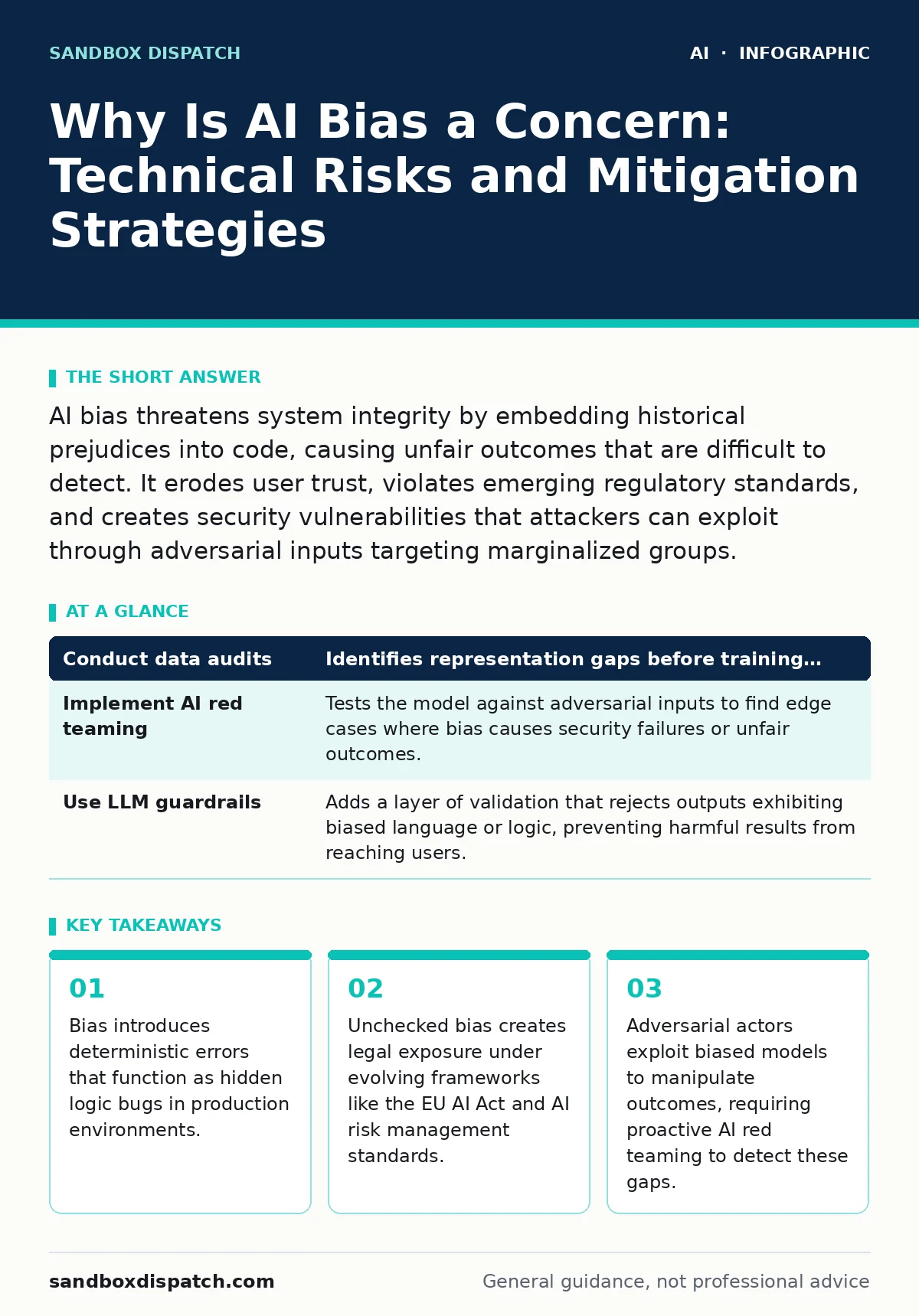
AI bias threatens system integrity by embedding historical prejudices into code, causing unfair outcomes that are difficult to detect. It erodes user trust, violates emerging regulatory standards, and creates security vulnerabilities that attackers can exploit through adversarial inputs targeting marginalized groups.
Why is ai bias a concern for system integrity
AI bias is a concern because it functions as a persistent logic error that compromises the reliability of automated decisions. When a model learns from skewed data, it encodes those distortions into its prediction engine. This creates a system that behaves unpredictably for specific user segments while appearing correct for others. Developers often mistake statistical correlation for causal truth, leading to features that amplify existing inequalities.
The technical debt accumulates silently. A biased model does not crash; it degrades. It returns incorrect classifications with high confidence. This makes debugging exceptionally difficult. The error is not in the syntax but in the semantic understanding of the data distribution. You must treat bias as a defect in the requirement specification phase, not merely an ethical afterthought.
Hidden costs of biased training data
Training data rarely represents reality evenly. Certain groups, languages, or edge cases are underrepresented. When you train a model on this imbalanced dataset, the algorithm optimizes for the majority pattern. It ignores the minority patterns to maximize overall accuracy metrics. This creates a blind spot. The model fails to recognize inputs from underrepresented groups. This failure mode is not random. It is systematic.
It replicates the historical gaps in the data collection process. For example, a facial recognition system trained primarily on one demographic will have higher error rates for others. This is not a moral failing of the code; it is a mathematical consequence of loss function optimization. You pay for this in support tickets, manual overrides, and eventual retraining cycles. The cost is measured in engineering hours spent fixing symptoms rather than addressing the root data skew.
Security implications of algorithmic unfairness
Bias is not just a fairness issue; it is a security vulnerability. Adversarial actors can identify which inputs trigger biased responses. They craft specific queries to exploit these weak points. This technique, known as adversarial prompting, relies on the model’s uneven performance across different data clusters. If a model is biased against a certain dialect or cultural context, an attacker can use that context to bypass safety filters or inject malicious content.
The model’s confidence in its own flawed reasoning makes it susceptible to manipulation. This intersects with concerns about exposed AI model servers, where direct API access allows attackers to probe for these biases at scale. You must assume that bias creates attack surfaces. Securing the model requires understanding not just what it predicts, but where it fails.
Regulatory compliance and legal exposure
Legal frameworks are catching up to technical realities. Regulations like the EU AI Act mandate risk assessments for high-impact AI systems. These laws require transparency in how decisions are made. If your system cannot explain why it rejected a user, you face compliance violations. AI transparency is no longer optional; it is a regulatory requirement. Bias creates a direct path to non-compliance. Auditors will look for disparate impact.
They will test whether your system treats different groups differently. If it does, you must justify the difference. Statistical artifacts are not a valid defense. You need documented processes for bias detection and mitigation. This includes regular reviews of model performance across demographic slices. Ignoring this leads to fines, product recalls, and bans. The legal risk is quantifiable and growing.
Decision | How it helps
| Conduct data audits | Identifies representation gaps before training begins, preventing systemic skew from entering the model weights. |
|---|---|
| Implement AI red teaming | Tests the model against adversarial inputs to find edge cases where bias causes security failures or unfair outcomes. |
| Use LLM guardrails | Adds a layer of validation that rejects outputs exhibiting biased language or logic, preventing harmful results from reaching users. |
See also: What Is AI Transparency: The Mechanics Behind Model Decisions · AI-Generated Phishing Emails: How to Spot the Synthetic Trap
Mitigation strategies for development teams
You can reduce bias through rigorous engineering practices. Start with data curation. Balance your datasets to ensure all relevant groups are represented. Use synthetic data to fill gaps where real data is scarce. Next, monitor model performance continuously. Do not rely on aggregate accuracy metrics. Track performance by subgroup. This reveals disparities that overall metrics hide. Implement LLM guardrails to catch biased outputs in real-time.
These guardrails act as a safety net, blocking responses that trigger bias alerts. Regular AI red teaming is also necessary. Have experts attempt to break the model using biased inputs. This proactive testing identifies weaknesses before deployment. Documentation is key. Record your data sources, preprocessing steps, and bias mitigation efforts. This creates an audit trail for compliance and debugging.
Long-term maintenance and model drift
Bias is not a one-time fix. Models drift over time. As new data flows in, the distribution changes. A model that was fair at launch may become biased as it learns from skewed user interactions. This is known as feedback loop bias. The model’s predictions influence user behavior, which generates new data that reinforces the model’s original biases. You must monitor for this drift.
Set up alerts for significant changes in subgroup performance. Retrain models regularly with fresh, balanced data. Review your mitigation strategies periodically. What worked yesterday may not work tomorrow. The landscape of bias is dynamic. Your defense must be adaptive. This requires ongoing investment in monitoring tools and expert review. It is not a set-and-forget process.
Integrating bias checks into the pipeline
Integrate bias detection into your continuous integration and deployment pipeline. Automate the testing of models against bias benchmarks. This ensures that every new version is checked for fairness. Use AI risk management frameworks to define acceptable thresholds. If a model exceeds these thresholds, the pipeline should halt.
This shifts bias testing from a manual, post-release activity to an automated, pre-release gate. It reduces the chance of biased code reaching users. It also provides immediate feedback to developers. They can fix issues before they merge code. This approach scales better than manual audits. It embeds fairness into the development culture. Engineers start to view bias as a technical constraint, not an abstract concept.
Key takeaways
- Bias introduces deterministic errors that function as hidden logic bugs in production environments.
- Unchecked bias creates legal exposure under evolving frameworks like the EU AI Act and AI risk management standards.
- Adversarial actors exploit biased models to manipulate outcomes, requiring proactive AI red teaming to detect these gaps.
Frequently asked questions
How do I know if my model is biased?
You detect bias by analyzing performance metrics across different subgroups. Look for significant disparities in accuracy, precision, or recall between groups. Statistical tests for disparate impact can quantify these differences objectively.
Can I fix bias without retraining the model?
Post-hoc adjustments can mitigate some bias, but they often reduce overall accuracy. Structural fixes require retraining with balanced data. Retaining the model without retraining is usually a temporary patch that fails under adversarial conditions.
Does removing labels prevent bias?
No. Removing explicit labels does not remove proxy variables. Other features may correlate strongly with protected attributes. The model can still learn to discriminate based on these proxies. You must test for outcomes, not just input features.
What is the role of AI red teaming in bias?
AI red teaming involves adversarial testing to find edge cases where bias causes failures. It helps identify vulnerabilities that standard testing misses. This proactive approach strengthens the model against manipulation and unfair outcomes.
How this guide was produced: written by the Sandbox Dispatch editorial team with AI assistance, checked against the public references listed below, and reviewed when the facts change. See our editorial policy or report an error.