EU AI Act Watermarking: How to Mark AI Content Correctly
The regulation mandates machine-readable labels for generated content, shifting liability to providers rather than just enforcing visual watermarks.

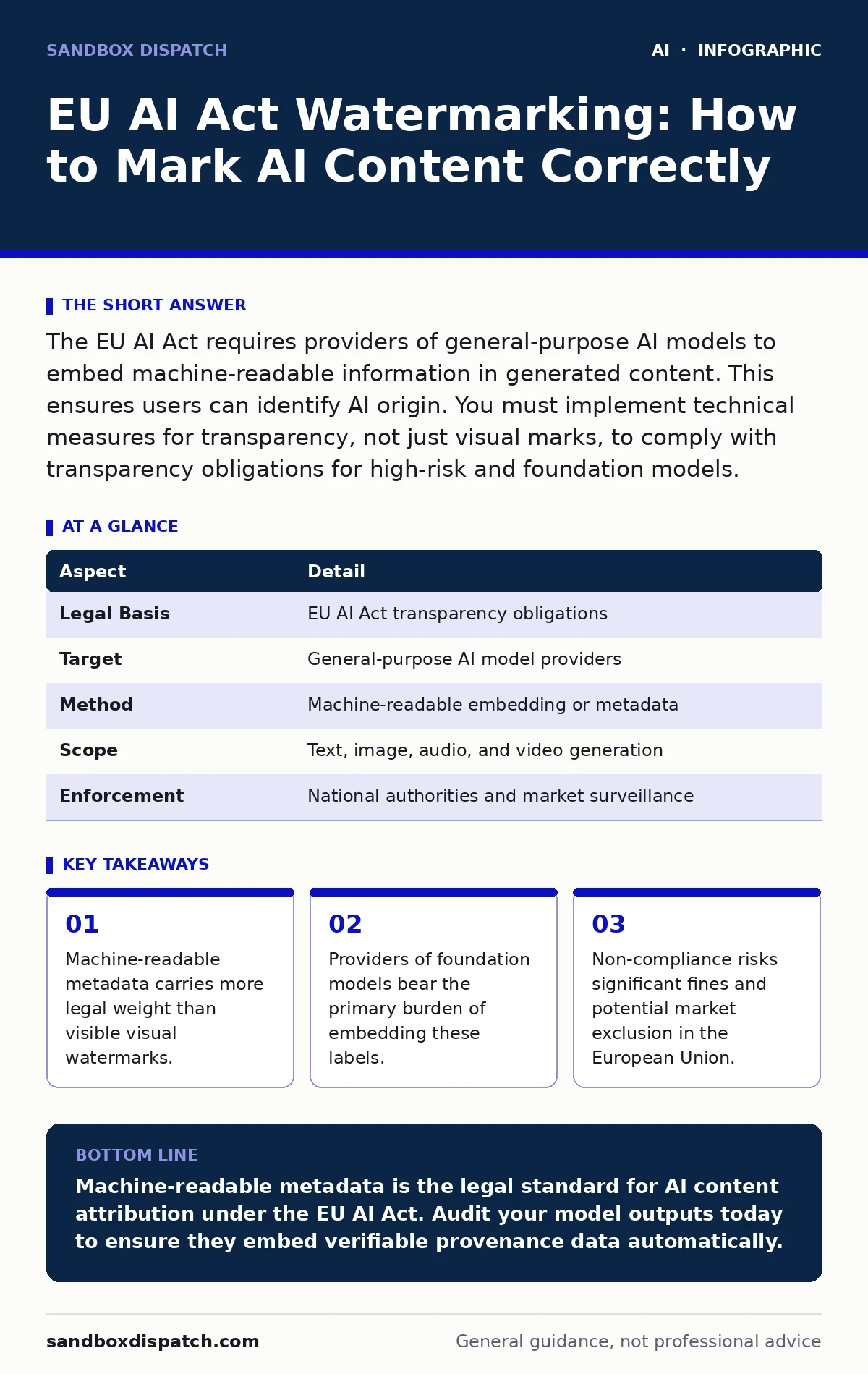
The EU AI Act requires providers of general-purpose AI models to embed machine-readable information in generated content. This ensures users can identify AI origin. You must implement technical measures for transparency, not just visual marks, to comply with transparency obligations for high-risk and foundation models.
The Invisible Stamp Analogy
Imagine buying a loaf of bread. The packaging lists ingredients, allergens, and a manufacturing date. You do not taste the label, but the information exists for your safety and choice. AI watermarking functions similarly. It is not about placing a visible logo on an image or text. It is about embedding data within the digital file that declares its artificial origin. This metadata travels with the content, even if the user edits the file later. The goal is provenance, not aesthetics.
At a Glance
| Aspect | Detail |
|---|---|
| Legal Basis | EU AI Act transparency obligations |
| Target | General-purpose AI model providers |
| Method | Machine-readable embedding or metadata |
| Scope | Text, image, audio, and video generation |
| Enforcement | National authorities and market surveillance |
What the EU AI Act Watermarking Rule Actually Means
The regulation defines watermarking as a technical requirement for transparency. Providers of general-purpose AI models must ensure that content generated by their systems is marked as artificial. This marking must be machine-readable. A visible logo is insufficient because it can be cropped or edited. Machine-readable data resides in the file header or sidecar metadata. It survives basic editing and allows automated tools to detect AI origin. This distinction separates marketing tricks from legal compliance.
The rule applies specifically to providers of foundation models. These are large models trained on vast datasets that can be adapted for many tasks. If you build and distribute such a model, you must implement this embedding mechanism. Users of the model do not need to add watermarks manually. The system must do it automatically. This shifts the technical burden to the infrastructure layer rather than the application layer.
Who Must Comply
The obligation falls on the entity that develops or deploys the general-purpose AI model. If you host a model that users can access via an API, you are the provider. If you fine-tune an existing open-source model and redistribute it as a new product, you may also be considered a provider. The definition hinges on control over the model’s output and distribution.
Organizations that merely use AI tools for internal processes are generally exempt from this specific technical requirement. They do not need to watermark their own internal reports. However, they must still ensure they are using compliant tools. The supply chain matters. If your vendor fails to watermark, you might inherit compliance risks depending on your specific use case and jurisdiction.
How to Implement Technical Marking
You must choose a standard for embedding metadata. Common approaches include modifying EXIF data for images or adding specific headers for text streams. The key is that the mark must be detectable by software. Visual steganography, which hides patterns in pixel noise, is often fragile. It breaks when the image is compressed or resized. Metadata survives these transformations better.
For text generation, appending a unique identifier or a specific token sequence at the end of the output is one method. Another is embedding a digital signature that verifies the source. You should test your implementation against common editing workflows. If a user copies and pastes your text into a word processor, does the mark survive? If not, you need a more robust mechanism. Consider using sidecar files that store provenance information separately from the content itself.
Common Misconceptions About Compliance
Many teams assume a visible badge satisfies the law. It does not. The regulation explicitly requires machine-readability. A badge is for human perception; metadata is for system verification. Another error is thinking this applies only to deepfakes. It applies to all generated content from covered models, including helpful text summaries or routine images.
Some believe that open-source models are exempt. They are not if they are provided as a service or distributed commercially. The exemption is narrow and often misunderstood. If you offer access to a model, you are subject to the transparency rules. Ignoring this because the model code is public is a risky legal stance.
Integration with Existing Security Practices
Watermarking intersects with other security controls. If you manage exposed AI model servers, watermarking provides an audit trail for leaked content. It helps you trace unauthorized usage back to specific model versions. This is critical for incident response. You can identify which model instance was compromised or misused.
This also relates to AI hallucinations. If your model generates false facts, the watermark helps users identify the source. It does not prevent the error, but it attributes it. You should combine watermarking with other safeguards. Refer to our guide on emergency stop for AI systems for methods to halt harmful generation. Also, review our section on AI bias to ensure your model’s training data does not introduce systematic errors that watermarking cannot fix.
Future-Proofing Your Implementation
Standards for AI provenance are evolving. The Coalition for Content Provenance and Authenticity is developing open standards. Aligning your implementation with these emerging norms reduces future rework. It also ensures interoperability with other systems. If you build a proprietary format, you risk isolation.
Regularly update your embedding logic. As editing tools become more sophisticated, they may strip metadata. You need to monitor the effectiveness of your marks. Conduct periodic tests to see if your watermarks survive common manipulations. This is an ongoing engineering task, not a one-time fix.
Key takeaways
- Machine-readable metadata carries more legal weight than visible visual watermarks.
- Providers of foundation models bear the primary burden of embedding these labels.
- Non-compliance risks significant fines and potential market exclusion in the European Union.
Machine-readable metadata is the legal standard for AI content attribution under the EU AI Act. Audit your model outputs today to ensure they embed verifiable provenance data automatically.
Frequently asked questions
Does the EU AI Act watermarking rule apply to text-only AI?
Yes, the requirement covers all generated content, including text, images, audio, and video, from general-purpose models.
Can I use a visible logo instead of metadata?
No, a visible logo is insufficient. The regulation mandates machine-readable information that can be detected by automated systems.
Who is responsible if the watermark is removed by a user?
The provider is responsible for embedding the mark. If a user deliberately removes it, the provider has met their obligation, but the content is then unverified.
How does this relate to deepfake detection?
Watermarking provides provenance data that aids detection. It is a preventive measure, whereas detection is reactive. See our guide on deepfake detection for more.
How this guide was produced: written by the Sandbox Dispatch editorial team with AI assistance, checked against the public references listed below, and reviewed when the facts change. See our editorial policy or report an error.