What Is HTTP Request Smuggling: Mechanisms and Fixes
HTTP request smuggling occurs when front-end and back-end servers interpret request boundaries differently, allowing attackers to insert hidden commands into queued traffic.

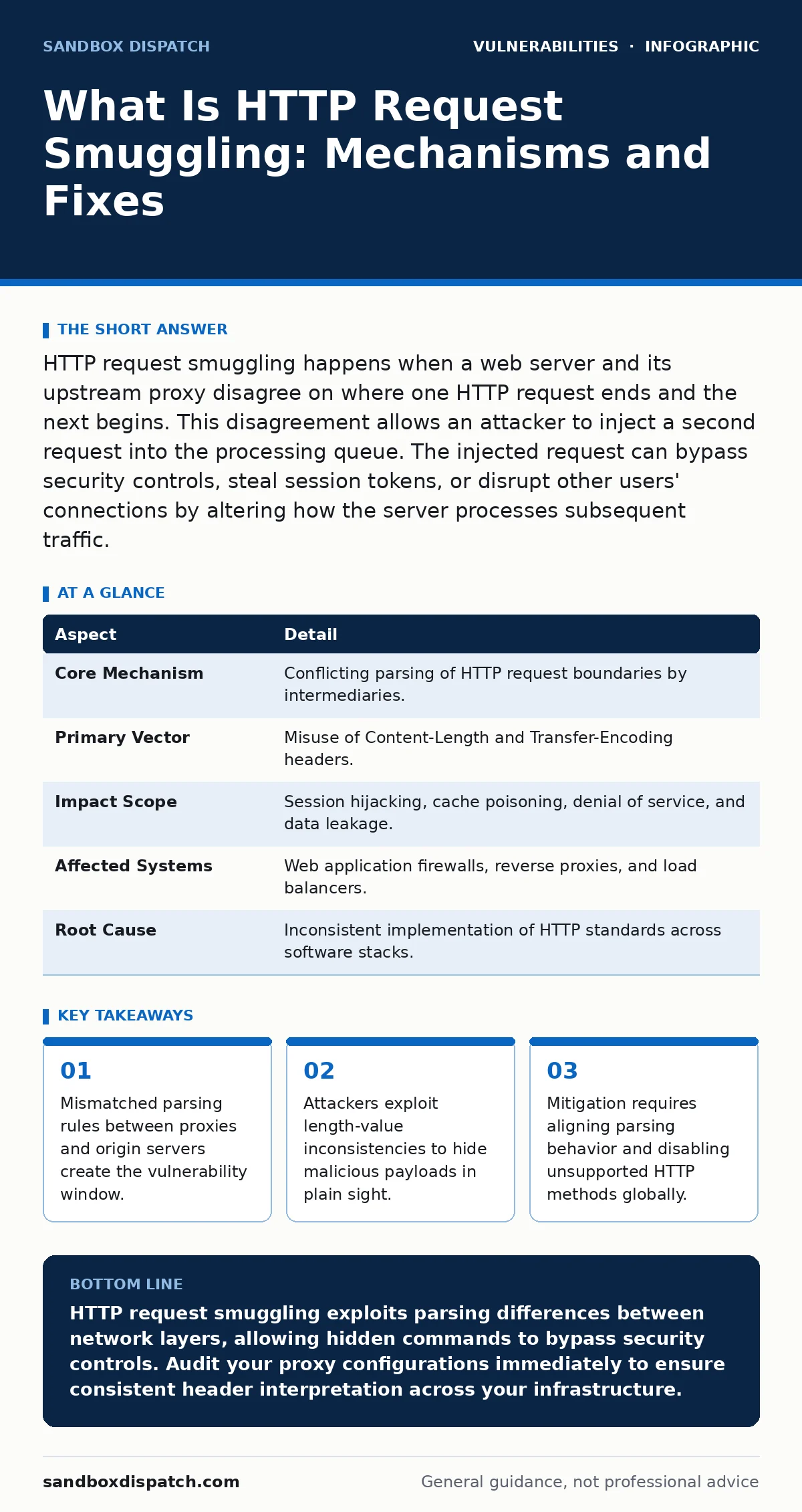
HTTP request smuggling happens when a web server and its upstream proxy disagree on where one HTTP request ends and the next begins. This disagreement allows an attacker to inject a second request into the processing queue. The injected request can bypass security controls, steal session tokens, or disrupt other users' connections by altering how the server processes subsequent traffic.
What Is HTTP Request Smuggling
Imagine you are mailing letters through a post office that uses two different sorting machines. The first machine reads the weight of the envelope to decide where it goes. The second machine reads the address label. If you craft an envelope that weighs one amount but has an address that implies another, the machines will sort it differently. One machine might think you sent one letter, while the other thinks you sent two. This disagreement creates a gap where you can slip a secret message past the first sorter without it being checked.
HTTP request smuggling works on this same principle of conflicting interpretations. It is a class of vulnerability where a client sends a malformed HTTP request that is parsed differently by a front-end server and a back-end server. The front-end server might treat the input as a single request, while the back-end server interprets part of that input as the beginning of a new, separate request. This desynchronization allows an attacker to "smuggle" a secondary request into the server’s processing queue. The smuggled request executes with the context of the victim’s session, often bypassing authentication or authorization checks.
| Aspect | Detail |
|---|---|
| Core Mechanism | Conflicting parsing of HTTP request boundaries by intermediaries. |
| Primary Vector | Misuse of Content-Length and Transfer-Encoding headers. |
| Impact Scope | Session hijacking, cache poisoning, denial of service, and data leakage. |
| Affected Systems | Web application firewalls, reverse proxies, and load balancers. |
| Root Cause | Inconsistent implementation of HTTP standards across software stacks. |
How The Attack Works
The protocol relies on specific headers to define the size and structure of the message body. The Content-Length header specifies the exact number of bytes in the body. The Transfer-Encoding header, often set to chunked, indicates that the body is sent in variable-sized chunks. However, many implementations interpret these rules differently.
Suppose a front-end proxy prioritizes Transfer-Encoding while the back-end server prioritizes Content-Length. An attacker sends a request with a Transfer-Encoding header that claims the body is small, but a Content-Length header that claims the body is large. The proxy sees the small body, finishes processing the request, and moves on. The back-end server sees the large body value, reads further into the stream, and interprets the next legitimate client request as part of the body. This leaves the queue misaligned. The attacker can then inject their own HTTP commands into that residual space.
Who It Affects
This vulnerability affects any architecture that uses an intermediary to handle HTTP traffic. Reverse proxies, load balancers, and web application firewalls are the most common victims. These components sit between the internet and the origin server. They are designed to inspect, filter, or route traffic. When they parse the HTTP stream differently than the server they protect, they create the conditions for smuggling.
Legacy systems are particularly at risk because older software often lacks strict adherence to modern HTTP standards. However, modern configurations are not immune. Complex setups with multiple layers of proxies increase the likelihood of a parsing mismatch. Even if the origin server is secure, a misconfigured proxy can expose the entire backend. This vulnerability highlights the hidden cost of infrastructure complexity. Adding more layers for security can inadvertently introduce new attack surfaces if those layers do not speak the same protocol dialect.
Common Misconceptions
Many developers believe that securing the origin server is sufficient. This view overlooks the role of the transport layer. If the proxy misinterprets the request, the origin server never sees the malicious payload in its intended form. It sees a corrupted or empty request. You cannot patch the origin server to fix a proxy’s parsing logic. The fix must address the entire chain of trust.
Another common error is assuming that disabling Transfer-Encoding is a complete solution. While it removes one vector, attackers can still exploit Content-Length mismatches or other header conflicts. Relying on a single mitigation strategy leaves gaps. Security must be holistic. You must ensure that every component in the stack parses HTTP requests identically. This requires testing the interaction between components, not just testing each component in isolation.
Mitigation Strategies
The most effective defense is to align the parsing behavior of all intermediaries. This often means configuring proxies to ignore Transfer-Encoding for specific paths or methods. Many modern proxies allow you to set a strict mode that rejects requests with conflicting headers. You should enable this mode where possible. It forces the client to adhere to a single, unambiguous format.
You must also disable unnecessary HTTP methods. Methods like TRACE or OPTIONS can sometimes be used to probe the server’s behavior or assist in crafting smuggling attacks. Removing these methods reduces the available attack surface. Additionally, ensure that your infrastructure uses the latest versions of proxy and server software. Vendors frequently release patches that correct parsing inconsistencies. See our guide on patch management for procedures on keeping infrastructure components updated without causing downtime.
Implementing strict input validation on the application level provides a secondary layer of defense. While this does not fix the protocol-level issue, it can limit the damage if a smuggled request does reach the backend. Validate all user inputs and ensure that the application does not trust headers blindly. This approach aligns with risk-based vulnerability management, which prioritizes fixes based on the potential impact and likelihood of exploitation.
Testing for Vulnerabilities
Identifying these vulnerabilities requires specialized testing tools. Standard vulnerability scanners often miss smuggling issues because they do not deeply analyze the interaction between proxies and servers. You need tools that can craft malformed requests and observe the server’s response. Look for tools that support custom HTTP headers and can manipulate the body length dynamically.
Manual testing is often more effective than automated scanning for this specific issue. Security engineers can craft requests that exploit known parsing differences between common software stacks. For instance, you might test how a specific proxy handles a request with both Content-Length and Transfer-Encoding headers. Document the behavior. If the proxy and server react differently, you have found a potential smuggling vector. This process is part of broader attack surface management, ensuring you understand how your infrastructure interprets external traffic.
Integrating With Security Practices
Fixing HTTP request smuggling is not a one-time task. It is part of ongoing security hygiene. When you deploy new infrastructure components, verify their parsing rules against your existing stack. Inconsistent defaults can re-introduce vulnerabilities. Your vulnerability disclosure policies should include guidelines for reporting parsing discrepancies. Researchers often find these subtle bugs before internal teams do. Encourage responsible disclosure by making it easy for outsiders to report these issues.
Consider the CVSS score when prioritizing fixes. While the base score might seem moderate, the impact can be severe if an attacker gains access to administrative functions. The attack vectors in CVSS classification help you understand the complexity required to exploit the flaw. However, do not rely solely on scores. The context of your specific architecture matters more than a generic metric. Integrate these findings into your exploit chains analysis to understand how smuggling could be used as a stepping stone for larger attacks.
Key takeaways
- Mismatched parsing rules between proxies and origin servers create the vulnerability window.
- Attackers exploit length-value inconsistencies to hide malicious payloads in plain sight.
- Mitigation requires aligning parsing behavior and disabling unsupported HTTP methods globally.
HTTP request smuggling exploits parsing differences between network layers, allowing hidden commands to bypass security controls. Audit your proxy configurations immediately to ensure consistent header interpretation across your infrastructure.
Frequently asked questions
Can HTTP request smuggling occur on HTTPS connections?
Yes, HTTPS encrypts the traffic but does not change how the server parses the HTTP headers inside the encrypted stream. The vulnerability exists in the application layer, not the transport layer encryption.
Does removing the Transfer-Encoding header fix the problem?
It reduces risk by removing one vector, but it does not fix the root cause. Attackers can still exploit Content-Length mismatches or other header conflicts if the parsing logic remains inconsistent.
How do I know if my server is vulnerable?
You must test the interaction between your proxy and your origin server. Send malformed requests with conflicting headers and check if the servers interpret the request boundaries differently.
Is this vulnerability common in modern web applications?
It remains a significant risk because many organizations use complex proxy setups. Misconfigurations are common, and default settings often allow the conflicting header combinations that enable smuggling.
How this guide was produced: written by the Sandbox Dispatch editorial team with AI assistance, checked against the public references listed below, and reviewed when the facts change. See our editorial policy or report an error.