EU AI Act Meaning: Plain Definition and Practical Impact
The EU AI Act classifies systems by risk level, forcing developers to prove safety before deployment rather than waiting for harm to occur.
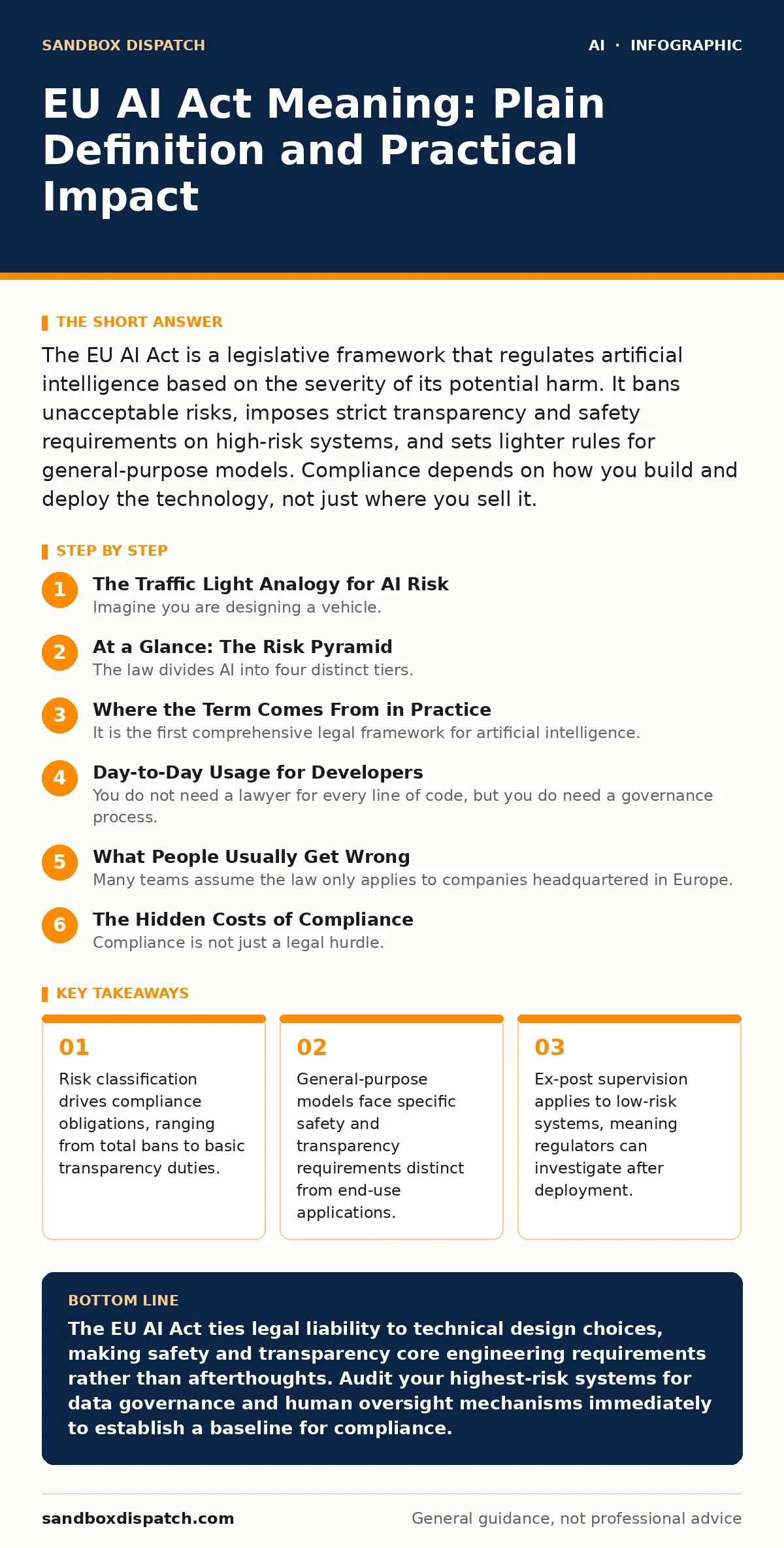
The EU AI Act is a legislative framework that regulates artificial intelligence based on the severity of its potential harm. It bans unacceptable risks, imposes strict transparency and safety requirements on high-risk systems, and sets lighter rules for general-purpose models. Compliance depends on how you build and deploy the technology, not just where you sell it.
The Traffic Light Analogy for AI Risk
Imagine you are designing a vehicle. A car that runs on tracks with automatic brakes is regulated differently than a sports car driven on public roads. The EU AI Act operates on this same logic of risk stratification. It does not ban artificial intelligence. Instead, it sorts systems into categories based on how much harm they could cause to safety, fundamental rights, or democracy.
This approach moves the industry away from self-regulation. You cannot simply claim your model is safe. You must demonstrate it meets specific legal standards before it reaches users. The framework applies to providers, deployers, and importers, creating a chain of responsibility that extends beyond the original code writers.
At a Glance: The Risk Pyramid
The law divides AI into four distinct tiers. Your obligations change drastically depending on which tier your system falls into.
| Risk Level | Legal Status | Typical Examples | Core Obligation |
|---|---|---|---|
| Unacceptable | Banned | Social scoring, real-time biometric ID in public | Do not build or deploy. |
| High | Strict Regulation | Medical devices, critical infrastructure, hiring tools | Conformity assessment, data governance, human oversight. |
| Limited | Transparency | Chatbots, emotion recognition, deepfakes | Inform users they are interacting with AI. |
| Minimal | No Regulation | Spam filters, video games, anti-cheat | Voluntary codes of conduct. |
Where the Term Comes From in Practice
It is the first comprehensive legal framework for artificial intelligence. The definition of "AI system" is broad. It covers machine learning systems, systems based on logic and knowledge, and statistical approaches. If the system produces output that can influence human behavior or physical environments, it likely falls under the scope.
The origin of this regulatory shift lies in the inability of existing product safety laws to address software that learns and adapts. Traditional hardware regulations assume a static product. AI changes after deployment. The Act addresses this by requiring ongoing monitoring and documentation, not just a one-time safety check at launch.
Day-to-Day Usage for Developers
You do not need a lawyer for every line of code, but you do need a governance process. Day-to-day, this means maintaining technical documentation. You must record data sources, training procedures, and performance metrics. This documentation proves that your system behaves as intended and does not introduce new risks over time.
For high-risk systems, you must implement human oversight mechanisms. This is not a checkbox. It requires designing interfaces that allow a human to intervene, stop, or override the AI decision. You must also ensure data quality. Training data must be free from bias and errors that could lead to discriminatory outcomes. This connects directly to AI bias, which requires active mitigation strategies during the training phase, not just post-hoc fixes.
What People Usually Get Wrong
Many teams assume the law only applies to companies headquartered in Europe. This is incorrect. The extraterritorial scope means any provider or deployer must comply if the output is used in the EU. If you sell a SaaS product to European customers, you are subject to these rules.
Another common error is conflating all AI with high-risk AI. Most consumer-facing tools, like spam filters or recommendation engines, are low-risk. They require minimal compliance. However, if you build a general-purpose model, you face specific rules regardless of its end use. These rules focus on transparency and robustness. You must provide detailed documentation about training data and copyright compliance. This area often intersects with large language models, where the scale of data creates unique legal challenges around intellectual property and safety.
The Hidden Costs of Compliance
Compliance is not just a legal hurdle. It changes how you build software. You must design for explainability from the start. If your model is a black box, you cannot prove it meets safety standards. This pushes teams toward explainable AI techniques, which may reduce performance or increase computational costs. You have to trade off some accuracy for the ability to audit the decision-making process.
Data governance becomes a primary engineering task. You need pipelines that track data lineage. Every piece of training data must be traceable to its source. This infrastructure is expensive and complex. It requires new tools and processes that many development teams do not currently have. The cost of compliance is often higher than the cost of the software itself.
Integration with Security Standards
The Act does not replace cybersecurity best practices. It builds on them. A system that is not secure cannot be considered safe. If an attacker can manipulate the input to change the output, the system fails its risk assessment. This is why AI security testing is now a regulatory requirement for high-risk systems. You must test for adversarial attacks and data poisoning.
You also need to protect against AI model theft. Your model weights are intellectual property. If they are stolen, you lose control over how the model is used. This can lead to unauthorized high-risk deployments that you cannot monitor. The Act requires you to implement measures to prevent unauthorized access and manipulation. This overlaps with insecure AI plugins and agents, where third-party integrations often become the weakest link in the security chain.
Navigating Emerging Threats
The regulatory landscape is static, but the threats are not. Jailbreaking AI chatbots is a growing concern. If users can bypass safety filters, your system may generate harmful content. This violates the transparency and safety requirements for limited and high-risk systems. You must implement robust guardrails that resist prompt injection.
Similarly, deepfake detection is not a silver bullet. The Act requires you to label synthetic content, but it does not mandate detection tools. However, deployers must ensure that the content they publish is not misleading. This creates a burden on platforms to verify the authenticity of user-generated content. The responsibility for preventing deception shifts from just the creator to the distributor.
The Path Forward
Compliance is an ongoing process. You must monitor your system after deployment. If the performance degrades or new risks emerge, you must update the system and the documentation. This is known as post-market monitoring. It requires continuous investment in testing and validation.
You should also prepare for international alignment. Other regions may adopt similar frameworks. Building compliance into your core architecture now saves costs later. It makes your product adaptable to new laws without major rewrites. The goal is not just to avoid fines. It is to build trust with users who are increasingly aware of AI risks.
Key takeaways
- Risk classification drives compliance obligations, ranging from total bans to basic transparency duties.
- General-purpose models face specific safety and transparency requirements distinct from end-use applications.
- Ex-post supervision applies to low-risk systems, meaning regulators can investigate after deployment.
- Non-EU entities must comply if they place AI systems or content generated by AI on the European market.
The EU AI Act ties legal liability to technical design choices, making safety and transparency core engineering requirements rather than afterthoughts. Audit your highest-risk systems for data governance and human oversight mechanisms immediately to establish a baseline for compliance.
Frequently asked questions
Does the EU AI Act apply to internal tools used only by employees?
Yes, if the internal tool is classified as high-risk, such as those used for employee monitoring or recruitment. The location of the user matters less than the nature of the risk posed by the system.
Are personal AI assistants considered high-risk under the Act?
Generally, no. Most personal AI assistants fall under limited or minimal risk categories. They require transparency, such as informing users when they are interacting with AI, but they do not face the strict safety assessments of high-risk systems.
How does the Act handle open-source models?
Open-source models are not automatically exempt. If you deploy an open-source model in a high-risk application, you are responsible for ensuring it meets all safety and transparency requirements. The exemption only applies to the model itself if it is released with full transparency and not used in high-risk contexts.
What happens if a system is deemed non-compliant?
Non-compliant systems can be banned from the market. Providers and deployers can face significant fines based on their global turnover. Regulators can also require the immediate withdrawal of the system and the erasure of training data if it violates fundamental rights.
How this guide was produced: written by the Sandbox Dispatch editorial team with AI assistance, checked against the public references listed below, and reviewed when the facts change. See our editorial policy or report an error.