How Insecure AI Plugins and Agents Fail: A Step-by-Step Breakdown
Most agent failures stem not from model hallucinations, but from unvalidated data flows between the reasoning engine and external tools.

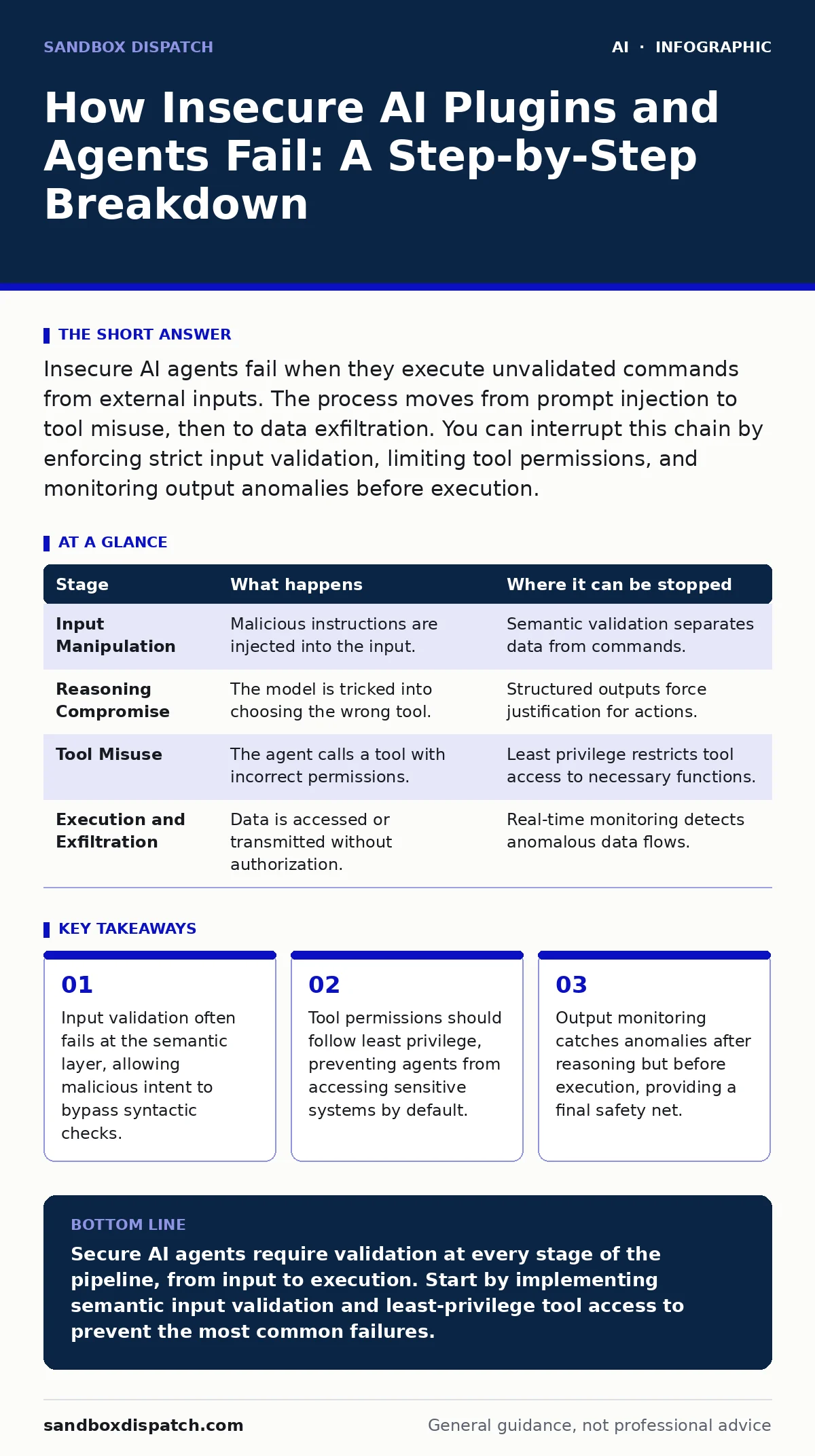
Insecure AI agents fail when they execute unvalidated commands from external inputs. The process moves from prompt injection to tool misuse, then to data exfiltration. You can interrupt this chain by enforcing strict input validation, limiting tool permissions, and monitoring output anomalies before execution.
The Anatomy of Agent Failure
Autonomous agents differ from static chatbots because they take actions. They do not just generate text; they call functions, query databases, and send emails. This capability introduces a new attack surface. The security gap rarely lies in the large language model itself. It exists in the bridge between the model’s reasoning and the external tools it controls.
When you build an agent, you are creating a pipeline. Data enters, the model processes it, and an action is taken. If any part of that pipeline trusts data without verification, the system becomes vulnerable. The attacker does not need to break the model. They only need to trick the pipeline into trusting bad data.
### Stage 1: Input Manipulation
The process begins with input. An agent receives text, often from a user or another system. This input contains the instructions the agent will follow. If the input is not cleaned, it can contain hidden commands. These commands are designed to override the agent’s original instructions.
Imagine an agent tasked with summarizing emails. An attacker sends an email with a hidden instruction to delete all attachments. The model sees the instruction and complies. This is known as prompt injection. The flaw relies on the model treating all input as equally authoritative. There is no distinction between data and instructions.
This stage can be interrupted by separating data from code. You must validate input at the semantic level, not just the syntactic level. Syntactic checks look for specific characters. Semantic checks understand the intent of the text. This distinction is critical for preventing injection attacks.
### Stage 2: Reasoning Compromise
Once the input is accepted, the model reasons about it. It decides which tool to use and what parameters to pass. This is where the logic breaks down. The model may be convinced to use a tool it should not use. It may also pass incorrect parameters to a valid tool.
Suppose an agent is allowed to read files but not write them. The attacker crafts an input that convinces the model to write a file. The model’s reasoning is compromised. It believes it is following valid instructions. The flaw here is the lack of context awareness. The model does not understand the broader security policy.
You can stop this by constraining the model’s reasoning space. Use structured outputs to force the model to justify its choices. If the model cannot provide a valid justification, the action is blocked. This adds a layer of verification before the tool is called.
### Stage 3: Tool Misuse
The agent now attempts to execute the action. It calls an external API or function. This is the most dangerous stage. The tool has real-world effects. It can delete data, send money, or change configurations. If the tool is not secured, the agent becomes a weapon.
The attacker relies on the tool trusting the agent. Many tools do not verify the source of the request. They assume that if the request comes from the agent, it is valid. This is a false assumption. The agent may have been compromised. The tool must validate the request independently.
This stage can be interrupted by implementing strict access controls. Each tool should verify the identity and permissions of the caller. The agent should only have access to the tools it needs. This is the principle of least privilege. It limits the damage if the agent is compromised.
### Stage 4: Execution and Exfiltration
The tool executes the action. Data may be read, written, or transmitted. If the action is malicious, it results in data exfiltration or system damage. The attacker has achieved their goal. The data is now outside the secure boundary.
The flaw here is the lack of monitoring. Many systems do not track what the agent does. They only track what the user does. This blind spot allows attackers to operate undetected. The system assumes that if the agent is running, it is doing the right thing.
You can interrupt this by monitoring tool outputs. Look for anomalies in the data being accessed. If an agent suddenly accesses a large amount of sensitive data, it is a red flag. Real-time monitoring can stop the exfiltration before it completes.
See also: Treat AI Models as Untrusted Insiders: 6 Common Misunderstandings
The Hidden Costs of Convenience
Building agents is easy. Securing them is hard. The convenience of automation comes with hidden costs. You must validate every input. You must constrain every reasoning step. You must monitor every output. This adds complexity to your system.
Many developers skip these steps. They trust the model to do the right thing. This trust is misplaced. The model is a probabilistic engine. It does not understand security policies. It only understands patterns. If the pattern suggests an action, it will take it.
The cost of insecurity is not just financial. It is also reputational. A compromised agent can damage your brand. Users lose trust in AI systems. This trust is hard to regain. Security must be built in from the start, not added later.
Where the Chain Breaks
The security of an agent depends on the weakest link. If input validation fails, the rest of the chain is compromised. If reasoning is not constrained, the agent can be tricked. If tools are not secured, the agent can cause damage.
You must protect every stage. Input validation prevents injection. Reasoning constraints prevent misuse. Tool permissions limit damage. Output monitoring catches anomalies. Each stage provides a layer of defense. If one layer fails, the others can still protect you.
This approach is known as defense in depth. It assumes that any single control may fail. By layering controls, you reduce the risk of a complete breach. This is the only reliable way to secure autonomous agents.
| Stage | What happens | Where it can be stopped |
|---|---|---|
| Input Manipulation | Malicious instructions are injected into the input. | Semantic validation separates data from commands. |
| Reasoning Compromise | The model is tricked into choosing the wrong tool. | Structured outputs force justification for actions. |
| Tool Misuse | The agent calls a tool with incorrect permissions. | Least privilege restricts tool access to necessary functions. |
| Execution and Exfiltration | Data is accessed or transmitted without authorization. | Real-time monitoring detects anomalous data flows. |
Integrating Security into the Lifecycle
Security is not a one-time task. It is a continuous process. As you update the model, you must re-evaluate the security controls. New capabilities may introduce new risks. New tools may have new vulnerabilities.
You should incorporate security into your development lifecycle. Test for prompt injection. Test for tool misuse. Test for output anomalies. This testing should be automated. Manual testing is not scalable.
Refer to the NIST AI Risk Management Framework for a structured approach. It provides guidelines for managing AI risks. It helps you identify, assess, and mitigate risks. This framework is not a solution, but a starting point.
The Role of Explainability
Understanding why an agent failed is critical. If you do not know why it failed, you cannot fix it. Explainable AI helps you understand the model’s reasoning. It provides insights into how the model arrived at its decision.
This is not just for debugging. It is for security. If you can explain why an agent took an action, you can determine if it was malicious. You can identify the point of failure. You can then strengthen that point.
Explainability is a tool for security. It helps you monitor and audit your agents. It provides transparency into the black box. This transparency is essential for trust and security.
Key takeaways
- Input validation often fails at the semantic layer, allowing malicious intent to bypass syntactic checks.
- Tool permissions should follow least privilege, preventing agents from accessing sensitive systems by default.
- Output monitoring catches anomalies after reasoning but before execution, providing a final safety net.
Secure AI agents require validation at every stage of the pipeline, from input to execution. Start by implementing semantic input validation and least-privilege tool access to prevent the most common failures.
Frequently asked questions
Can I trust the AI model to follow security rules?
No, models are probabilistic and can be tricked into ignoring rules. You must enforce security through external controls, not just instructions.
How do I detect prompt injection in real-time?
Use semantic validation to distinguish between data and instructions. Monitor for unusual patterns in input that suggest malicious intent.
What is the difference between guardrails and validation?
Guardrails are high-level constraints, while validation is low-level checking. Both are needed, but validation is more reliable for preventing injection.
Do I need to secure every tool the agent uses?
Yes, every tool is a potential attack vector. Apply least-privilege access and monitor all tool interactions for anomalies.
How this guide was produced: written by the Sandbox Dispatch editorial team with AI assistance, checked against the public references listed below, and reviewed when the facts change. See our editorial policy or report an error.