Jailbroken AI Response: Immediate Containment and Recovery Steps
A successful jailbreak often leaves no server-side trace until data exfiltration begins, making immediate network isolation the only viable first step.
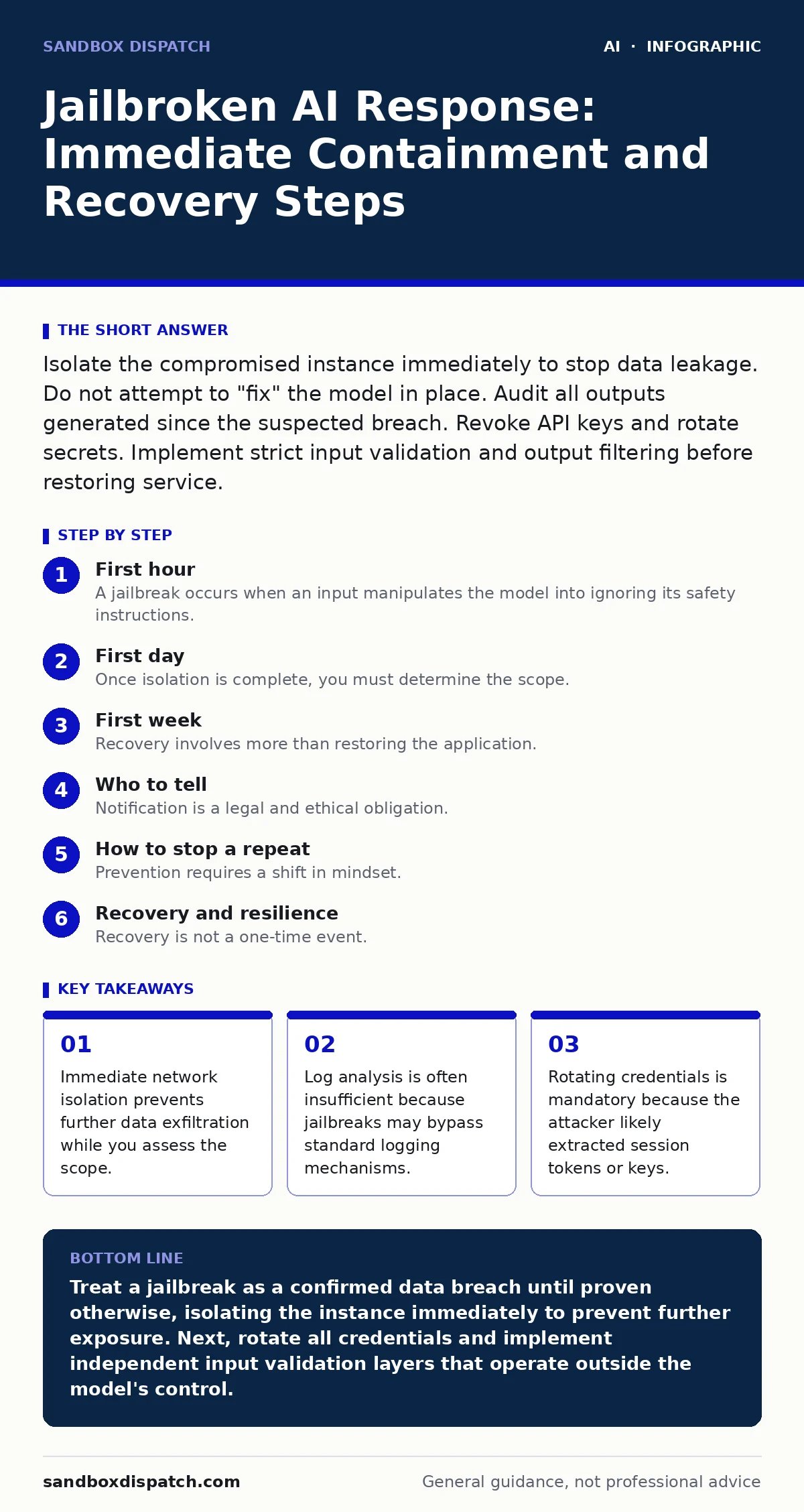
Isolate the compromised instance immediately to stop data leakage. Do not attempt to "fix" the model in place. Audit all outputs generated since the suspected breach. Revoke API keys and rotate secrets. Implement strict input validation and output filtering before restoring service.
First hour
A jailbreak occurs when an input manipulates the model into ignoring its safety instructions. This is not a traditional software vulnerability with a patch. It is a failure of the alignment layer. Your immediate goal is not to understand how it happened. Your goal is to stop the bleeding.
- Isolate the affected AI instance from the network immediately.
- Revoke all active API keys associated with the service.
- Disable the application or endpoint that hosted the interaction.
- Preserve server logs and session data in a read-only format.
- Notify your incident response team and legal counsel.
The most damaging action you can take is to assume the model has "recovered" after a restart. Stateful models retain context in memory. Non-stateful models may still have cached embeddings or vector store entries that reflect the compromised state. Treating the instance as clean without verification is a critical error.
Imagine a developer uses a local LLM for code review. The model is jailbroken to ignore copyright restrictions. The developer continues to use it, believing the next prompt resets the behavior. The model continues to output proprietary code snippets from its training data, which it was previously blocked from accessing. The damage compounds with every request.
First day
Once isolation is complete, you must determine the scope. Did the jailbreak occur once, or is it a persistent pattern? Did the model output sensitive data, or did it merely refuse to follow safety guidelines?
Check your application logs for unusual input patterns. Look for prompts containing role-play scenarios, base64 encoded text, or requests to ignore previous instructions. These are common vectors. However, sophisticated jailbreaks may use subtle semantic shifts that evade simple keyword filters.
Review all outputs generated during the compromised window. If the model processed user data, assume that data has been exposed. This includes personally identifiable information, proprietary code, and internal business logic. The model may have memorized this data and made it retrievable through follow-up prompts.
You must rotate all secrets. This includes API keys, database credentials, and session tokens. The attacker may have used the jailbreak to extract these values. Even if you do not see explicit exfiltration in the logs, the model’s internal state may have been manipulated to leak them in subtle ways.
Consult your AI risk management framework to classify the severity. Was this a minor policy violation, or a critical data breach? The classification dictates your notification obligations. Do not underestimate the impact. A jailbreak can reveal more than a traditional intrusion because the model synthesizes information from its entire training set.
First week
Recovery involves more than restoring the application. You must harden the system against repeat attacks. This requires a multi-layered approach to input and output control.
Implement LLM guardrails that operate independently of the model. These are pre-processing and post-processing steps that validate inputs and scan outputs. They should check for known jailbreak patterns, sensitive data types, and policy violations. The model itself cannot be trusted to police itself.
Consider using explainable AI techniques to audit model decisions. While large language models are often black boxes, you can use attribution methods to understand which parts of the input influenced the output. This helps identify weak points in your safety filters.
Update your AI vendor assessments if you use third-party models. Verify that the provider has implemented recent safety patches and alignment improvements. Ask for details on their red-teaming processes. If they cannot provide transparent evidence of their safety measures, consider switching providers.
Who to tell
Notification is a legal and ethical obligation. Identify who was affected. Did the jailbreak expose user data? Did it impact internal operations?
Notify your legal team immediately. They will determine if regulatory reporting is required. This depends on the type of data exposed and the jurisdiction. Do not delay this step. Early notification can mitigate penalties and preserve trust.
Inform your users if their data was compromised. Be transparent about what happened, what data was exposed, and what steps you are taking to prevent recurrence. Avoid technical jargon. Focus on the impact and the remediation.
If you use agentic AI systems that can take actions autonomously, notify any human operators who oversee these agents. The jailbreak may have allowed the agent to perform unauthorized actions, such as sending emails or executing transactions. These actions need to be reviewed and reversed.
How to stop a repeat
Prevention requires a shift in mindset. You cannot rely on the model to be safe. You must build safety into the infrastructure.
Implement strict input validation. Reject prompts that contain unusual formatting, encoded text, or requests to ignore instructions. Use allowlists for permitted topics and actions. This reduces the attack surface.
Monitor for anomalous behavior. Set up alerts for spikes in token usage, unusual response lengths, or repeated policy violations. These can indicate an ongoing attack.
Regularly update your safety filters. Jailbreak techniques evolve rapidly. What works today may fail tomorrow. Your defenses must adapt accordingly.
Consider insecure AI plugins and agents as a potential vector. If your AI system can call external tools, ensure those tools are secure and validated. A jailbreak may leverage a plugin to execute arbitrary code or access sensitive files.
See also: Treat AI Models as Untrusted Insiders: 6 Common Misunderstandings
Recovery and resilience
Recovery is not a one-time event. It is an ongoing process. You must continuously test and improve your defenses.
Conduct regular red-teaming exercises. Hire ethical hackers to attempt jailbreaks on your system. This helps identify weaknesses before attackers do.
Train your developers on AI security best practices. They need to understand the risks and how to mitigate them. Include AI security in your development lifecycle.
Document every incident. Analyze what went wrong and how you responded. Use these lessons to improve your processes.
Final considerations
The landscape of AI security is changing. New attacks are discovered regularly. You must stay informed and adapt.
Do not ignore AI bias as a security issue. Bias can be exploited to manipulate the model into harmful outputs. Address bias in your training data and evaluation processes.
Be wary of AI model theft. Attackers may attempt to steal your fine-tuned model or training data. Protect your intellectual property with strong access controls and encryption.
Remember that no system is perfectly secure. Your goal is to reduce risk to an acceptable level. Balance security with usability. Overly restrictive controls can hinder productivity.
Key takeaways
- Immediate network isolation prevents further data exfiltration while you assess the scope.
- Log analysis is often insufficient because jailbreaks may bypass standard logging mechanisms.
- Rotating credentials is mandatory because the attacker likely extracted session tokens or keys.
Treat a jailbreak as a confirmed data breach until proven otherwise, isolating the instance immediately to prevent further exposure. Next, rotate all credentials and implement independent input validation layers that operate outside the model's control.
Frequently asked questions
How do I know if my AI model has been jailbroken?
Look for outputs that contradict safety guidelines, unusual input patterns in logs, or unexpected access to sensitive data. Sudden changes in model behavior are also red flags.
Can I patch a jailbroken model?
No. Jailbreaks exploit the model's alignment, not a code bug. You must retrain the model or apply external safety filters. Restarting the instance does not fix the underlying vulnerability.
Should I use open-source models to avoid vendor lock-in?
Open-source models offer transparency but require you to manage security. You must implement your own safety measures and keep the model updated. This adds operational complexity.
Is it legal to attempt to jailbreak an AI model?
It depends on your jurisdiction and the terms of service. Unauthorized testing may violate laws or contracts. Always obtain explicit permission before testing.
How this guide was produced: written by the Sandbox Dispatch editorial team with AI assistance, checked against the public references listed below, and reviewed when the facts change. See our editorial policy or report an error.