How to Prevent Adversarial Examples in Production AI Systems
Standard sanitization fails against adversarial examples because they exploit model mathematics, not data hygiene, requiring mathematical defenses.

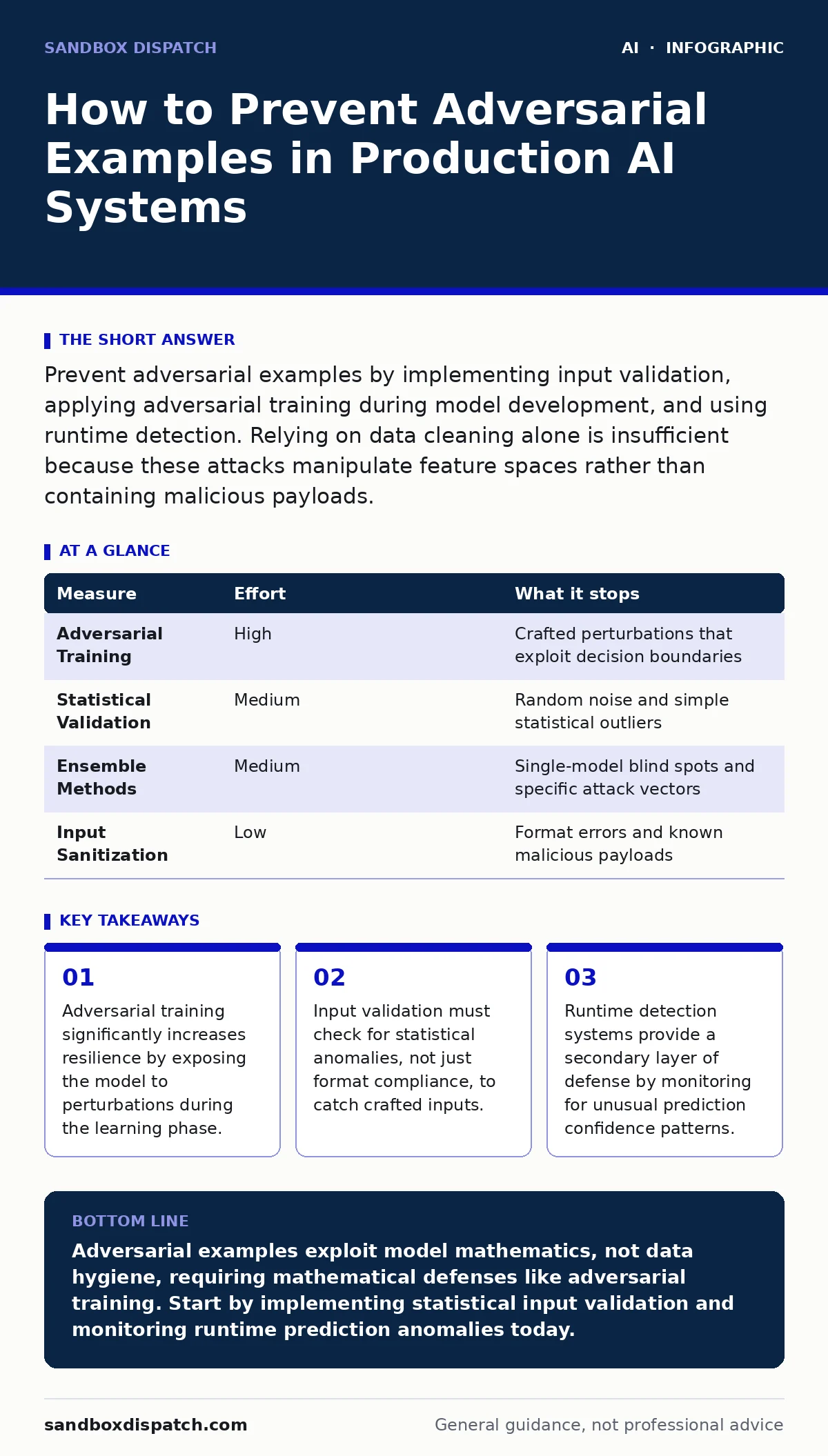
Prevent adversarial examples by implementing input validation, applying adversarial training during model development, and using runtime detection. Relying on data cleaning alone is insufficient because these attacks manipulate feature spaces rather than containing malicious payloads.
Understanding the Adversarial Threat Model
Adversarial examples are inputs crafted to deceive machine learning models into making incorrect predictions. These inputs often appear normal to human observers but contain subtle perturbations that exploit the mathematical weaknesses of the model. In a classification task, a slight change in pixel values can cause an image classifier to mislabel a stop sign as a speed limit sign. This phenomenon is not a bug in the code but a property of high-dimensional decision boundaries.
You cannot patch this vulnerability with traditional security updates. The model itself is the vulnerable component. Understanding this distinction changes how you approach defense. You are not securing a server; you are securing a mathematical function. This requires a shift from perimeter defense to internal model hardening.
The Failure of Standard Sanitization
Many teams assume that standard data sanitization prevents adversarial attacks. This assumption is dangerous. Sanitization removes known bad patterns, such as SQL injection strings or script tags. Adversarial examples do not contain recognizable malicious patterns. They are often mathematically optimized noise.
Imagine a text input that triggers a language model to ignore its safety guidelines. The input might look like coherent English to a human reader. Standard filters check for profanity or known hate speech keywords. They do not check for semantic structures designed to bypass alignment training. Consequently, the input passes sanitization and reaches the model core. The model processes it and produces an unsafe output. This gap between sanitization and model behavior is where adversarial attacks succeed.
Priority One: Adversarial Training
Adversarial training is the most effective measure for increasing model resilience. This technique involves generating adversarial examples during the training process and including them in the training dataset. The model learns to recognize and correctly classify these perturbed inputs. This forces the model to develop smoother decision boundaries that are less sensitive to small changes.
Implementing this requires a generative attack model. You use algorithms like Fast Gradient Sign Method to create worst-case inputs. You then retrain your model on both clean data and these generated adversarial examples. This process increases the computational cost of training. It may also slightly reduce performance on clean data. You must balance resilience with accuracy.
This method addresses the root cause of vulnerability. It teaches the model to be robust rather than brittle. It does not guarantee immunity. New attack methods may emerge that your training did not cover. However, it raises the bar for attackers significantly.
Priority Two: Input Validation and Anomaly Detection
Input validation serves as a first line of defense before data reaches the model. Traditional validation checks for data types and length. Adversarial-aware validation checks for statistical anomalies. You analyze the input distribution and flag inputs that deviate from the expected norm.
For image models, this might involve checking for unusual frequency components. For text models, it might involve detecting unusual token sequences or perplexity scores. High perplexity indicates that the input is statistically unlikely compared to the training data. Flagging these inputs allows you to reject them or route them to a human reviewer.
This method stops many random or poorly crafted attacks. It does not stop sophisticated attacks that mimic the training distribution. Attackers can craft inputs that look statistically normal but still trigger misclassification. Therefore, validation must work in conjunction with model hardening.
| Measure | Effort | What it stops |
|---|---|---|
| Adversarial Training | High | Crafted perturbations that exploit decision boundaries |
| Statistical Validation | Medium | Random noise and simple statistical outliers |
| Ensemble Methods | Medium | Single-model blind spots and specific attack vectors |
| Input Sanitization | Low | Format errors and known malicious payloads |
Priority Three: Ensemble and Runtime Detection
Ensemble methods combine predictions from multiple models. Different models have different vulnerabilities. An input that fools one model may not fool another. By requiring consensus among models, you reduce the probability of a successful attack. This approach adds latency and complexity. You must manage multiple models and aggregate their outputs.
Runtime detection monitors the model's behavior during inference. It tracks prediction confidence and feature activation patterns. If the model outputs a high-confidence prediction for an input that activates unusual neurons, the system flags it as suspicious. This provides a feedback loop for detection. It allows you to catch attacks that bypass input validation.
These methods provide defense in depth. They do not replace the need for robust model training. They add layers of verification that make successful attacks more difficult and noticeable.
See also: Treat AI Models as Untrusted Insiders: 6 Common Misunderstandings
What Does Not Work
Several popular measures fail to prevent adversarial examples. Data augmentation, such as rotating images or adding noise, helps with generalization but not with targeted attacks. Adversarial attacks are precise, not random. Random noise does not prepare the model for precise perturbations.
Regularization techniques like dropout or weight decay improve generalization. They do not specifically harden against adversarial inputs. These techniques reduce overfitting to training data. They do not smooth decision boundaries against targeted manipulation.
Integrating Defenses into the Lifecycle
You must integrate these defenses into your development lifecycle. Adversarial training should be a standard part of model development. Input validation should be part of the API layer. Runtime detection should be part of the monitoring stack. This integration ensures that resilience is not an afterthought.
Refer to the NIST AI Risk Management Framework for structured guidance on managing these risks. The framework provides a holistic approach to AI safety. It covers risk identification, measurement, and mitigation. Using it helps align your technical measures with broader organizational goals.
Consider AI risk management practices that extend beyond technical controls. These include policy and governance. Technical measures alone are insufficient. You need processes to review and update defenses as attack methods evolve.
Immediate Action Checklist
Start with these three actions to improve your system's resilience today.
- Implement statistical input validation to flag anomalous inputs before they reach the model.
- Review your model training pipeline to include adversarial examples in the training set.
- Set up runtime monitoring to detect unusual prediction confidence or feature activation patterns.
These steps provide immediate risk reduction. They do not require a complete model rebuild. They allow you to start hardening your systems while planning for more extensive changes.
Key takeaways
- Adversarial training significantly increases resilience by exposing the model to perturbations during the learning phase.
- Input validation must check for statistical anomalies, not just format compliance, to catch crafted inputs.
- Runtime detection systems provide a secondary layer of defense by monitoring for unusual prediction confidence patterns.
Adversarial examples exploit model mathematics, not data hygiene, requiring mathematical defenses like adversarial training. Start by implementing statistical input validation and monitoring runtime prediction anomalies today.
Frequently asked questions
Can I stop adversarial attacks with better data cleaning?
No, data cleaning removes known bad patterns, but adversarial examples are mathematically crafted to look like clean data to standard filters.
Does adversarial training make the model slower?
Adversarial training increases training time and computational cost, but it does not necessarily slow down inference speed unless you use complex detection methods.
How do I know if my model is vulnerable?
You can test your model with automated attack libraries that generate adversarial examples to measure its resilience against targeted perturbations.
Is ensemble learning enough to prevent all attacks?
No, ensemble learning reduces the success rate of attacks but does not guarantee immunity, as sophisticated attackers can target all models in the ensemble.
How this guide was produced: written by the Sandbox Dispatch editorial team with AI assistance, checked against the public references listed below, and reviewed when the facts change. See our editorial policy or report an error.