Open-Source or Closed AI Models: How to choose your weights
Selecting model weights changes your infrastructure liability forever, trading upfront licensing simplicity for silent operational debt.

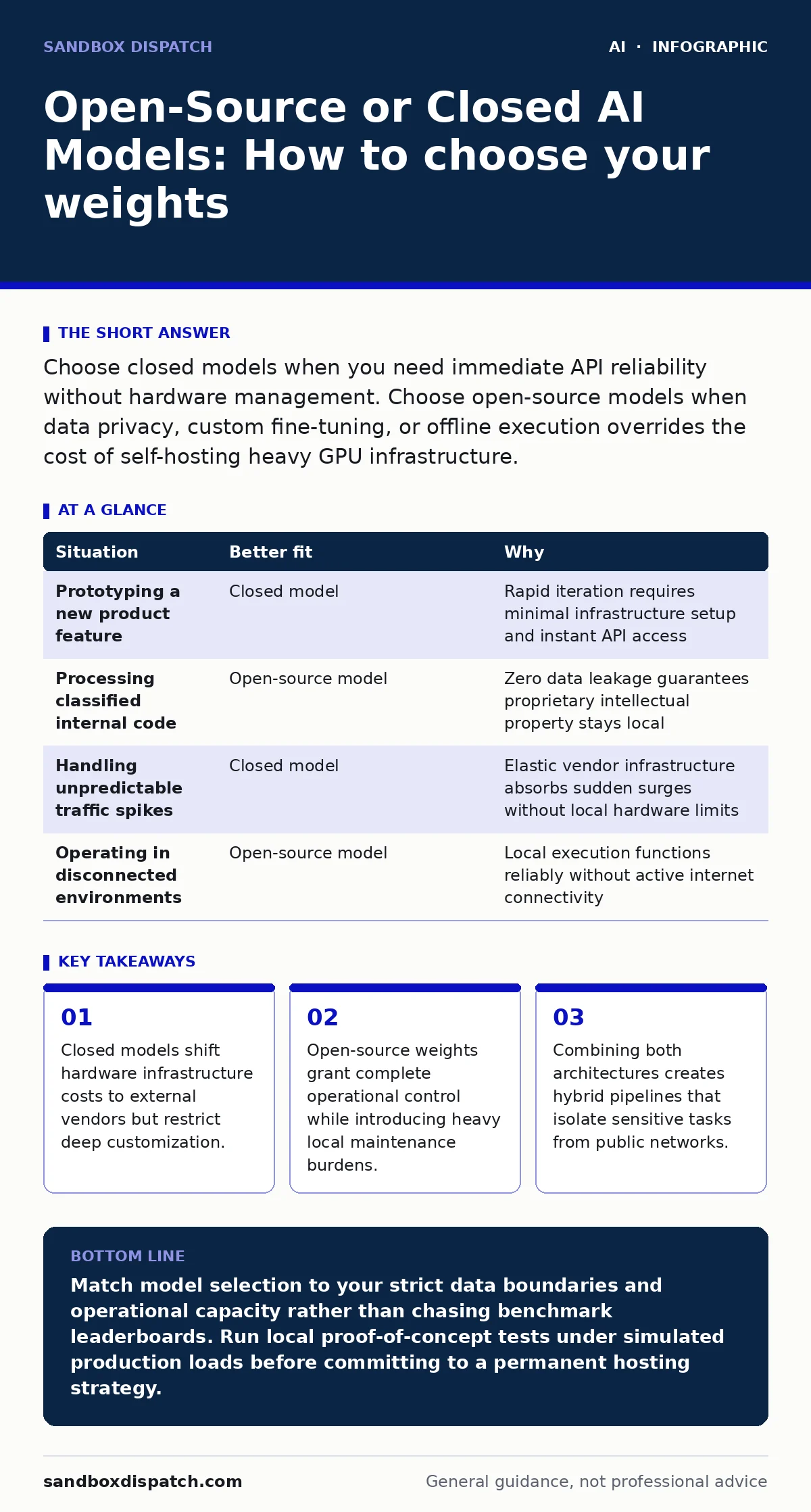
Choose closed models when you need immediate API reliability without hardware management. Choose open-source models when data privacy, custom fine-tuning, or offline execution overrides the cost of self-hosting heavy GPU infrastructure.
Can your data leave your local infrastructure boundary?
Data residency requirements dictate whether you can transmit inputs to external application programming interfaces, which are software endpoints that accept requests and return responses. Closed models hosted by third-party providers process your text on remote servers, creating compliance exposures for regulated industries handling healthcare records or financial transactions. Open-source models downloaded to your own servers keep every byte inside your perimeter, satisfying strict regulatory mandates.
Local execution introduces hidden operational costs that catch engineering teams off guard. Managing graphics processing unit clusters requires specialized DevOps skills, constant driver updates, and expensive hardware procurement cycles. Closed models handle this infrastructure overhead automatically, trading raw data sovereignty for operational simplicity. You must weigh the expense of maintaining local inference servers against the legal risk of sending proprietary codebases to external vendor endpoints.
Do you need domain-specific behavioral alignment?
Model weights represent the numerical parameters adjusted during training that determine how inputs transform into outputs. Closed models provide fixed behavior through vendor-managed fine-tuning interfaces, limiting how deeply you can alter core responses. Open-source weights allow complete parameter access, enabling aggressive fine-tuning on proprietary internal documentation or legacy programming languages.
Unrestricted weight access creates unexpected failure modes during fine-tuning, such as catastrophic forgetting where the system discards general reasoning capabilities while learning narrow tasks. Vendor-hosted models prevent this degradation by enforcing rigid guardrails during their own proprietary training runs. Modifying open-source models demands rigorous evaluation suites to catch regressions before deployment into production environments.
What is your total cost of ownership at scale?
Token volume pricing makes closed models expensive for high-throughput applications processing millions of daily requests. Open-source models require large initial capital investments in hardware, but their marginal cost per token drops significantly once infrastructure utilization hits optimal capacity. High-volume systems often achieve a lower cost per inference using self-hosted weights despite the upfront capital expenditure.
Hidden scaling bottlenecks emerge when self-hosted models experience traffic spikes that exceed local compute capacity. Cloud-based APIs handle elastic demand automatically by spinning up additional remote instances behind load balancers. Local deployments require complex auto-scaling groups and queue management systems to prevent dropped requests during traffic surges.
When to deploy open-source versus closed models
| Situation | Better fit | Why |
|---|---|---|
| Prototyping a new product feature | Closed model | Rapid iteration requires minimal infrastructure setup and instant API access |
| Processing classified internal code | Open-source model | Zero data leakage guarantees proprietary intellectual property stays local |
| Handling unpredictable traffic spikes | Closed model | Elastic vendor infrastructure absorbs sudden surges without local hardware limits |
| Operating in disconnected environments | Open-source model | Local execution functions reliably without active internet connectivity |
See also: AI-assisted threat detection: how pattern matching catches subtle attacks · EU AI Act Watermarking: How to Mark AI Content Correctly
How to combine both model types in production
Hybrid architectures route mundane classification tasks to fast open-source models while dispatching complex reasoning tasks to frontier closed systems. This layered approach optimizes both latency and operational expenditure by matching the task complexity to the appropriate model capability. Routing logic must evaluate input sensitivity and token length dynamically before selecting the target endpoint.
Combining architectures introduces integration friction and complex error-handling requirements across different API schemas. Different models tokenize text using distinct vocabularies, meaning context windows and cost calculations vary wildly between internal and external endpoints. Documenting these discrepancies prevents subtle bugs from creeping into multi-model orchestration pipelines.
Integrating multiple systems also complicates compliance audits regarding AI bias, as tracking data lineage across disparate vendor boundaries requires rigorous logging infrastructure. Maintaining consistent output quality across mixed model tiers demands unified evaluation benchmarks that test both local and remote endpoints against identical test cases.
Operational resilience improves when you maintain a fallback provider to handle outages gracefully during primary API downtime. If your primary closed model encounters an unhandled exception, your system can temporarily failover to a smaller self-hosted model running locally. This redundancy protects your application uptime against unexpected third-party service disruptions.
Key takeaways
- Closed models shift hardware infrastructure costs to external vendors but restrict deep customization.
- Open-source weights grant complete operational control while introducing heavy local maintenance burdens.
- Combining both architectures creates hybrid pipelines that isolate sensitive tasks from public networks.
Match model selection to your strict data boundaries and operational capacity rather than chasing benchmark leaderboards. Run local proof-of-concept tests under simulated production loads before committing to a permanent hosting strategy.
Frequently asked questions
Can open-source models match the reasoning performance of closed frontier models?
Smaller open-source models often lag behind massive closed systems on complex reasoning tasks, but domain-specific fine-tuning can bridge this gap for narrow use cases.
How do I secure proprietary weights running on local servers?
Protect local weights using encrypted storage volumes, strict network segmentation, and role-based access control policies to prevent unauthorized exfiltration.
What hardware is required to run modern open-source models locally?
Running modern open-source models efficiently requires enterprise-grade graphics processing units with substantial video memory to handle large context windows.
Are open-source models truly free from copyright and licensing restrictions?
Many open-source models carry permissive licenses, but some restrict commercial usage or mandate specific attribution requirements depending on the creators' terms.
How this guide was produced: written by the Sandbox Dispatch editorial team with AI assistance, checked against the public references listed below, and reviewed when the facts change. See our editorial policy or report an error.