AI-assisted threat detection: how pattern matching catches subtle attacks
Artificial intelligence spots digital intruders by learning normal behavior rather than memorizing known malicious signatures.

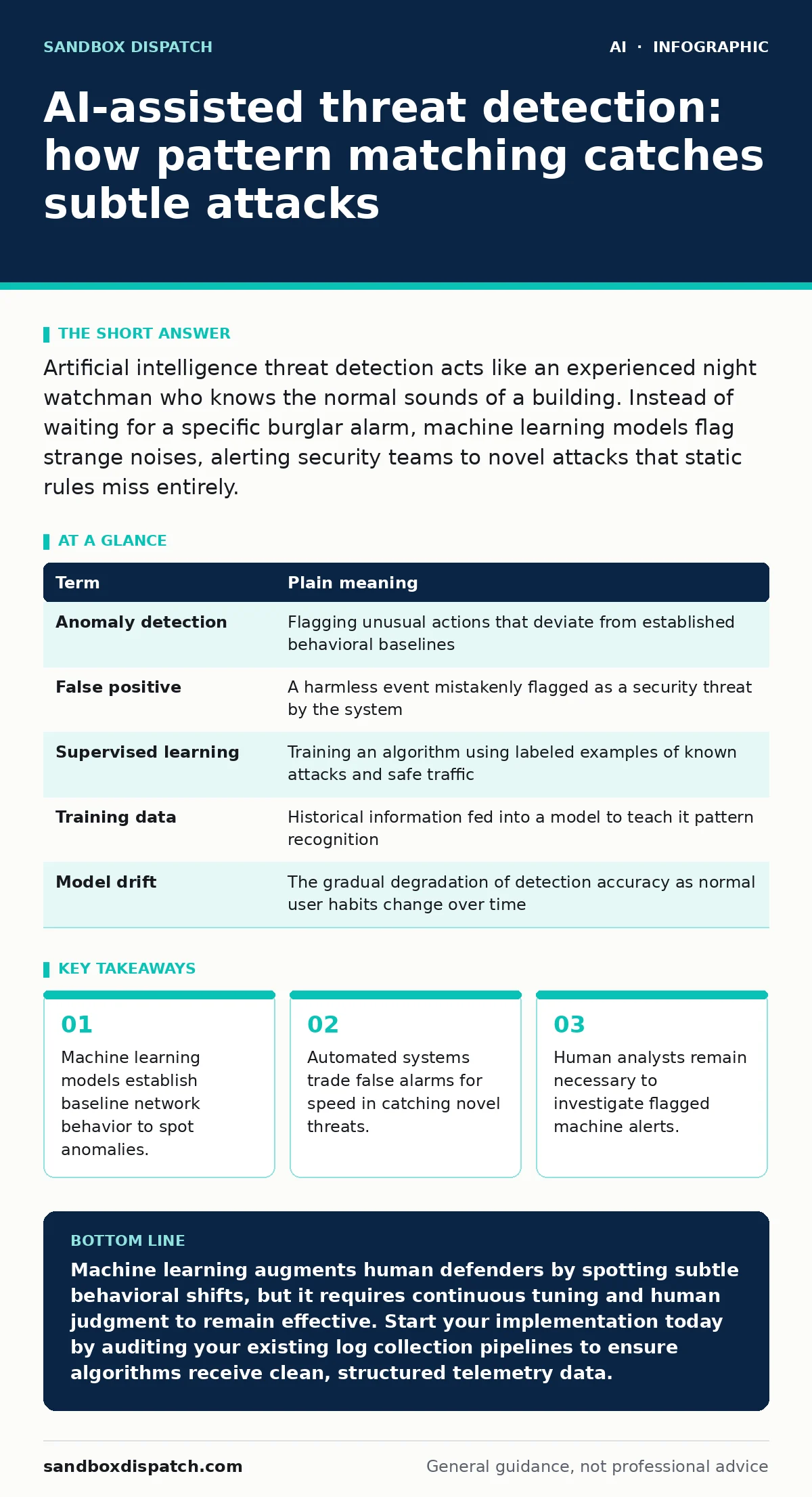
Artificial intelligence threat detection acts like an experienced night watchman who knows the normal sounds of a building. Instead of waiting for a specific burglar alarm, machine learning models flag strange noises, alerting security teams to novel attacks that static rules miss entirely.
How AI threat detection works like a night watchman
Artificial intelligence threat detection operates like an observant night watchman patrolling a sprawling corporate campus. Instead of memorizing the face of every known criminal, this guard learns the normal rhythms of the buildings over months of quiet shifts. When someone rattles a door handle at 3 AM in a rarely visited hallway, the guard investigates immediately.
Machine learning algorithms process massive streams of telemetry data from servers, network switches, and endpoint devices. These models build statistical baselines of everyday operations, tracking typical login times, usual data transfer volumes, and standard application interactions. Deviations from these established baselines trigger alerts, revealing novel attack techniques that lack predefined signatures.
Key terms in machine learning security
| Term | Plain meaning |
|---|---|
| Anomaly detection | Flagging unusual actions that deviate from established behavioral baselines |
| False positive | A harmless event mistakenly flagged as a security threat by the system |
| Supervised learning | Training an algorithm using labeled examples of known attacks and safe traffic |
| Training data | Historical information fed into a model to teach it pattern recognition |
| Model drift | The gradual degradation of detection accuracy as normal user habits change over time |
The hidden cost of automated behavioral analysis
Automated behavioral analysis introduces a heavy operational tax known as alert fatigue. Security analysts drowning in thousands of daily false positives often miss genuine incursions buried beneath mountains of noise. Tuning these systems requires constant calibration, demanding skilled engineers who spend hours adjusting sensitivity thresholds rather than stopping actual intruders.
Attackers also exploit the blind spots of statistical models through slow, low-volume data exfiltration. By mimicking the gradual data consumption habits of a legitimate researcher, a malicious actor slips past anomaly detectors designed to spot sudden, massive traffic spikes.
When statistical models fail completely
Static signature filters fail against polymorphic malware, but machine learning models suffer from poisoning vulnerabilities. Clever adversaries feed manipulated training data into the pipeline long before launching an attack, gradually teaching the algorithm that malicious commands are completely normal behavior.
Complex neural networks function as black boxes, making it notoriously difficult to explain why a specific alert fired. When an incident responder asks an algorithm why a particular process execution looks suspicious, the mathematical weights offer no intuitive rationale. This opacity complicates incident triage and regulatory compliance reporting.
Moving beyond simple signature matching
Traditional security tools rely on static rules, flagging files that match known lists of malicious hashes or IP addresses. Artificial intelligence systems expand this defensive posture by evaluating context, such as the parent process of a script or the unusual destination of an encrypted connection.
Effective defense in depth combines deterministic rules for known threats with probabilistic models for unknown behavior. This dual approach catches ordinary attacks cheaply while reserving expensive human brainpower for sophisticated intrusions that defy simple categorization. Sometimes developers explore generative AI systems, which require careful isolation to prevent unintended data exposure or lateral movement risks.
See also: Endpoint Telemetry Misconceptions That Blind Your Defenses
Your first practical step to implement monitoring
3 practical steps help you begin testing automated threat detection in a controlled environment without risking production systems.
- Export a clean week of anonymized access logs from a non-critical staging environment to establish your baseline dataset.
- Train a simple unsupervised clustering algorithm to group user login sessions by duration, frequency, and source location.
- Review the top outliers flagged by the clustering model to separate genuine anomalies from harmless administrative scripts.
Key takeaways
- Machine learning models establish baseline network behavior to spot anomalies.
- Automated systems trade false alarms for speed in catching novel threats.
- Human analysts remain necessary to investigate flagged machine alerts.
Machine learning augments human defenders by spotting subtle behavioral shifts, but it requires continuous tuning and human judgment to remain effective. Start your implementation today by auditing your existing log collection pipelines to ensure algorithms receive clean, structured telemetry data.
Frequently asked questions
Can artificial intelligence completely replace human security analysts?
Algorithms excel at processing vast quantities of telemetry data rapidly, but human judgment remains essential for investigating complex incidents and separating clever attacks from bizarre administrative workflows.
Why do machine learning models generate false positives?
Statistical models flag deviations from normal behavior, meaning legitimate but unusual business practices often trigger alerts that mimic malicious activity.
How do attackers trick behavioral detection systems?
Adversaries mimic normal user habits over extended periods, gradually shifting the baseline or poisoning training data so malicious actions appear routine.
What is the main difference between signature-based and AI detection?
Signatures look for exact matches of known threats, whereas artificial intelligence models look for statistical anomalies that might indicate novel attacks.
How this guide was produced: written by the Sandbox Dispatch editorial team with AI assistance, checked against the public references listed below, and reviewed when the facts change. See our editorial policy or report an error.