AI supply chain security: block backdoors in open weights
Pulling third-party machine learning models into your codebase introduces remote execution vectors that traditional static analysis tools miss entirely.

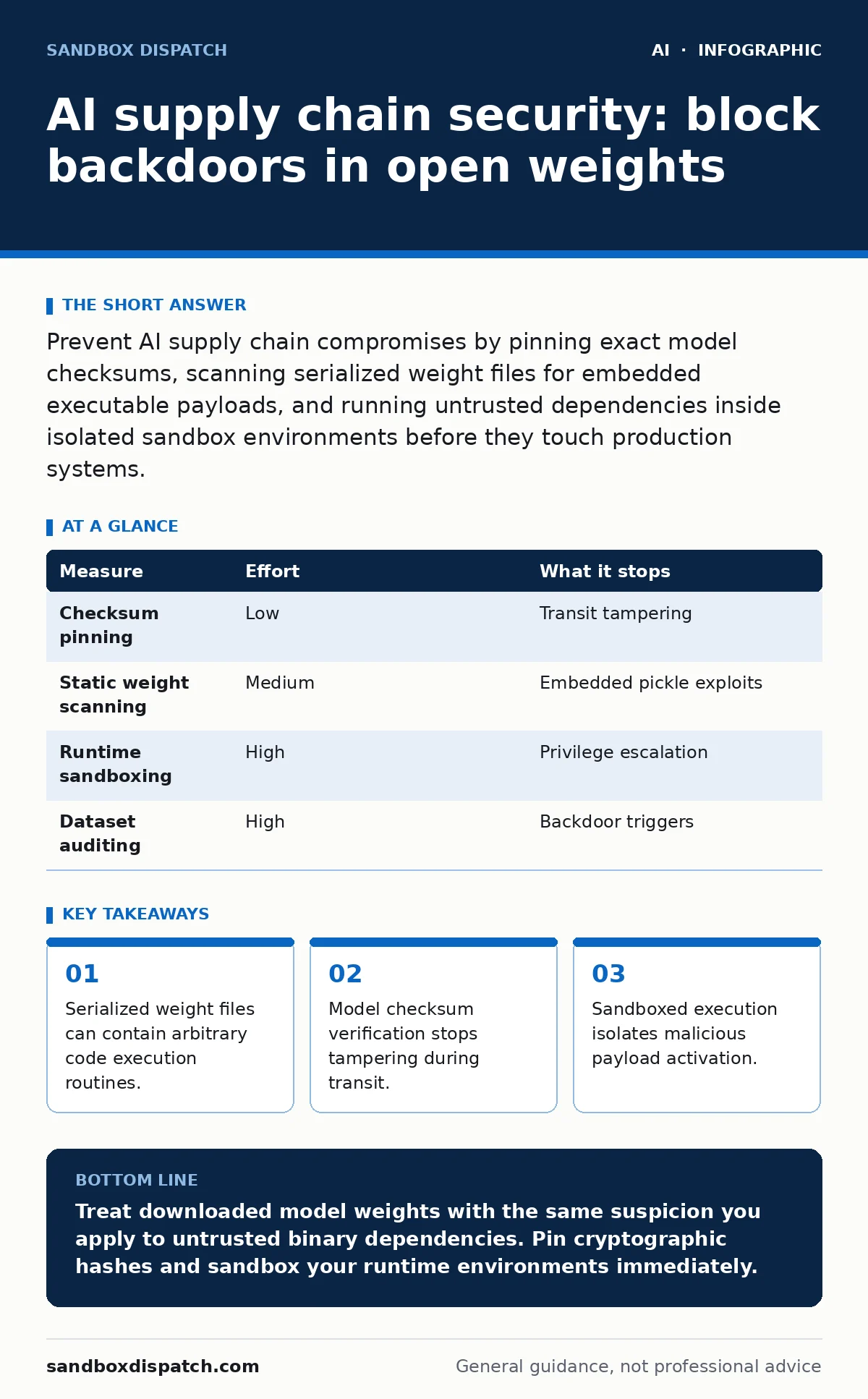
Prevent AI supply chain compromises by pinning exact model checksums, scanning serialized weight files for embedded executable payloads, and running untrusted dependencies inside isolated sandbox environments before they touch production systems.
Why check sums stop tampering
Cryptographic hashes ensure the model files you download match the original publisher's artifacts exactly. Checksum verification calculates a mathematical fingerprint of the file to prove it has not changed during transport through public registries.
Software developers frequently pull large weights from community hubs without verifying cryptographic proofs, leaving applications vulnerable to alterations. Computing a SHA-256 hash, a mathematical algorithm that produces a unique identifier for any file, takes seconds but stops silent replacements.
Malicious actors frequently compromise public repository accounts to swap clean files with modified versions that leak data or execute instructions upon loading. You must store these hashes securely inside your version control system rather than relying on mutable tag names.
How scanners detect serialized payloads
Serialized machine learning formats permit arbitrary code execution because they often store executable functions alongside numerical matrices. Model serialization translates memory structures into storable files, but popular formats frequently embed instructions that run commands when deserialized during parsing.
Scanning these files requires specialized parsers that inspect the structural layout rather than looking for text signatures. Traditional antivirus tools fail completely against these threats because the malicious logic hides safely inside valid mathematical tensor definitions.
Treating AI models as untrusted insiders helps frame your defensive posture when dealing with opaque binary weights downloaded from public repositories. Proper isolation prevents minor supply chain breaches from expanding into total system compromise during active inference phases.
Where sandboxing limits blast radius
Isolating model inference processes inside strict containment boundaries prevents systemic compromise if a weight file executes malicious instructions. Runtime sandboxing restricts system call access, network connectivity, and file system permissions for the specific process loading the weights.
Operating system virtualization or containerization limits the blast radius when an exploit triggers during weight parsing operations. Software architectures must enforce strict privilege separation so that the inference engine runs under a service account with zero access to sensitive internal networks.
Configuring these boundaries requires careful testing because overly aggressive restrictions break tensor processing libraries that require specific hardware acceleration interfaces. Balancing security containment with performance demands steady iteration and thorough integration testing across diverse environments.
What dataset provenance reveals
Poisoned training data introduces backdoor behaviors that standard vulnerability scanners cannot detect during standard code review phases. Data provenance tracking documents the exact lineage of every dataset used to fine-tune open-weight models before deployment.
Malicious contributors inject subtle visual or textual triggers into training sets, causing models to fail specifically when encountering rare input patterns. Comprehensive dataset auditing demands cryptographic provenance logs and statistical anomaly detection to identify abnormal sample distributions quickly.
Neglecting dataset hygiene often leads to catastrophic failures that mimic unexpected AI bias during production operations, masking intentional tampering as natural model drift. Maintaining strict oversight over data pipelines stops unauthorized modifications before training begins entirely.
How to prioritize prevention measures
Defensive investments yield different returns based on where they sit in your build pipeline and runtime architecture. Ranking supply chain controls helps you allocate limited engineering hours to the vulnerabilities that cause the greatest operational impact today.
Suppose an adversary targets your staging environment with a modified tensor file designed to harvest internal secrets. Evaluating these controls demands understanding that no single tool catches every possible vector of attack against complex machine learning pipelines.
| Measure | Effort | What it stops |
|---|---|---|
| Checksum pinning | Low | Transit tampering |
| Static weight scanning | Medium | Embedded pickle exploits |
| Runtime sandboxing | High | Privilege escalation |
| Dataset auditing | High | Backdoor triggers |
See also: Open-Source or Closed AI Models: How to choose your weights
What daily checks keep pipelines secure
Actionable routines maintain your security posture against evolving supply chain tactics over extended operational periods without exception. 3 practical checks keep your pipelines secure without grinding feature development to a complete halt across engineering teams.
- Pin exact cryptographic hashes for every downloaded weight file in your configuration manifests.
- Run specialized weight parsers to detect embedded execution instructions before loading files into memory.
- Deploy restricted container boundaries around inference endpoints to limit potential compromise impact.
Operational discipline matters more than complex tooling when defending against remote adversaries targeting modern application dependencies. Integrating these steps alongside your existing practices for sensitive data leaks through AI chatbots ensures a resilient application architecture.
Key takeaways
- Serialized weight files can contain arbitrary code execution routines.
- Model checksum verification stops tampering during transit.
- Sandboxed execution isolates malicious payload activation.
Treat downloaded model weights with the same suspicion you apply to untrusted binary dependencies. Pin cryptographic hashes and sandbox your runtime environments immediately.
Frequently asked questions
Can standard package managers handle AI model dependencies safely?
Standard package managers lack the ability to inspect binary tensor weights for embedded execution scripts. You must use specialized tools designed to parse machine learning formats safely.
Why do traditional security scanners miss backdoors in model files?
Traditional scanners look for known malicious text signatures rather than analyzing mathematical tensor structures. Malicious code inside model files usually masquerades as standard matrix initialization data.
How often should development teams audit their model training pipelines?
Teams should audit data provenance and training logs continuously during the model fine-tuning process. Automated checks must run every time a new dataset enters the staging environment.
What happens if an inference container lacks proper privilege separation?
An exploited model file can execute arbitrary commands with the privileges of the parent application process. This failure allows attackers to pivot directly into internal network segments.
How this guide was produced: written by the Sandbox Dispatch editorial team with AI assistance, checked against the public references listed below, and reviewed when the facts change. See our editorial policy or report an error.