What Is Cyber Threat Intelligence: Definition and Practical Use
Cyber threat intelligence transforms raw data into context, allowing defenders to predict attacker moves rather than just reacting to alarms after damage occurs.
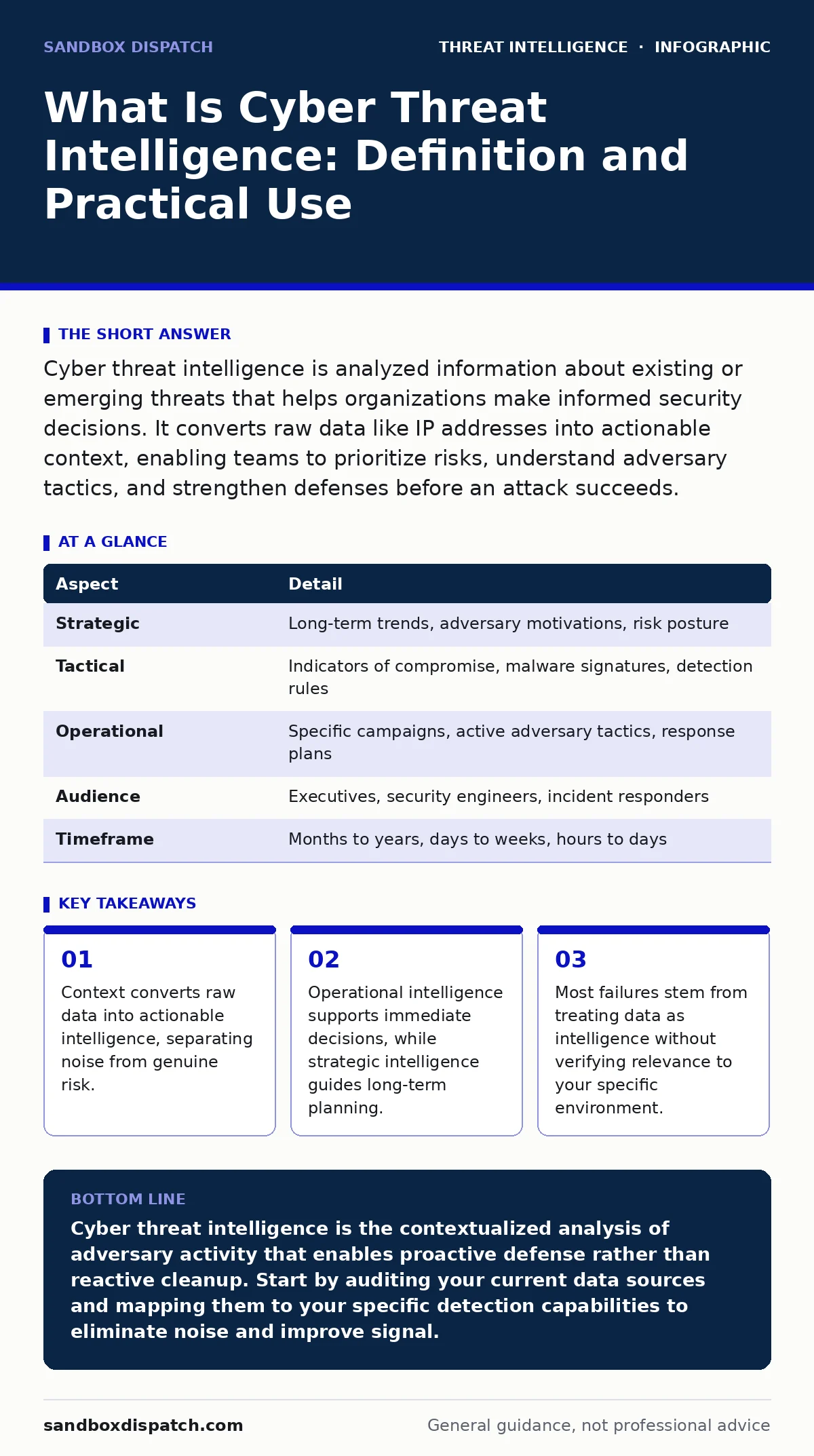
Cyber threat intelligence is analyzed information about existing or emerging threats that helps organizations make informed security decisions. It converts raw data like IP addresses into actionable context, enabling teams to prioritize risks, understand adversary tactics, and strengthen defenses before an attack succeeds.
From Raw Data to Actionable Context
Imagine a weather service. Raw data consists of temperature readings, barometric pressure, and wind speed collected from sensors. Intelligence is the forecast that tells you whether to carry an umbrella or cancel a flight. In cybersecurity, raw data includes logs, network packets, and file hashes. Intelligence is the analyzed information that tells you whether a specific IP address is part of a coordinated attack targeting your industry.
The term cyber threat intelligence, often abbreviated as CTI, refers to evidence-based information about existing or emerging threats. This information helps you understand the context, mechanisms, and potential impact of those threats. It is not the data itself. It is the processed, analyzed, and curated output that supports decision-making.
Without this processing, you face an overwhelming volume of alerts. With it, you can distinguish between a false positive and a targeted intrusion attempt. The value lies in the reduction of uncertainty. You move from knowing something happened to understanding why it happened and what to do next.
The Three Layers of Intelligence
Intelligence operates at three distinct levels, each serving a different function within an organization. Strategic intelligence provides high-level insights for leadership. It covers trends, adversary motivations, and long-term risk assessment. This layer helps executives allocate budget and understand the broader risk environment.
Tactical intelligence focuses on the methods and tools used by adversaries. It includes indicators of compromise, such as malicious file hashes or domain names. This layer supports the security operations center in updating detection rules and blocking known bad actors. It bridges the gap between strategy and execution.
Operational intelligence deals with specific campaigns and adversary tradecraft. It details the tactics, techniques, and procedures used in active attacks. This layer helps incident responders understand the scope of a breach and the attacker’s objectives. It is the most time-sensitive layer, requiring rapid dissemination to contain active threats.
| Aspect | Detail |
|---|---|
| Strategic | Long-term trends, adversary motivations, risk posture |
| Tactical | Indicators of compromise, malware signatures, detection rules |
| Operational | Specific campaigns, active adversary tactics, response plans |
| Audience | Executives, security engineers, incident responders |
| Timeframe | Months to years, days to weeks, hours to days |
The Collection and Analysis Cycle
The process begins with collection. You gather raw data from open sources, closed sources, and your own network telemetry. Open sources include public forums, technical blogs, and government advisories. Closed sources involve paid feeds and private information sharing groups. Internal telemetry comes from your own logs and endpoint detection systems.
Collection is only the first step. The next phase is processing. You normalize the data, remove duplicates, and structure it for analysis. This step is critical because raw data is often messy and inconsistent. Standardizing formats allows automated tools to ingest the information efficiently.
Analysis transforms processed data into intelligence. Analysts correlate new data with existing knowledge. They identify patterns and link disparate pieces of information. This step requires human judgment to determine relevance. An IP address might be malicious in one context but benign in another. Context is the differentiator.
Finally, dissemination delivers the intelligence to the right people. A strategic report goes to leadership. A tactical indicator goes to the firewall. An operational alert goes to the responder. Timing and format matter. The wrong audience receiving the wrong format leads to ignored warnings or alert fatigue.
Day-to-Day Application in Security Operations
In practice, intelligence drives daily security tasks. Security engineers use tactical intelligence to update intrusion prevention systems. They block known malicious domains and filter out traffic from hostile IP ranges. This reduces the volume of alerts that reach the human analyst.
Incident responders use operational intelligence to investigate breaches. When a host shows signs of compromise, they check threat intelligence platforms for related indicators. This helps them determine if the activity is part of a larger campaign. It also reveals the attacker’s likely next steps.
Imagine a scenario where a server begins communicating with a new external domain. Without intelligence, this might look like normal user activity. With intelligence, you discover the domain is associated with a known command-and-control server. You can then isolate the host and investigate further, rather than dismissing the alert.
This application extends to proactive hunting. Teams use intelligence to search for signs of compromise that have not yet triggered alerts. They look for subtle behaviors that match known adversary tactics. This shifts the defense from reactive to proactive. You find the attacker before they exfiltrate data.
Common Misconceptions and Pitfalls
Many organizations mistake data for intelligence. Having a list of malicious IP addresses is not intelligence. It is data. Intelligence requires analysis, context, and relevance. Without these elements, the data is just noise. It consumes storage and processing power without providing value.
Another common error is assuming all intelligence applies to your environment. Generic threat feeds often contain indicators that are irrelevant to your specific industry or technology stack. Consuming too much irrelevant data leads to alert fatigue. Analysts become desensitized to warnings, missing genuine threats amidst the clutter.
Some teams also fail to validate the source of their intelligence. Unverified information can lead to false positives. Blocking a legitimate service because of bad intelligence disrupts business operations. Always verify indicators before action. Cross-reference multiple sources to confirm validity.
See also: Memory Forensics: Extracting Hidden Malware from RAM
Integrating Intelligence into Defense Strategies
Effective integration requires aligning intelligence with your detection capabilities. You must map adversary tactics to your monitoring controls. If you do not monitor for a specific behavior, you cannot detect it, regardless of how much intelligence you have. This is where frameworks like the Pyramid of Pain become useful. They help you understand which indicators are harder for attackers to change, guiding your detection efforts.
For instance, detecting file hashes is easy but low-value. Attackers can change hashes with minimal effort. Detecting attacker infrastructure, such as command-and-control servers, is more valuable. It disrupts their operations. Understanding this hierarchy helps you prioritize your defensive measures.
You should also consider how attackers gather information about you. Attacker reconnaissance often involves scanning for publicly exposed services or misconfigured assets. By reducing your digital footprint, you limit the data available to adversaries. This defensive posture complements your intelligence efforts.
Consider the risks of internal credential abuse. Techniques like pass-the-ticket attacks or AS-REP roasting allow adversaries to move laterally within a network. Intelligence about these specific tactics helps you configure monitoring to detect anomalous authentication patterns. You cannot defend against what you do not understand.
The Human Element in Analysis
Technology supports intelligence, but humans drive it. Automated tools can collect and process data at scale. However, they lack the nuance to understand context. Human analysts identify patterns that machines might miss. They connect dots across different data sources.
This human element introduces challenges. Analyst burnout is a real risk. The volume of data is immense, and the pressure to respond is high. Organizations must invest in training and tooling to support their teams. Good tooling reduces manual effort, allowing analysts to focus on high-value analysis.
Collaboration is also key. Intelligence is more effective when shared. Participating in information sharing groups allows you to benefit from the collective knowledge of the community. It also allows you to contribute your own findings, strengthening the overall defense.
However, sharing requires caution. You must protect sensitive information about your own infrastructure. Anonymizing data before sharing ensures you do not inadvertently reveal vulnerabilities to potential attackers. Balance openness with security.
Key takeaways
- Context converts raw data into actionable intelligence, separating noise from genuine risk.
- Operational intelligence supports immediate decisions, while strategic intelligence guides long-term planning.
- Most failures stem from treating data as intelligence without verifying relevance to your specific environment.
Cyber threat intelligence is the contextualized analysis of adversary activity that enables proactive defense rather than reactive cleanup. Start by auditing your current data sources and mapping them to your specific detection capabilities to eliminate noise and improve signal.
Frequently asked questions
How is threat intelligence different from threat data?
Threat data is raw facts like IP addresses or file hashes. Threat intelligence is the analyzed, contextualized information derived from that data, explaining the relevance and impact of the threat to your organization.
Do I need a dedicated team for threat intelligence?
Not necessarily. Small organizations can leverage automated tools and curated feeds. Larger organizations often benefit from dedicated analysts who can provide deep, contextual analysis and tailor intelligence to specific business needs.
How quickly does threat intelligence become outdated?
Tactical indicators like IP addresses can become obsolete in days or weeks as attackers rotate infrastructure. Strategic insights last longer but still require regular updates to reflect evolving adversary motivations and global trends.
Can threat intelligence prevent all attacks?
No measure can prevent all attacks. Threat intelligence reduces risk by enabling earlier detection and better response. It helps you block known threats and understand new tactics, but it does not eliminate the possibility of novel or targeted attacks.
How this guide was produced: written by the Sandbox Dispatch editorial team with AI assistance, checked against the public references listed below, and reviewed when the facts change. See our editorial policy or report an error.