How Threat Intelligence Programs Work and Where They Fail
Threat intelligence fails when teams collect raw data instead of analyzing attacker behavior, turning expensive tools into storage bins for useless noise.

A threat intelligence program transforms raw data into actionable context. It requires collection, processing, analysis, and dissemination. Most programs fail because they automate collection without human analysis, creating noise that hides real attacks. Success depends on aligning intelligence with specific defensive actions.
The Intelligence Cycle Foundation
Threat intelligence is not a product you buy. It is a continuous process that converts raw data into decisions. You do not start with a dashboard. You start with a question about what your adversaries might do. The cycle consists of planning, collection, processing, analysis, dissemination, and feedback. Each stage feeds the next. Breaking the chain at any point renders the previous efforts useless.
Many organizations treat intelligence as a static repository. This approach fails because adversary behavior changes. You must treat the program as a living mechanism. The goal is not to know everything. The goal is to know enough to stop the attacks that matter to you.
Planning Requirements and Priorities
The cycle begins with planning. You define what you need to know before you collect anything. This prevents data overload. If you do not define the scope, you will gather irrelevant information. Ask who the consumers are. Is the audience a network administrator or an executive? The answer changes the format and depth of the intelligence.
You must identify the specific threats that pose the greatest risk. Not all adversaries target you. Focus on those who have the capability and motivation. This step requires honest assessment of your own defenses. If you cannot detect a specific technique, intelligence about it is less useful. Align your questions with your detection capabilities.
Collection Mechanisms
Collection gathers raw data from various sources. These sources include open-source data, commercial feeds, dark web monitoring, and internal logs. Open-source data is free but noisy. Commercial feeds offer curation but cost money. Internal logs provide context about your specific environment.
You must balance breadth and depth. Collecting too much data overwhelms your processing stage. Collecting too little leaves blind spots. Automation helps here. Scripts can pull data from multiple APIs simultaneously. However, automation cannot determine relevance. You still need to filter out noise.
The quality of your intelligence depends on the quality of your sources. A source that provides high-fidelity data is better than one that provides volume. Verify your sources regularly. Sources change hands, change quality, or stop updating. A stale source is worse than no source.
Processing and Normalization
Raw data is unusable for analysis. Processing converts raw data into a standard format. This step involves cleaning, deduplication, and enrichment. You remove duplicate entries. You convert timestamps to a single format. You enrich indicators with contextual data.
Normalization is critical. Different sources use different formats for IP addresses, domains, and hashes. You must map these to a common schema. Without normalization, your tools cannot correlate events. This stage is mechanical but vital. It prepares the data for human or machine analysis.
Automation handles most of this work. But you must monitor the process. If the normalization rules are wrong, the data becomes corrupted. A corrupted dataset leads to incorrect conclusions. You must validate the output of the processing stage. Check for missing fields or malformed records.
Analysis and Contextualization
Analysis is the heart of the program. Analysts examine processed data to find patterns. They determine if an indicator is malicious. They assess the intent behind the activity. They link indicators to specific adversary groups. This step requires human judgment.
Context is key. An IP address alone tells you little. An IP address linked to a known campaign tells you more. You must consider the broader context. Is this part of a larger trend? Is it targeting a specific sector? Analysis answers these questions.
The Pyramid of Pain framework helps here. It suggests that focusing on tactics and techniques is more effective than focusing on indicators. Indicators change easily. Tactics change slowly. By analyzing tactics, you create defenses that last longer. This approach reduces the maintenance burden on your team.
See also: Incident Triage Meaning: How to Prioritize Alerts Fast
Dissemination and Integration
Analysis is useless if no one uses it. Dissemination delivers the intelligence to the right people. The format must match the consumer's needs. A network engineer needs technical details. An executive needs risk summaries. A developer needs code patterns.
Integration is the technical side of dissemination. You push indicators into your security tools. You update firewall rules. You configure intrusion detection systems. You enrich ticketing systems. This step must be automated. Manual entry is slow and error-prone.
However, automation has risks. If your analysis is wrong, you break your systems. False positives in threat detection can cause outages. You must test integrations thoroughly. You must have a rollback plan. Never trust a single source for automated blocking.
Feedback and Iteration
The cycle ends with feedback. You measure the effectiveness of the intelligence. Did it help stop an attack? Did it reduce noise? You gather input from consumers. They tell you what was useful and what was not. This feedback informs the next planning phase.
Without feedback, the program stagnates. You continue producing intelligence that no one uses. You waste resources. You must close the loop. Ask your consumers directly. Monitor the metrics. Track how many alerts were reduced. Track how many incidents were prevented.
Iterate based on the feedback. Adjust your planning. Change your sources. Refine your analysis methods. The program must evolve as the threat environment evolves. A static program becomes obsolete quickly.
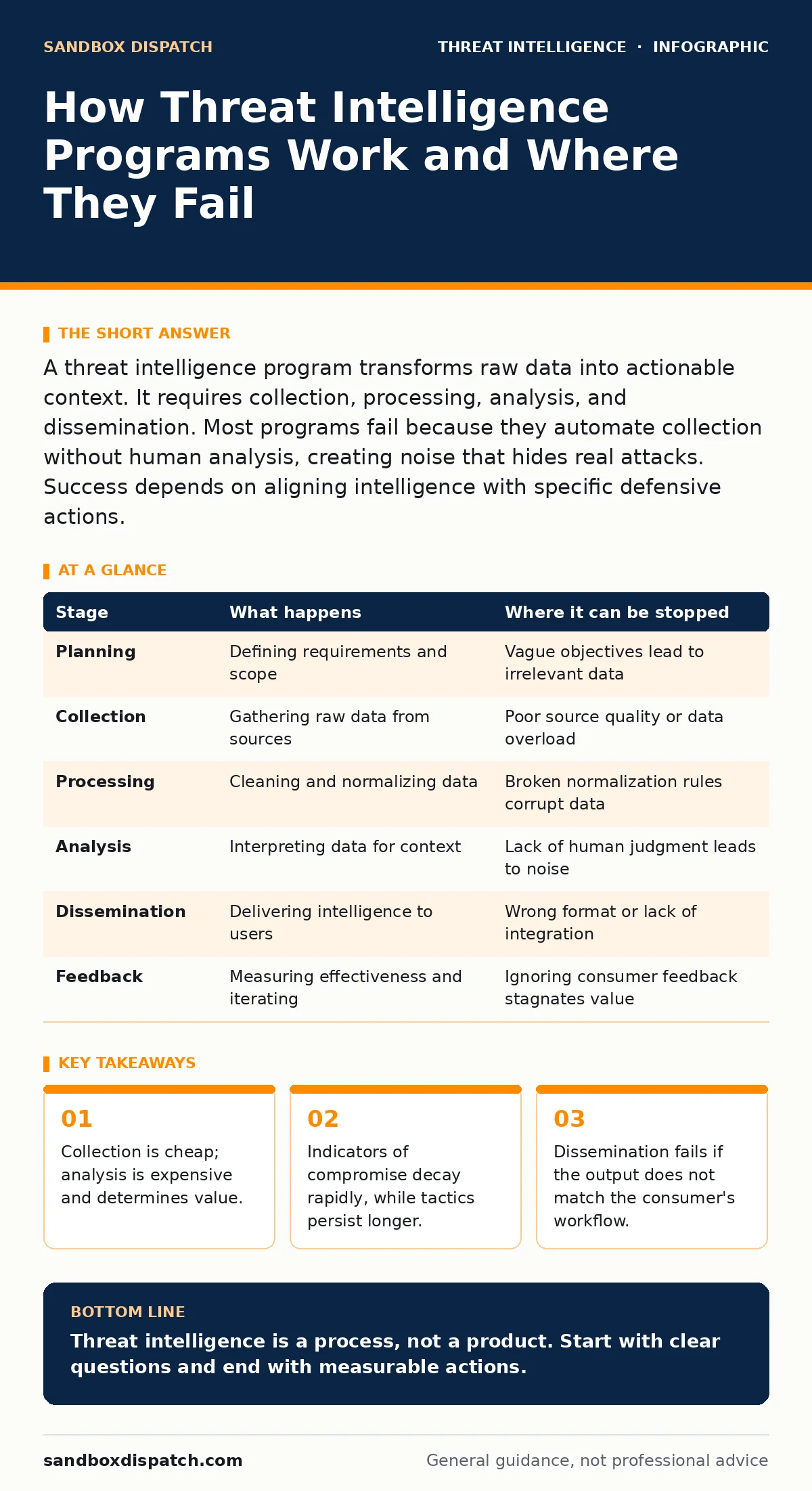
| Stage | What happens | Where it can be stopped |
|---|---|---|
| Planning | Defining requirements and scope | Vague objectives lead to irrelevant data |
| Collection | Gathering raw data from sources | Poor source quality or data overload |
| Processing | Cleaning and normalizing data | Broken normalization rules corrupt data |
| Analysis | Interpreting data for context | Lack of human judgment leads to noise |
| Dissemination | Delivering intelligence to users | Wrong format or lack of integration |
| Feedback | Measuring effectiveness and iterating | Ignoring consumer feedback stagnates value |
Limits and Hidden Costs
Threat intelligence does not stop attacks. It informs decisions. It reduces the time to detect and respond. It cannot eliminate risk. You must accept this limit.
The hidden cost is analysis time. Collecting data is cheap. Analyzing it is expensive. You need skilled analysts. These professionals are scarce. The cost of hiring and training them is high. If you outsource analysis, you lose control over context.
Another limit is relevance. Most intelligence is not relevant to you. You must filter aggressively. This filtering requires expertise. Without it, you drown in noise.
Imagine a team that collects every open-source feed available. They have terabytes of data. They have no analysts. They cannot detect a breach because they are busy managing data. This is a common failure mode. Depth matters more than breadth.
Consider how attacker reconnaissance shapes your defenses. If you understand how they scout, you can hide your assets. This is a specific application of intelligence. It is more effective than generic blocking.
Similarly, understanding techniques like AS-REP roasting helps you configure your systems correctly. Intelligence tells you the tactic. You implement the fix. This is the practical value of the program.
LSASS credential theft is another example. Intelligence reveals the prevalence. You respond by hardening memory protection. This is a direct action. It is better than just knowing the threat exists.
Pass-the-ticket attacks rely on stolen credentials. Intelligence helps you detect the movement. You respond by rotating credentials. This is a concrete outcome. It shows the program works.
Breach and attack simulation can validate your defenses. You simulate the attacks identified by intelligence. You see if you detect them. This closes the loop. It proves your program adds value.
Key takeaways
- Collection is cheap; analysis is expensive and determines value.
- Indicators of compromise decay rapidly, while tactics persist longer.
- Dissemination fails if the output does not match the consumer's workflow.
Threat intelligence is a process, not a product. Start with clear questions and end with measurable actions.
Frequently asked questions
How do I start a threat intelligence program?
Start by defining what you need to know. Identify your top risks. Collect data only for those risks. Analyze it manually first. Automate only after you understand the process.
Do I need expensive tools?
No. You need skilled people. Tools help, but they cannot replace analysis. Start with free open-source tools. Invest in people first. Buy tools only when manual processes break.
How do I measure success?
Measure reduction in detection time. Measure reduction in false positives. Ask your consumers if the intelligence helped them. If they do not use it, you are failing.
What is the biggest mistake?
Collecting too much data. It creates noise. It wastes resources. Focus on quality. Focus on relevance. Ignore the rest.
How this guide was produced: written by the Sandbox Dispatch editorial team with AI assistance, checked against the public references listed below, and reviewed when the facts change. See our editorial policy or report an error.