The Pyramid of Pain: Why Attacker Indicators Fail and How to Fix It
Most defenses track surface noise that attackers change instantly, allowing them to persist undetected while you chase false leads and waste analyst time.

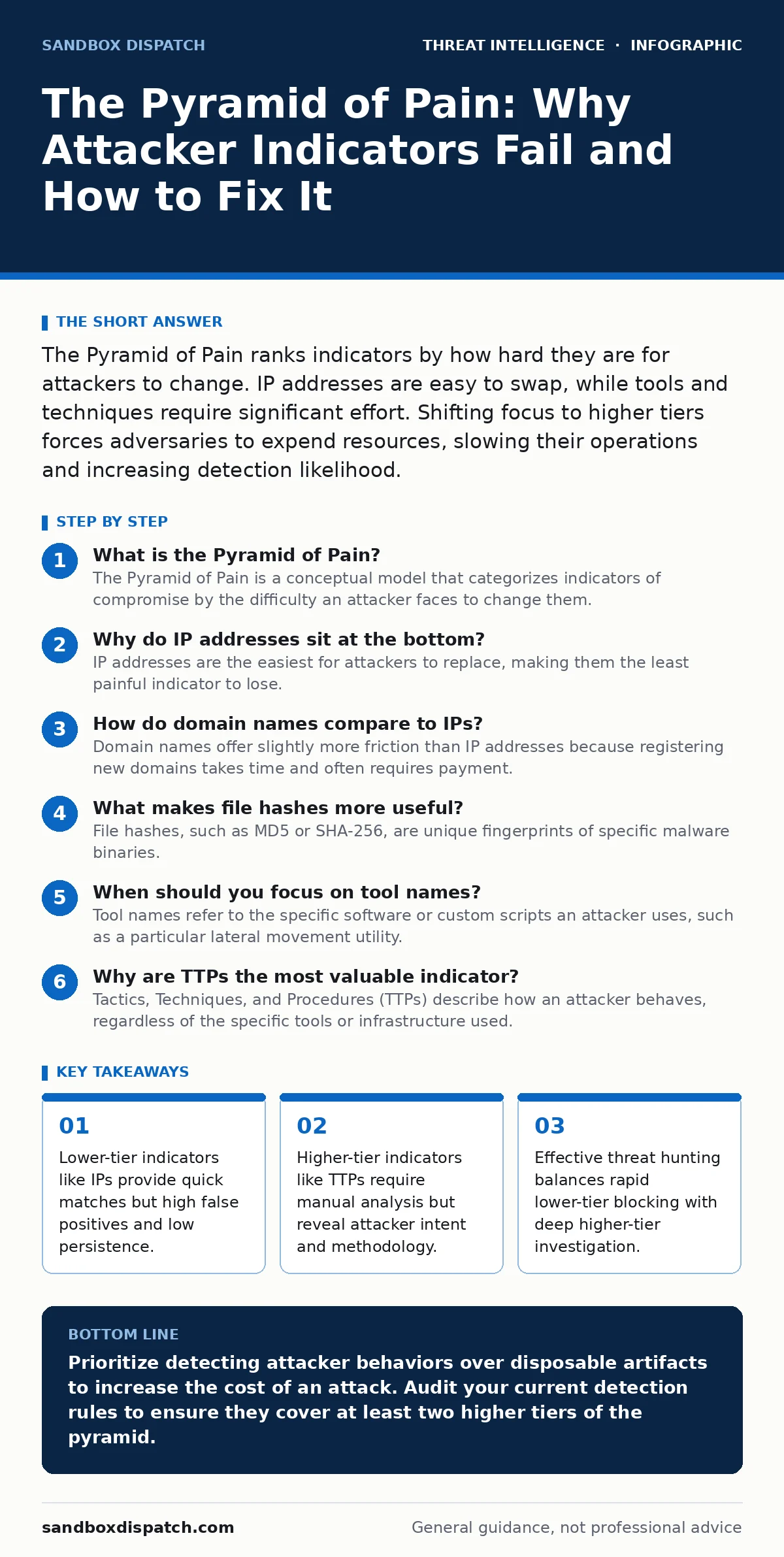
The Pyramid of Pain ranks indicators by how hard they are for attackers to change. IP addresses are easy to swap, while tools and techniques require significant effort. Shifting focus to higher tiers forces adversaries to expend resources, slowing their operations and increasing detection likelihood.
What is the Pyramid of Pain?
The Pyramid of Pain is a conceptual model that categorizes indicators of compromise by the difficulty an attacker faces to change them. Daniel Cid introduced this framework to help security teams understand that not all data carries equal weight in disrupting adversary operations. The pyramid has five levels, ranging from easily disposable artifacts at the base to complex behaviors at the apex. Using this model helps you prioritize which signals deserve your limited investigative resources.
Why do IP addresses sit at the bottom?
IP addresses are the easiest for attackers to replace, making them the least painful indicator to lose. An adversary can rotate through thousands of residential or cloud-hosted IPs in seconds using botnets or compromised infrastructure. Blocking a specific IP often stops nothing because the next request comes from a different address. This volatility means IP-based blocking provides a false sense of security while consuming significant network logs.
How do domain names compare to IPs?
Domain names offer slightly more friction than IP addresses because registering new domains takes time and often requires payment. However, attackers frequently use fast-flux DNS or disposable registrars to churn through names rapidly. While a domain name provides more context than an IP, it is still a low-hanging fruit for evasion. You might see a spike in alerts for a new domain, but the underlying threat remains unchanged.
What makes file hashes more useful?
File hashes, such as MD5 or SHA-256, are unique fingerprints of specific malware binaries. These are harder to change because the attacker must recompile or modify the malicious code, which risks breaking functionality. However, simple packing or obfuscation changes the hash entirely, rendering previous intelligence useless. Hashes are effective for detecting known malware variants but fail against customized or polymorphic threats.
When should you focus on tool names?
Tool names refer to the specific software or custom scripts an attacker uses, such as a particular lateral movement utility. Tracking these requires deeper endpoint visibility and often behavioral analysis rather than simple signature matching. Attackers may rename their tools, but the underlying functionality and communication patterns often remain consistent. Identifying these tools helps you understand the specific capabilities the adversary brings to your environment.
See also: Memory Forensics: Extracting Hidden Malware from RAM
Why are TTPs the most valuable indicator?
Tactics, Techniques, and Procedures (TTPs) describe how an attacker behaves, regardless of the specific tools or infrastructure used. Changing TTPs requires the attacker to develop new methods, train personnel, and potentially abandon successful strategies. This represents the highest pain point because it forces a fundamental shift in their operational model. Focusing on TTPs allows you to detect novel attacks that use unknown tools but familiar behaviors.
| Tier | Indicator Type | Attacker Effort to Change | Defender Value |
|---|---|---|---|
| 1 | IP Addresses | Trivial | Low, high noise |
| 2 | Domain Names | Low | Moderate, context |
| 3 | File Hashes | Medium | High, specific |
| 4 | Tool Names | High | Very High, capability |
| 5 | TTPs | Extreme | Highest, intent |
How does this affect threat intelligence sharing?
Sharing lower-tier indicators like IPs often leads to alert fatigue and wasted resources across the community. When you share TTPs, you enable other organizations to detect similar behaviors even if the infrastructure differs. This collaborative approach raises the overall cost of attack for adversaries who must constantly reinvent their methods. Effective threat intelligence program integration relies on translating raw data into actionable behavioral insights.
Can automation help with higher tiers?
Automation excels at processing lower-tier indicators but struggles with the nuance required for TTP analysis. SOAR platforms can block IPs or hashes instantly, but identifying complex behavioral patterns requires human judgment or advanced machine learning. You can use automation to triage alerts, but the final correlation of TTPs often needs expert review. Relying solely on automation for high-tier detection creates blind spots in your defense.
What is the hidden cost of ignoring the top?
Ignoring TTPs means you are reacting to symptoms rather than the disease. Attackers who know you only watch IPs will simply rotate them, while their core methodology remains undetected. This allows them to conduct attacker reconnaissance and prepare for deeper breaches without triggering behavioral alerts. You may also miss opportunities to understand cyber espionage campaigns that use slow, subtle techniques.
How do you shift your team's focus?
Shifting focus requires changing how you train analysts and what tools you prioritize. Invest in endpoint detection and response capabilities that capture process trees and command lines. Encourage analysts to ask "how" and "why" rather than just "what." This cultural shift transforms your team from a ticket-closing unit to a proactive hunting organization.
Does this apply to cloud environments?
Cloud environments introduce dynamic infrastructure that makes lower-tier indicators even less reliable. Serverless functions and containerized workloads change IPs and hashes constantly, rendering traditional signatures obsolete. In these settings, TTPs and identity-based behaviors become the primary detection vectors. You must adapt your monitoring to focus on API calls and privilege usage rather than static artifacts.
How does this relate to active defense?
Active defense strategies, such as breach and attack simulation, help you validate whether your controls detect specific TTPs. By simulating attacks that mimic real adversary behaviors, you can test your detection capabilities against the higher tiers of the pyramid. This proactive testing reveals gaps that passive monitoring might miss. It ensures your defenses are aligned with the actual methods used by sophisticated threats.
What about credential theft scenarios?
Credential theft often involves specific techniques like LSASS credential theft or AS-REP roasting. These are TTPs that can be detected by monitoring for unusual process access or authentication anomalies. Focusing on these behaviors allows you to detect attackers even if they use new tools or infrastructure. Ignoring these TTPs leaves your identity layer vulnerable to lateral movement.
Key takeaways
- Lower-tier indicators like IPs provide quick matches but high false positives and low persistence.
- Higher-tier indicators like TTPs require manual analysis but reveal attacker intent and methodology.
- Effective threat hunting balances rapid lower-tier blocking with deep higher-tier investigation.
Prioritize detecting attacker behaviors over disposable artifacts to increase the cost of an attack. Audit your current detection rules to ensure they cover at least two higher tiers of the pyramid.
Frequently asked questions
Is the Pyramid of Pain still relevant?
Yes, the principle that behaviors are harder to change than infrastructure remains true regardless of technology shifts.
How do I detect TTPs without expensive tools?
Start by analyzing logs for unusual process chains and authentication patterns, which often reveal behavioral anomalies.
Can I automate TTP detection?
You can automate parts of the process, but initial rule creation and validation require human expertise and context.
What if I only have SIEM logs?
Focus on correlation rules that link multiple low-tier events into a higher-tier behavioral narrative.
How this guide was produced: written by the Sandbox Dispatch editorial team with AI assistance, checked against the public references listed below, and reviewed when the facts change. See our editorial policy or report an error.