Data Retention Policies: Benefits, Limits, and When to Delete
Keeping data longer than necessary increases the attack surface without adding business value, while strict deletion reduces liability but creates operational friction.

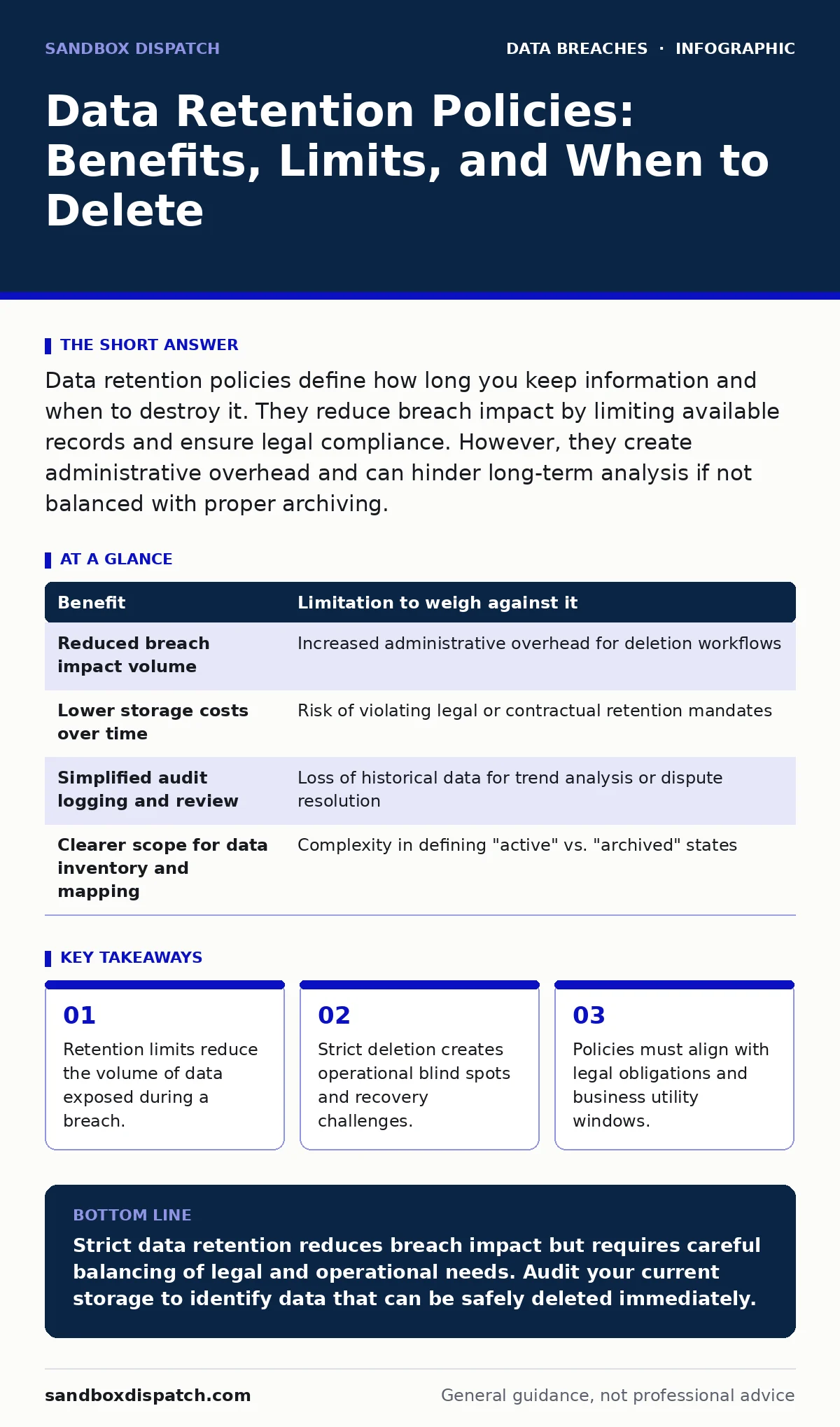
Data retention policies define how long you keep information and when to destroy it. They reduce breach impact by limiting available records and ensure legal compliance. However, they create administrative overhead and can hinder long-term analysis if not balanced with proper archiving.
The Mechanics of Time-Bound Data
Data retention is not merely about storage capacity. It is a governance mechanism that dictates the lifecycle of information. You define a specific duration for which data remains active, accessible, and editable. After this period, the data moves to archival storage or is permanently deleted. This process relies on immutable timestamps and automated workflows. Manual deletion is prone to human error and inconsistency. Automated systems enforce the policy uniformly across databases, file shares, and cloud buckets.
The core mechanism is the separation of active data from historical records. Active data supports daily operations and requires high availability. Historical data serves legal, regulatory, or analytical purposes and requires low-cost, secure storage. By defining this boundary, you reduce the amount of data that sits in your primary, high-risk environments. This reduction directly lowers the potential impact of a security incident.
Reducing the Attack Surface
The primary benefit of strict retention is the reduction of the attack surface. Every record you keep is a potential target. If an attacker gains unauthorized access, they harvest everything available. A smaller dataset means less exposure. This is not just about volume; it is about the quality of the data. Old records often contain sensitive personal data that no longer serves a business function.
Imagine a database containing ten years of customer transactions. A breach exposes a decade of financial behavior. If you retain only three years of active transactions, the breach exposes significantly less context. This limits the utility of the stolen data for identity theft or fraud. The attacker has fewer data points to correlate and exploit. This defense-in-depth strategy works in tandem with encryption and access controls.
The Hidden Cost of Deletion
Deletion is not a free action. It requires verification, auditing, and sometimes complex technical processes. Secure deletion ensures that data cannot be recovered, which differs from simple file removal. On modern storage systems, especially solid-state drives, ensuring complete erasure requires overwriting or cryptographic shredding. This process consumes compute resources and time.
Furthermore, aggressive deletion can create operational blind spots. If you delete data too quickly, you may lose the ability to investigate long-term trends or resolve customer disputes. You might also violate retention mandates for tax identity theft prevention or financial auditing. The limitation is that retention policies create a tension between security and utility. You must balance the desire for a clean environment with the need for historical context.
Compliance and Liability Management
Legal compliance is a driver for retention, but it is also a constraint. Laws vary by jurisdiction and industry. Some regulations require you to keep data for a specific period, while others mandate deletion after that period. A clear policy ensures you meet these obligations consistently. Without a policy, you risk keeping data indefinitely, which increases liability.
Liability arises when you hold data you do not need. In the event of a data leak, regulators scrutinize whether the data was necessary. If you cannot justify the retention, you face penalties. A documented policy provides a defense. It shows that you have a systematic approach to data lifecycle management. This documentation is critical during audits or legal discovery processes.
The Retention Trade-Off Matrix
You must weigh the security benefits against operational and legal limitations. The table below outlines the primary trade-offs you will encounter when designing your policy.
| Benefit | Limitation to weigh against it |
|---|---|
| Reduced breach impact volume | Increased administrative overhead for deletion workflows |
| Lower storage costs over time | Risk of violating legal or contractual retention mandates |
| Simplified audit logging and review | Loss of historical data for trend analysis or dispute resolution |
| Clearer scope for data inventory and mapping | Complexity in defining "active" vs. "archived" states |
See also: User Access Provisioning: How Identity Systems Grant and Restrict Rights · Data Inventory and Mapping: Track Every Byte to Prevent Leaks
When Strict Retention Is Worth It
Strict retention is worth it when the data holds high value to attackers but low value to your operations. This includes temporary access tokens, session cookies, and cached search results. These items expire naturally and serve no long-term purpose. Deleting them immediately reduces the window for session hijacking.
It is also worth it for sensitive personal data that has a short legal lifecycle. For example, application data for jobs you did not hire may only need to be kept for a year. After that, it is liability. Implementing automated deletion for these categories provides immediate security benefits with minimal operational friction. The cost of keeping this data outweighs any marginal utility.
When Retention Hinders Operations
Retention is not worth it when it impedes legitimate business functions or violates long-term obligations. Financial records, for instance, often require long-term preservation for tax identity theft prevention and audit trails. Deleting these records prematurely creates legal risk. You must identify these exceptions early in your data inventory and mapping process.
Additionally, strict retention can hinder security investigations. If you delete logs too quickly, you may lose the evidence needed to understand the scope of an incident. Audit logging must be retained long enough to support forensic analysis. Balancing this requires separate retention schedules for operational data and security logs. One size does not fit all.
Implementation and Enforcement
Policies fail without enforcement. You need technical controls to enforce retention rules. This includes database triggers, cloud storage lifecycle policies, and secure deletion tools. Manual processes are unreliable. You should integrate retention checks into your development pipeline. Code that creates data should also define its expiration.
Regular audits ensure the policy is followed. You must verify that data is actually being deleted, not just moved. Check for "zombie" data that persists despite policy rules. Involve legal and compliance teams to review the policy annually. As laws change, your retention periods must adapt. This is an ongoing process, not a one-time configuration.
Key takeaways
- Retention limits reduce the volume of data exposed during a breach.
- Strict deletion creates operational blind spots and recovery challenges.
- Policies must align with legal obligations and business utility windows.
Strict data retention reduces breach impact but requires careful balancing of legal and operational needs. Audit your current storage to identify data that can be safely deleted immediately.
Frequently asked questions
How do I handle data that is needed for both short-term operations and long-term compliance?
Separate the data into active and archived states. Keep the active copy for operations and move the archived copy to secure, low-cost storage for compliance.
Does deleting data remove it from all backups immediately?
No. Standard backups often retain data longer than primary storage. You must configure backup lifecycle policies to align with your retention rules.
What is the difference between data retention and data archival?
Retention defines how long data is kept. Archival defines how it is stored after the active period. Archival data is typically immutable and accessed rarely.
Can automated deletion cause accidental loss of critical data?
Yes. If policies are misconfigured or exceptions are not defined, automated systems will delete data indiscriminately. Regular audits prevent this.
How this guide was produced: written by the Sandbox Dispatch editorial team with AI assistance, checked against the public references listed below, and reviewed when the facts change. See our editorial policy or report an error.