Endpoint Telemetry Misconceptions That Blind Your Defenses
Endpoint telemetry reveals behavioral anomalies rather than static signatures, turning raw system calls into a narrative of intent that traditional antivirus tools miss entirely.

Endpoint telemetry records system activity to detect behavior, not just known malware. Misunderstanding its scope leads to data hoarding, alert fatigue, and blind spots. Correct usage focuses on high-fidelity signals, strict retention policies, and correlating events with identity context to spot subtle threats.
Misreading: More data equals better security
Correct reading: Volume does not equal visibility. Collecting every possible event from every endpoint creates a data deluge that overwhelms analysis tools and human reviewers. Security teams often assume that if an event is not logged, it cannot be detected. This leads to enabling verbose logging for low-value processes, which consumes storage and processing power without adding defensive value.
Imagine a server that logs every file open event. The resulting data stream is too wide to search effectively. Attackers operating within standard processes blend into this noise. You need high-fidelity telemetry that captures process creation, network connections, and registry changes. These specific events provide the context needed to distinguish normal operations from malicious activity. Broad logging dilutes the signal.
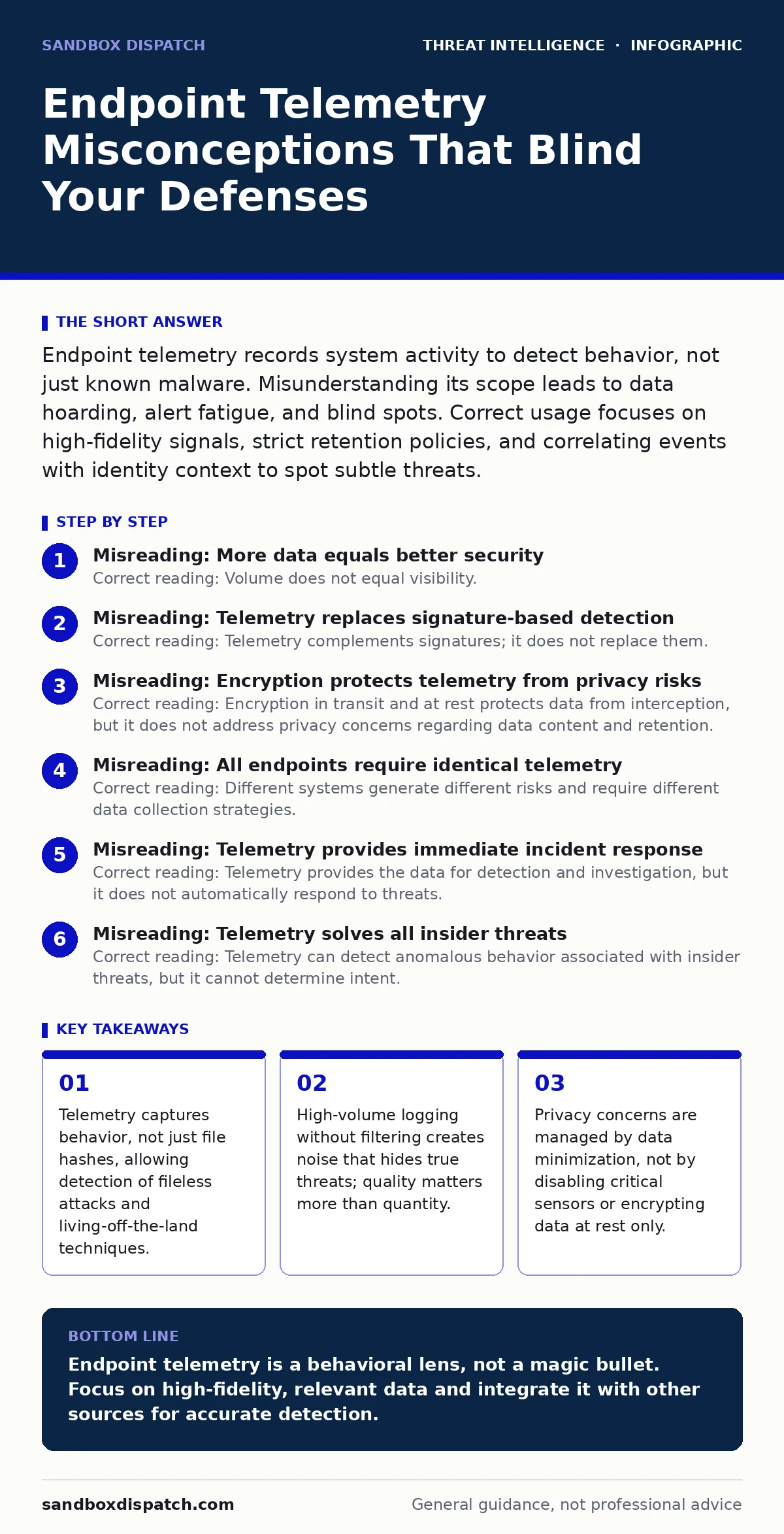
Misreading: Telemetry replaces signature-based detection
Correct reading: Telemetry complements signatures; it does not replace them. Signature-based detection identifies known malicious files by their unique hash or structure. Endpoint telemetry observes the behavior of processes, regardless of whether the file is known or signed. A legitimate tool like PowerShell can execute malicious commands. Signatures cannot detect this if the code is generated on the fly.
Telemetry detects the execution of the command and the subsequent changes to the system. It identifies the pattern of abuse, not the presence of a specific bad file. Relying solely on telemetry leaves you vulnerable to new, unknown threats that do not exhibit suspicious behavior immediately. Relying solely on signatures leaves you vulnerable to fileless attacks. You need both layers working together. See how breach and attack simulation validates these layered defenses.
Misreading: Encryption protects telemetry from privacy risks
Correct reading: Encryption in transit and at rest protects data from interception, but it does not address privacy concerns regarding data content and retention. Endpoint telemetry often captures user activity, including keystrokes, application usage, and file access. Users and regulators care about what is collected, not just how it is stored. Encrypting the data does not make the collection itself acceptable if it violates data minimization principles.
You must define what data is necessary for security. Collecting only the fields required for detection reduces the privacy footprint. Retaining data longer than necessary increases risk. Define clear retention policies that delete raw event data after aggregation or analysis. This approach balances security needs with privacy obligations. It prevents the accumulation of sensitive user data that could be exposed in a breach.
Misreading: All endpoints require identical telemetry
Correct reading: Different systems generate different risks and require different data collection strategies. A database server requires detailed audit logs for access control and query execution. A standard workstation needs process and network monitoring. Applying a uniform telemetry configuration to all endpoints wastes resources and creates irrelevant noise. Servers often have higher performance constraints, making verbose logging detrimental to operations.
Tailor your collection strategy to the role of the device. Identify critical assets and apply higher-fidelity monitoring to them. Use lighter-weight agents on less critical systems to reduce overhead. This targeted approach ensures you capture the most valuable data without impacting system performance. It also simplifies analysis by reducing the volume of irrelevant events.
Misreading: Telemetry provides immediate incident response
Correct reading: Telemetry provides the data for detection and investigation, but it does not automatically respond to threats. Endpoint Detection and Response (EDR) platforms use telemetry to identify anomalies and alert security teams. However, the actual response—such as isolating a host or killing a process—often requires manual verification or automated playbooks. Telemetry is the evidence, not the action.
Automated response based solely on telemetry can lead to false positives and business disruption. A legitimate administrative task might trigger a high-severity alert. Isolating a server based on this alert could halt critical operations. Human oversight or carefully tuned automation is required. Integrate telemetry with SOAR platforms to automate routine tasks while keeping complex decisions under human control. This ensures accurate and proportionate responses.
See also: Sensitive Personal Data: Small Business Protection Tactics · Data Privacy vs Security: How to Choose the Right Control
Misreading: Telemetry solves all insider threats
Correct reading: Telemetry can detect anomalous behavior associated with insider threats, but it cannot determine intent. An employee accessing sensitive files outside of business hours may be a threat, or they may be working late on a legitimate project. Telemetry shows the action, not the motive. Context from other sources, such as HR records or user behavior baselines, is needed to interpret the data.
Without context, telemetry alerts for insider threats generate high false positive rates. Security teams may ignore these alerts due to fatigue. Combine endpoint telemetry with identity and access management logs. Look for patterns of privilege abuse or data exfiltration. This holistic view improves the accuracy of insider threat detection. It helps distinguish between risky behavior and actual malicious intent.
Misreading: Telemetry is invisible to attackers
Correct reading: Attackers are aware of telemetry collection and actively work to evade it. They may disable security agents, tamper with logging services, or use techniques that generate minimal telemetry. Assuming your telemetry is invisible creates a false sense of security. Attackers can identify which events are being logged and adjust their tactics to avoid triggering alerts.
You must monitor the health of your telemetry collection. Detect when agents are stopped or logging services are disabled. Use integrity checks to ensure the security software itself has not been tampered with. Regularly test your detection capabilities against known evasion techniques. This proactive approach ensures your telemetry remains effective against sophisticated adversaries.
Misreading: Telemetry data is always accurate
Correct reading: Telemetry data can be incomplete or misleading due to system errors, agent failures, or intentional obfuscation. Processes may terminate before logging their actions. Network connections may be missed due to firewall rules. Attackers can inject false data to confuse analysts. Assuming telemetry is a perfect record of system activity is dangerous.
Validate telemetry data by cross-referencing multiple sources. Compare endpoint logs with network traffic data and identity logs. Look for inconsistencies that suggest data tampering or collection failures. Use multiple data sources to build a complete picture of an event. This redundancy helps identify gaps and inaccuracies in the telemetry stream.
Key takeaways
- Telemetry captures behavior, not just file hashes, allowing detection of fileless attacks and living-off-the-land techniques.
- High-volume logging without filtering creates noise that hides true threats; quality matters more than quantity.
- Privacy concerns are managed by data minimization, not by disabling critical sensors or encrypting data at rest only.
Endpoint telemetry is a behavioral lens, not a magic bullet. Focus on high-fidelity, relevant data and integrate it with other sources for accurate detection.
Frequently asked questions
How do I reduce telemetry noise without losing visibility?
Prioritize high-fidelity events like process creation and network connections. Disable verbose logging for low-value processes. Use filtering rules to exclude known benign activities. Regularly review and tune your collection strategy based on detection outcomes.
Can endpoint telemetry detect ransomware before encryption starts?
Yes, telemetry can detect early-stage ransomware behaviors like mass file enumeration, shadow copy deletion, and process injection. These actions occur before files are encrypted. Detecting these behaviors allows for early isolation and prevention of data loss.
What is the difference between EDR and endpoint telemetry?
Endpoint telemetry is the raw data collected from endpoints. EDR is the platform that collects, analyzes, and responds to this data. Telemetry is the input; EDR is the tool that processes it. You can use telemetry with other tools, but EDR provides a dedicated workflow for detection and response.
How does telemetry help with pass-the-ticket attacks?
Telemetry captures authentication events and token usage. It can detect anomalies like a user authenticating from multiple locations simultaneously or using cached credentials for lateral movement. These behavioral indicators help identify pass-the-ticket attacks that bypass standard password checks.
How this guide was produced: written by the Sandbox Dispatch editorial team with AI assistance, checked against the public references listed below, and reviewed when the facts change. See our editorial policy or report an error.