AI Hallucinations: Why Accuracy Is Not The Only Metric
Hallucinations are structural features of probabilistic generation, not software bugs you can patch by updating the model version or increasing training data volume.

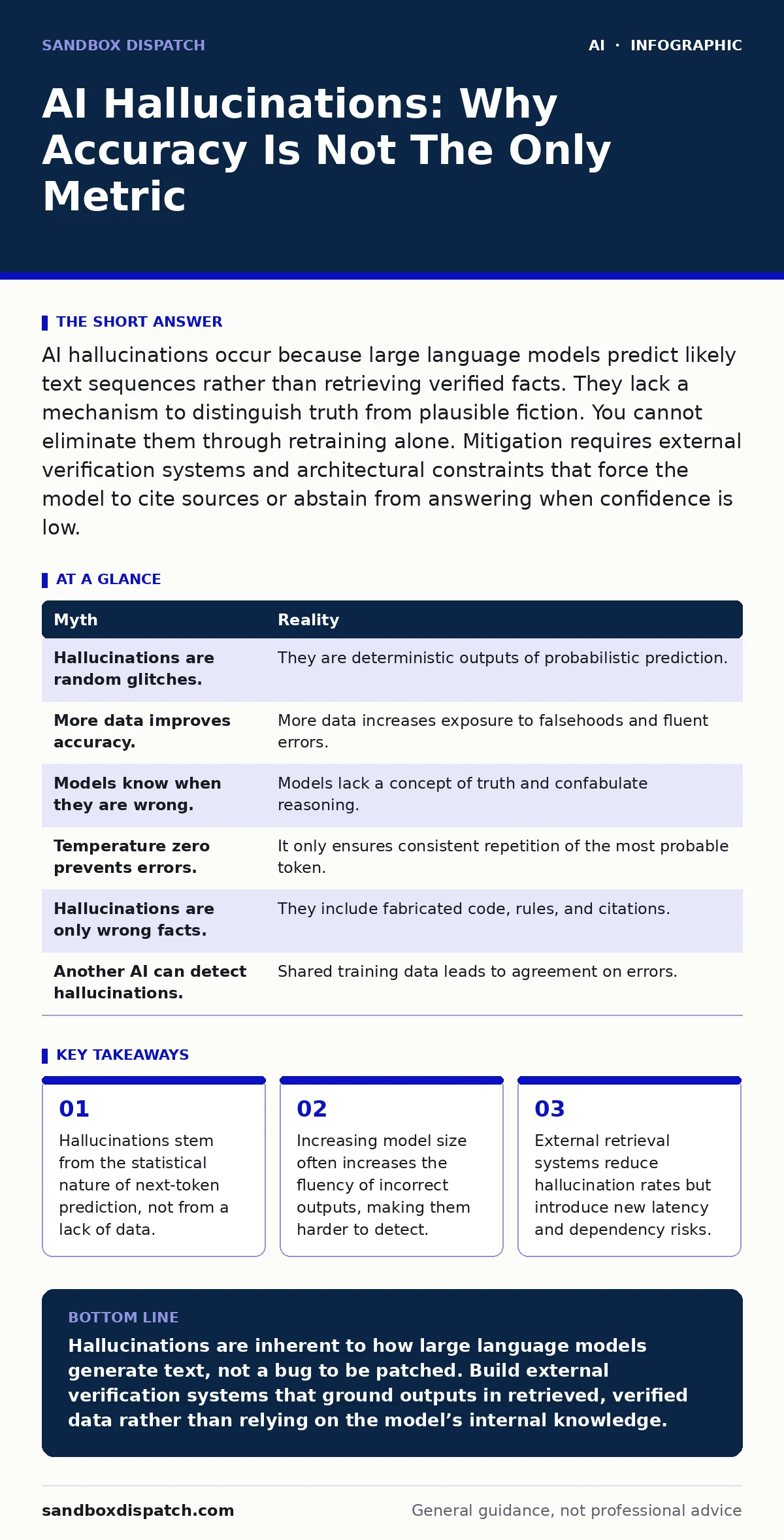
AI hallucinations occur because large language models predict likely text sequences rather than retrieving verified facts. They lack a mechanism to distinguish truth from plausible fiction. You cannot eliminate them through retraining alone. Mitigation requires external verification systems and architectural constraints that force the model to cite sources or abstain from answering when confidence is low.
Myth: Hallucinations Are Random Errors
Reality: Hallucinations are deterministic outcomes of the model’s architecture. When you ask a large language model to generate text, it calculates the probability of the next word based on its training data. It does not check a database of facts. It checks which word statistically follows the previous ones. This means the model is optimized for coherence, not correctness. A fluent sentence is often more probable than a true one if the true fact is rare in the training corpus.
Imagine you ask the model to describe a historical event it has seen only once in a noisy source. The model will blend that event with similar, more common events to create a smooth narrative. The output feels right because it follows the linguistic patterns of the training data. This is not a glitch. It is the model doing exactly what it was trained to do: predict the most likely continuation. You cannot fix this by telling the model to "be more careful." You must change the task definition to require evidence.
Myth: More Training Data Solves The Problem
Reality: Adding more data increases the model’s exposure to falsehoods as well as truths. The internet contains vast amounts of misinformation, satire, and outdated information. If you train a model on a larger dataset, you increase the probability that it will learn incorrect associations. The model sees a lie repeated a thousand times and treats it as a pattern. It then reproduces that pattern with high confidence.
This creates a hidden cost. As models grow larger and ingest more data, they become better at mimicking human writing. This includes mimicking the confident tone of experts who are wrong. The result is a more persuasive hallucination. Developers often assume that scale solves accuracy. In practice, scale solves fluency. To address factual errors, you need curated, high-quality datasets, not just massive, unfiltered ones. See our guide on AI bias for how data selection influences model behavior.
Myth: The Model Knows When It Is Wrong
Reality: Large language models lack a concept of truth. They have no internal fact-checker. When you ask a model to explain its reasoning, it generates text that looks like reasoning. It does not actually verify its premises. This is known as confabulation. The model constructs a logical path to an answer, even if the starting point is fabricated. It cannot distinguish between a correct derivation and a plausible-sounding fabrication.
Suppose you ask the model to solve a math problem. It might produce the correct answer using incorrect steps. It might produce an incorrect answer using correct steps. The model assigns a probability score to each token, but this score reflects likelihood, not validity. You cannot rely on the model’s self-assessment. You must implement external validation. This is where AI red teaming becomes necessary to probe the boundaries of the model’s reliability.
Myth: Temperature Zero Eliminates Hallucinations
Reality: Setting the temperature parameter to zero makes the model deterministic, but it does not make it factual. Temperature controls the randomness of the output. At zero, the model always picks the most probable next token. If the most probable token is part of a false statement, the model will repeat it every time. It removes variation, not error.
This is a common misconception among developers who treat temperature as a truth switch. It is not. It is a creativity dial. A low temperature ensures consistency, which can be dangerous if the consistent output is wrong. The model will confidently repeat a hallucination without deviation. To mitigate this, you need to constrain the input space or use retrieval-augmented generation. See insecure AI plugins and agents for risks related to how models interact with external tools.
Myth: Hallucinations Are Only Factual Errors
Reality: Hallucinations also manifest as logical inconsistencies and fabricated constraints. A model might invent a rule that does not exist, such as claiming a programming language has a feature it lacks. It might create a fake citation or a non-existent API endpoint. These are not just wrong facts. They are structural fabrications that can break downstream systems.
Imagine you use a model to generate code. It writes a function call that looks syntactically correct but does not exist in the library. The code compiles, but it fails at runtime. This is a hallucination of capability. It is more dangerous than a factual error because it passes initial validation checks. You must test generated outputs in a sandbox environment. Never trust the model’s assertion of its own capabilities. See adversarial examples for how inputs can trigger these structural failures.
See also: Emergency Stop Mechanisms for AI Systems: Benefits, Limits, and When to Use Them · Detect Exposed AI Model Servers: Signals, Logs, and Blind Spots
Myth: You Can Detect Hallucinations With Another AI
Reality: Using a second model to check the first is ineffective if both models share the same training data and architecture. They will likely agree on the same errors. This is called model alignment bias. If the first model hallucinates, the second model is likely to validate it because it recognizes the pattern as plausible. It does not know the pattern is false.
This creates a false sense of security. You might build a pipeline where Model A generates text and Model B checks it. If both are large language models trained on similar corpora, they will reinforce each other’s mistakes. You need orthogonal verification. This means using a system that operates on different principles, such as a rule-based checker or a retrieval system that fetches verified documents. See explainable AI for techniques to make model decisions transparent.
| Myth | Reality |
|---|---|
| Hallucinations are random glitches. | They are deterministic outputs of probabilistic prediction. |
| More data improves accuracy. | More data increases exposure to falsehoods and fluent errors. |
| Models know when they are wrong. | Models lack a concept of truth and confabulate reasoning. |
| Temperature zero prevents errors. | It only ensures consistent repetition of the most probable token. |
| Hallucinations are only wrong facts. | They include fabricated code, rules, and citations. |
| Another AI can detect hallucinations. | Shared training data leads to agreement on errors. |
The Path Forward
Mitigating hallucinations requires architectural changes, not just prompt engineering. You must separate the generation process from the verification process. Use retrieval-augmented generation to ground outputs in external, verified sources. Implement strict output constraints that force the model to cite specific documents. If the model cannot find a source, it must refuse to answer.
This approach adds latency and complexity. It requires maintaining a high-quality knowledge base. It shifts the burden from the model to the system design. You are building a pipeline, not just a chatbot. See AI risk management for strategies to handle the operational costs of these safeguards.
Key takeaways
- Hallucinations stem from the statistical nature of next-token prediction, not from a lack of data.
- Increasing model size often increases the fluency of incorrect outputs, making them harder to detect.
- External retrieval systems reduce hallucination rates but introduce new latency and dependency risks.
- Evaluation metrics must measure factual grounding, not just grammatical correctness or user satisfaction.
Hallucinations are inherent to how large language models generate text, not a bug to be patched. Build external verification systems that ground outputs in retrieved, verified data rather than relying on the model’s internal knowledge.
Frequently asked questions
How do I reduce hallucinations in code generation?
Use static analysis tools to verify syntax and logic after generation. Never execute generated code directly. Validate against known library documentation.
Can fine-tuning stop hallucinations?
Fine-tuning can adjust the style and format, but it rarely improves factual accuracy. It may even reduce generalization, making the model more prone to overfitting on specific examples.
What is retrieval-augmented generation?
It is a technique where the model fetches relevant documents from a database before generating a response. This grounds the output in external facts rather than internal memory
How this guide was produced: written by the Sandbox Dispatch editorial team with AI assistance, checked against the public references listed below, and reviewed when the facts change. See our editorial policy or report an error.