How to Prevent AI Hallucinations: Engineering Controls That Work
Temperature settings and prompt engineering fail to stop factual errors. Structural constraints and external verification layers provide the only reliable defense against synthetic misinformation.

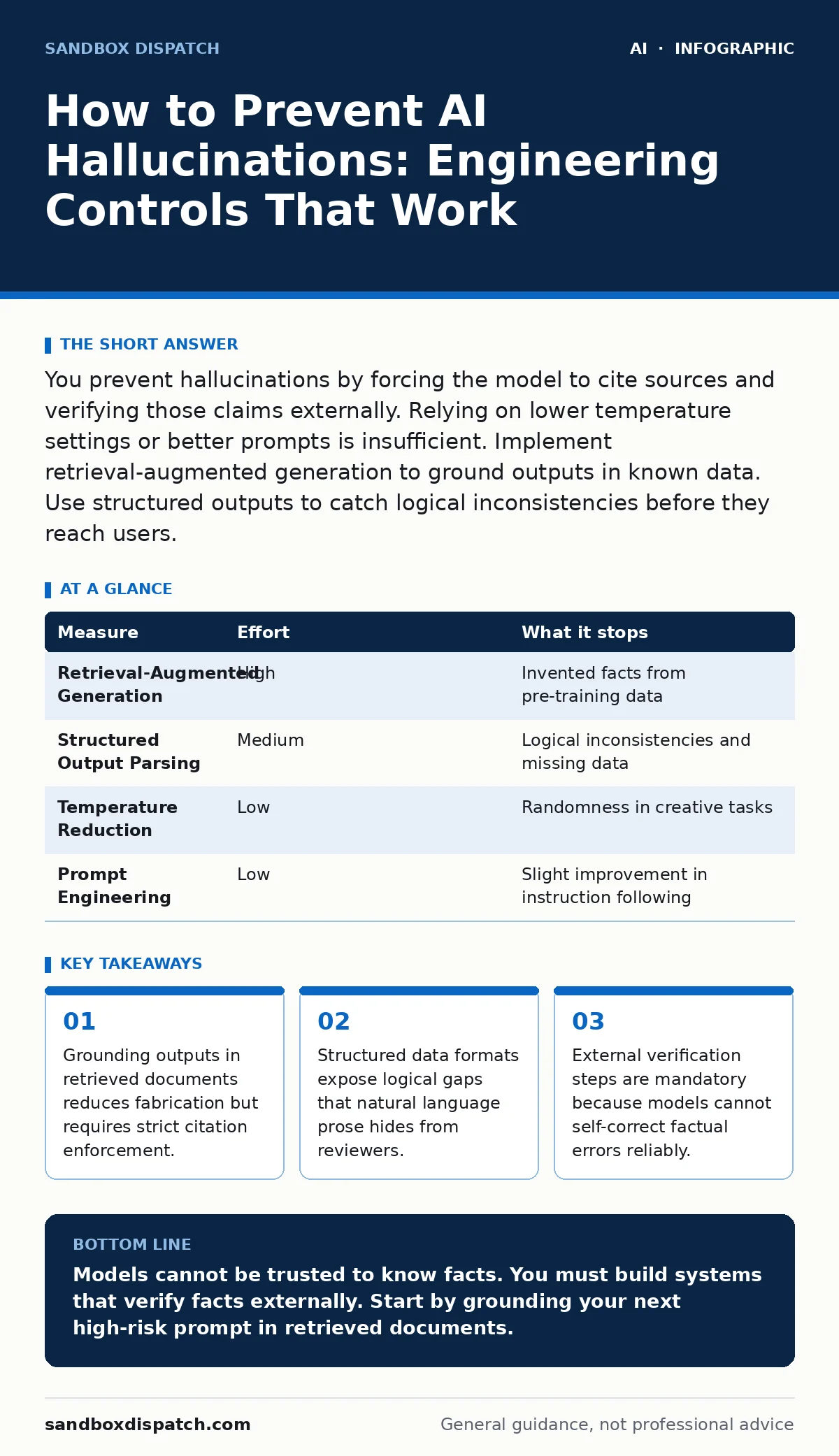
You prevent hallucinations by forcing the model to cite sources and verifying those claims externally. Relying on lower temperature settings or better prompts is insufficient. Implement retrieval-augmented generation to ground outputs in known data. Use structured outputs to catch logical inconsistencies before they reach users.
How to Prevent AI Hallucinations
You prevent AI hallucinations by separating the reasoning process from the factual content generation. Large language models predict the next likely token based on probability, not truth. This mechanism creates a fundamental risk: the model will prioritize fluency over accuracy. When asked for a fact it does not know, it invents a plausible-sounding answer. This is a hallucination.
The goal is not to make the model "smarter." The goal is to constrain where it gets its information. If the model retrieves a document before answering, it can only hallucinate if the document is wrong. This shifts the burden from prediction to retrieval. You must design systems that treat the model as a reasoning engine, not a knowledge base.
Grounding Outputs with Retrieval
Retrieval-augmented generation connects the model to a specific, trusted corpus of documents. The system searches this corpus for relevant information before generating an answer. The model then synthesizes the answer using only the retrieved text. This method prevents the model from relying on its pre-training data, which may be outdated or incorrect.
Imagine a customer service bot that answers questions about a product manual. Without retrieval, the bot might invent features that do not exist. With retrieval, it finds the exact section of the manual and paraphrases it. If the manual does not contain the answer, the system should be configured to say "I do not know" rather than guessing.
This approach introduces latency. Searching a database takes time. You must balance speed against accuracy. High-stakes applications, such as legal or medical advice, require this delay. Low-stakes applications, like creative writing, may not need it. The trade-off is always between response time and factual fidelity.
| Measure | Effort | What it stops |
|---|---|---|
| Retrieval-Augmented Generation | High | Invented facts from pre-training data |
| Structured Output Parsing | Medium | Logical inconsistencies and missing data |
| Temperature Reduction | Low | Randomness in creative tasks |
| Prompt Engineering | Low | Slight improvement in instruction following |
Structuring Outputs for Verification
Natural language prose is difficult to verify programmatically. A paragraph of text can hide a subtle error in the middle of a sentence. Structured outputs, such as JSON or XML, force the model to separate distinct pieces of information. This separation allows your code to validate each field independently.
Suppose you ask a model to extract dates from a contract. If it returns a paragraph, you must parse the text to find the dates. If it returns a JSON object with a "date" field, you can check if the field exists and if the format is correct. If the field is empty, you know the model failed. If the format is wrong, you know the model hallucinated the structure.
You must define the schema strictly. The model should not be allowed to add extra fields or omit required ones. Validation scripts should reject any output that does not match the schema. This rejection triggers a retry or a fallback mechanism. It prevents bad data from entering your downstream systems.
The Limits of Temperature Settings
Many developers try to reduce hallucinations by lowering the temperature parameter. Temperature controls the randomness of the model's output. A lower temperature makes the model more deterministic, choosing the most probable next token. This reduces creative variation and can make the output more consistent.
Imagine a model asked for the capital of a country. With high temperature, it might give different answers each time. With low temperature, it gives the same answer each time. If that answer is wrong, it is wrong every time. Determinism is not accuracy. You must verify the fact regardless of the temperature setting.
This misconception leads to false confidence. Teams assume that because the output is stable, it is correct. Stability is a property of the distribution, not the truth. You must implement external checks that validate the content against a known ground truth. These checks are independent of the model's internal probability scores.
Prompt Engineering as a Weak Control
Prompt engineering involves crafting specific instructions to guide the model's behavior. Techniques include few-shot examples, chain-of-thought reasoning, and explicit constraints. These methods can improve the model's adherence to instructions and reduce some types of errors. They do not eliminate the risk of hallucination.
Chain-of-thought prompting asks the model to show its reasoning steps. This can help the model catch logical errors in its own process. However, the model may still hallucinate the reasoning steps themselves. It can invent a logical path that leads to an incorrect conclusion. The reasoning looks coherent but is fundamentally flawed.
Few-shot examples provide the model with samples of correct input-output pairs. This helps the model understand the desired format and style. It does not provide new factual knowledge. If the model does not know the answer, it will still guess, even with examples. The examples only shape the presentation, not the source of the truth.
See also: Emergency Stop Mechanisms for AI Systems: Benefits, Limits, and When to Use Them · Detect Exposed AI Model Servers: Signals, Logs, and Blind Spots
External Verification and Red Teaming
You must assume the model will fail. External verification steps catch errors that the model cannot self-correct. This involves running the output through a separate process that checks for consistency, completeness, and factual accuracy. This process can be another model, a rule-based script, or a human reviewer.
AI red teaming helps you identify how the model might fail before it reaches production. By testing the system with adversarial examples, you can find edge cases where the model hallucinates. These tests should cover not just factual errors but also logical fallacies and safety violations. The goal is to break the system in a controlled environment.
Imagine a system that generates code snippets. A verification step might compile the code and run unit tests. If the tests fail, the code is rejected. This is a form of external verification. It does not rely on the model's judgment. It relies on objective metrics. This approach is far more reliable than asking the model to "check your work."
Integrating Transparency and Compliance
AI transparency requires that users know when they are interacting with a model-generated response. Disclosing this helps manage expectations and reduces the risk of users trusting incorrect information. You should clearly label AI-generated content and provide sources where possible.
The EU AI Act and other regulatory frameworks are beginning to mandate transparency and risk management for AI systems. Compliance often requires documentation of how the model was trained, tested, and monitored. You must maintain records of your verification processes and any incidents where hallucinations occurred.
AI bias can manifest as hallucinations that favor certain groups or perspectives. If the training data contains biased information, the model may hallucinate facts that reinforce those biases. You must audit your retrieval corpus for bias and ensure that your verification steps catch biased outputs. This is an ongoing process, not a one-time fix.
Checklist for Today
- Implement retrieval-augmented generation for any task requiring factual accuracy.
- Define strict output schemas and validate all model responses programmatically.
- Add an external verification step that checks outputs against known ground truth.
Key takeaways
- Grounding outputs in retrieved documents reduces fabrication but requires strict citation enforcement.
- Structured data formats expose logical gaps that natural language prose hides from reviewers.
- External verification steps are mandatory because models cannot self-correct factual errors reliably.
Models cannot be trusted to know facts. You must build systems that verify facts externally. Start by grounding your next high-risk prompt in retrieved documents.
Frequently asked questions
Does prompt engineering stop hallucinations?
No. Prompt engineering improves instruction following and format consistency. It does not provide new factual knowledge or prevent the model from inventing facts.
Can I trust a model with a temperature of zero?
No. A temperature of zero makes the output deterministic but not accurate. The model will still repeat incorrect facts if they are probable in its training data.
What is the best way to verify AI outputs?
Use external verification methods such as code compilation, database checks, or cross-referencing with trusted sources. Do not rely on the model to self-verify.
How do I handle hallucinations in creative writing?
Creative writing does not require factual accuracy. Focus on style and coherence. Use human review to ensure the output meets creative goals and does not contain harmful content.
How this guide was produced: written by the Sandbox Dispatch editorial team with AI assistance, checked against the public references listed below, and reviewed when the facts change. See our editorial policy or report an error.