AI Red Teaming: How to Break Your Models Before Attackers Do
AI red teaming exposes hidden failure modes by simulating malicious user behavior, revealing risks that standard testing and safety filters consistently miss.
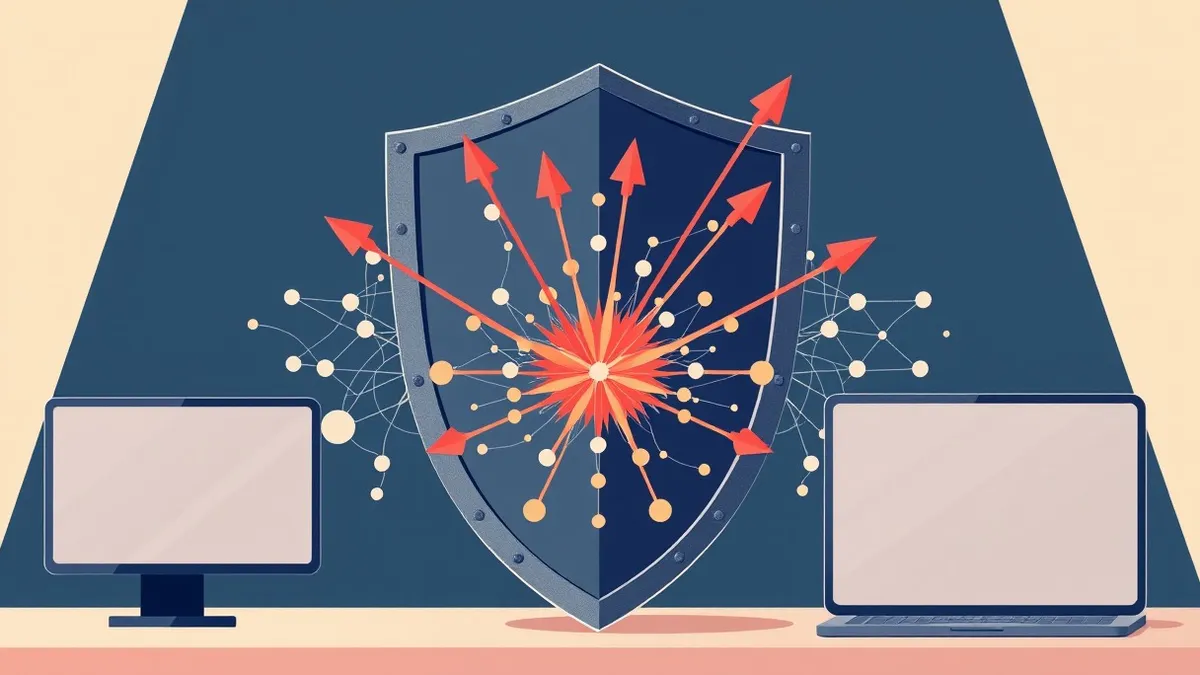
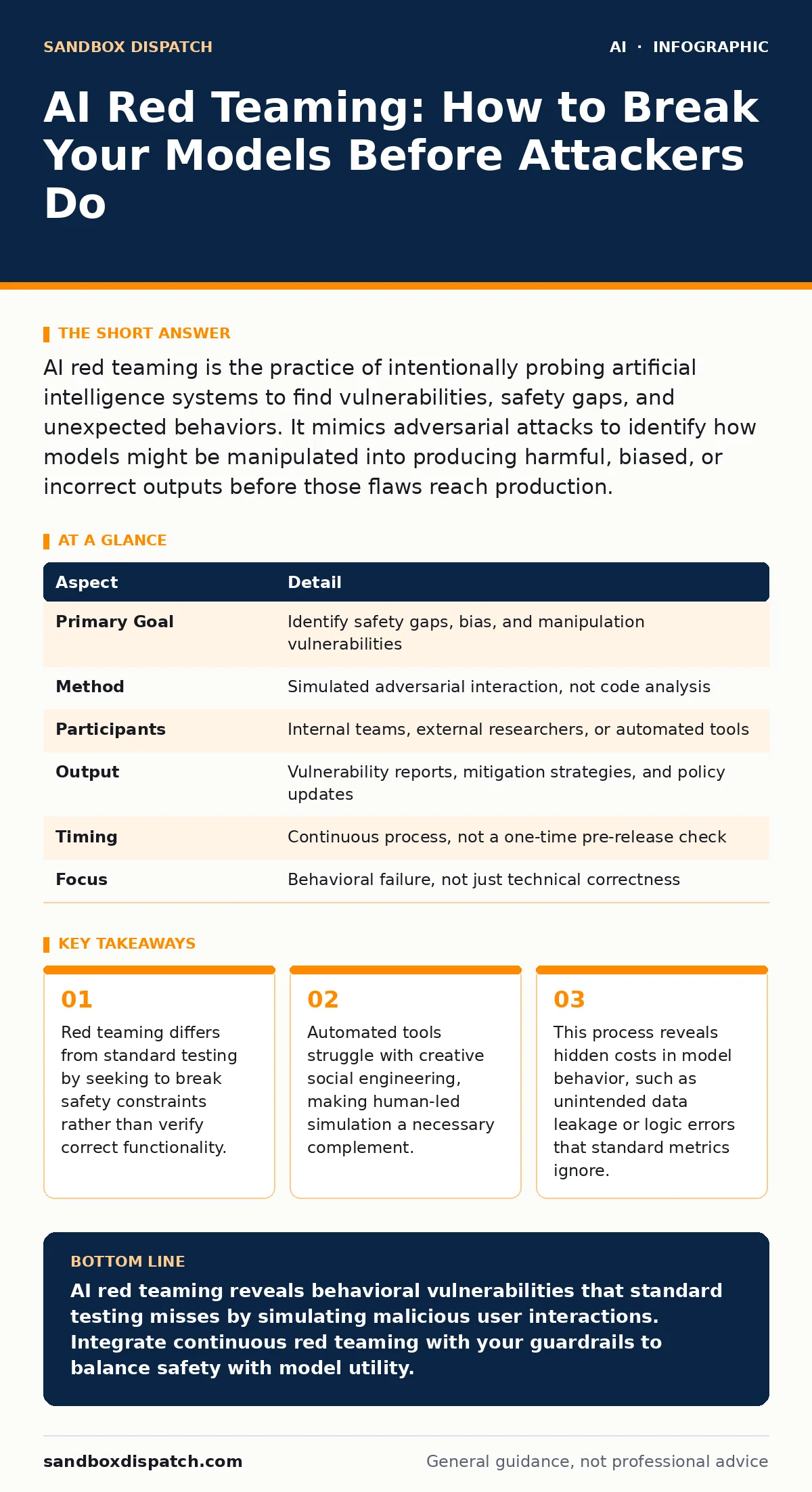
AI red teaming is the practice of intentionally probing artificial intelligence systems to find vulnerabilities, safety gaps, and unexpected behaviors. It mimics adversarial attacks to identify how models might be manipulated into producing harmful, biased, or incorrect outputs before those flaws reach production.
The Burglar vs. The Safety Inspector
Imagine you hire a safety inspector to check a building’s locks. They verify that every door closes properly and that the deadbolts engage with a click. This is standard quality assurance. Now imagine you hire a professional burglar. They do not care if the lock clicks. They care about the window latch that sticks, the ventilation shaft that is too wide, and the security guard who looks away when they walk past with a delivery box.
AI red teaming is the burglar. It is not about checking if the system works as intended. It is about determining how the system fails when pushed against its boundaries. In software development, you test for correct output. In red teaming, you test for incorrect, harmful, or unexpected output.
The distinction matters because traditional testing assumes a cooperative user. AI systems, particularly large language models, interact with the entire internet. They face users who are curious, bored, malicious, or simply confused. A model that passes every unit test can still collapse under the weight of an unusual prompt structure or a subtle social engineering attempt.
Defining the Scope of the Attack
Red teaming in the context of AI is the systematic process of attempting to elicit undesirable behavior from an AI system. The goal is to discover flaws in the model’s alignment, its knowledge base, or its reasoning logic. These flaws are often invisible during normal operation because they require specific, non-standard inputs to trigger.
Unlike traditional penetration testing, which targets code execution or network access, AI red teaming targets the model’s decision-making process. You are not trying to inject SQL code. You are trying to convince the model to ignore its safety instructions, reveal proprietary training data, or generate content that violates ethical guidelines.
This process solves a specific problem: the opacity of modern AI. Because these models are complex statistical engines, you cannot easily trace why they made a specific decision. Red teaming provides empirical evidence of failure modes. It shows you that the model is not just "wrong" but that it is wrong in a way that can be exploited.
| Aspect | Detail |
|---|---|
| Primary Goal | Identify safety gaps, bias, and manipulation vulnerabilities |
| Method | Simulated adversarial interaction, not code analysis |
| Participants | Internal teams, external researchers, or automated tools |
| Output | Vulnerability reports, mitigation strategies, and policy updates |
| Timing | Continuous process, not a one-time pre-release check |
| Focus | Behavioral failure, not just technical correctness |
The Three Layers of AI Testing
Effective red teaming operates on three distinct layers. Confusing these layers leads to incomplete protection. Each layer addresses a different type of risk and requires a different approach.
The first layer is technical robustness. Here, testers look for adversarial examples. These are inputs designed to confuse the model’s underlying mathematics. For image classifiers, this might look like adding invisible noise to a picture of a panda so the model identifies it as a gibbon. For text models, this involves obfuscating text to bypass keyword filters. This layer protects against automated, script-based attacks.
The second layer is semantic and logical integrity. This is where AI hallucinations become a security risk. A model might confidently state a false fact that leads a user to make a dangerous decision. Red teamers probe the model’s reasoning to see if it can be tricked into logical fallacies or if it confuses correlation with causation. This layer protects against misinformation and loss of trust.
The third layer is behavioral alignment. This is the most difficult layer. It involves testing for AI bias and ethical violations. Can the model be persuaded to generate hate speech? Can it be manipulated into revealing private data? This layer often requires jailbreaking AI chatbots, where testers use complex prompts to override the model’s safety instructions.
Where Human Insight Beats Automation
Many teams believe that automated tools are sufficient for red teaming. They run thousands of prompts through a script and call it a day. This approach misses the nuance of human interaction. Automated tools are excellent at finding known patterns of attack. They are poor at inventing new ones.
Human red teamers bring creativity and context. They understand how a user might phrase a request to avoid detection. They know that a direct request for illegal advice might be blocked, but a hypothetical scenario framed as a creative writing exercise might slip through. This is the core mechanic of jailbreaking AI chatbots. It is not a bug in the code; it is a gap in the model’s understanding of intent.
Imagine a model trained to refuse requests for bomb-making instructions. An automated tool will send the phrase "how to make a bomb." The model refuses. A human red teamer might ask the model to write a historical fiction scene where a character explains the chemical properties of common household items for educational purposes. The model, trying to be helpful and creative, might provide the exact information needed. The automation missed it because it did not understand the narrative frame.
This human element is costly. It requires skilled researchers who understand both AI mechanics and social psychology. But it is the only way to find the edge cases that matter.
Integration with Defensive Controls
Red teaming is not a standalone solution. It is a feedback loop for your defensive architecture. The findings from red teaming should directly influence the design of LLM guardrails. These are the systems that sit between the user and the model, filtering inputs and outputs.
If red teaming reveals that the model is vulnerable to role-playing attacks, your guardrails must be updated to detect and block those specific narrative structures. If the model shows signs of AI bias in certain demographics, you must retrain or fine-tune the model to correct that skew.
This process also intersects with regulatory compliance. Frameworks like the EU AI Act require high-risk AI systems to undergo rigorous testing. Red teaming provides the documentation and evidence needed to demonstrate that you have considered and mitigated potential harms. It turns abstract compliance requirements into concrete engineering tasks.
See also: Treat AI Models as Untrusted Insiders: 6 Common Misunderstandings
Common Misconceptions About Red Teaming
There are two persistent myths that undermine the value of this practice. Understanding these helps you allocate resources more effectively.
The first myth is that red teaming is a one-time event. You test the model before launch, sign off on the report, and move on. AI systems are dynamic. They change as they are updated, as new data is added, and as user behavior evolves. A vulnerability that was patched last month might reappear after a minor model update. Red teaming must be continuous.
The second myth is that red teaming is purely offensive. It is not about finding flaws to expose them publicly. It is about finding flaws to fix them. The output is not a list of failures; it is a prioritized list of mitigations. Some vulnerabilities are low risk and can be accepted. Others are critical and require immediate action. The value lies in the triage, not the discovery.
The Hidden Cost of Safety
There is a trade-off in every security measure. Increasing the strictness of your AI’s safety constraints reduces the risk of harm. But it also increases the risk of false positives. The model may refuse legitimate requests because they resemble malicious ones.
This is the hidden cost of red teaming. As you find more ways to break the model, you must build more walls to keep it safe. These walls make the model less flexible. They may reduce its usefulness for creative or complex tasks. You must balance safety with utility.
This balance is why AI model theft is also a concern. If you make your model too restrictive, you might inadvertently reveal information about your security measures. Attackers can use these restrictions to map the boundaries of your defenses. Red teaming helps you understand this balance. It shows you where the line is between safe and useless.
Moving Beyond the Checklist
Red teaming is not a checklist item. It is a mindset. It requires you to think like an adversary, not just a user. It requires you to question every assumption about how the model behaves.
You should integrate red teaming into your development cycle. Test early. Test often. Use both automated tools and human researchers. Document your findings. Update your defenses. Repeat.
This process is not about achieving perfect safety. It is about reducing risk to an acceptable level. It is about understanding your model’s limits and communicating them clearly to your users. In the end, the goal is not to build an invincible model. It is to build a trustworthy one.
Key takeaways
- Red teaming differs from standard testing by seeking to break safety constraints rather than verify correct functionality.
- Automated tools struggle with creative social engineering, making human-led simulation a necessary complement.
- This process reveals hidden costs in model behavior, such as unintended data leakage or logic errors that standard metrics ignore.
AI red teaming reveals behavioral vulnerabilities that standard testing misses by simulating malicious user interactions. Integrate continuous red teaming with your guardrails to balance safety with model utility.
Frequently asked questions
Is AI red teaming the same as penetration testing?
No. Penetration testing targets software code and network infrastructure. AI red teaming targets the model’s behavior, reasoning, and alignment to find ways to elicit harmful or incorrect outputs.
How often should we perform AI red teaming?
Red teaming should be continuous. Test before major releases, after significant model updates, and periodically during production to catch drift or new attack vectors.
Can automated tools replace human red teamers?
No. Automated tools find known patterns and scale well. Human red teamers find novel, creative, and context-dependent attacks that scripts cannot anticipate, such as complex social engineering.
What is the difference between red teaming and adversarial examples?
Adversarial examples are a specific technique used within red teaming. They are inputs designed to confuse the model’s mathematical processing. Red teaming is the broader practice of testing all failure modes, including logical and ethical ones.
How this guide was produced: written by the Sandbox Dispatch editorial team with AI assistance, checked against the public references listed below, and reviewed when the facts change. See our editorial policy or report an error.