Deepfake Detection Checklist for Synthetic Media Verification
Most detection tools fail because they look for artifacts rather than analyzing the underlying signal consistency and physical plausibility of the content.

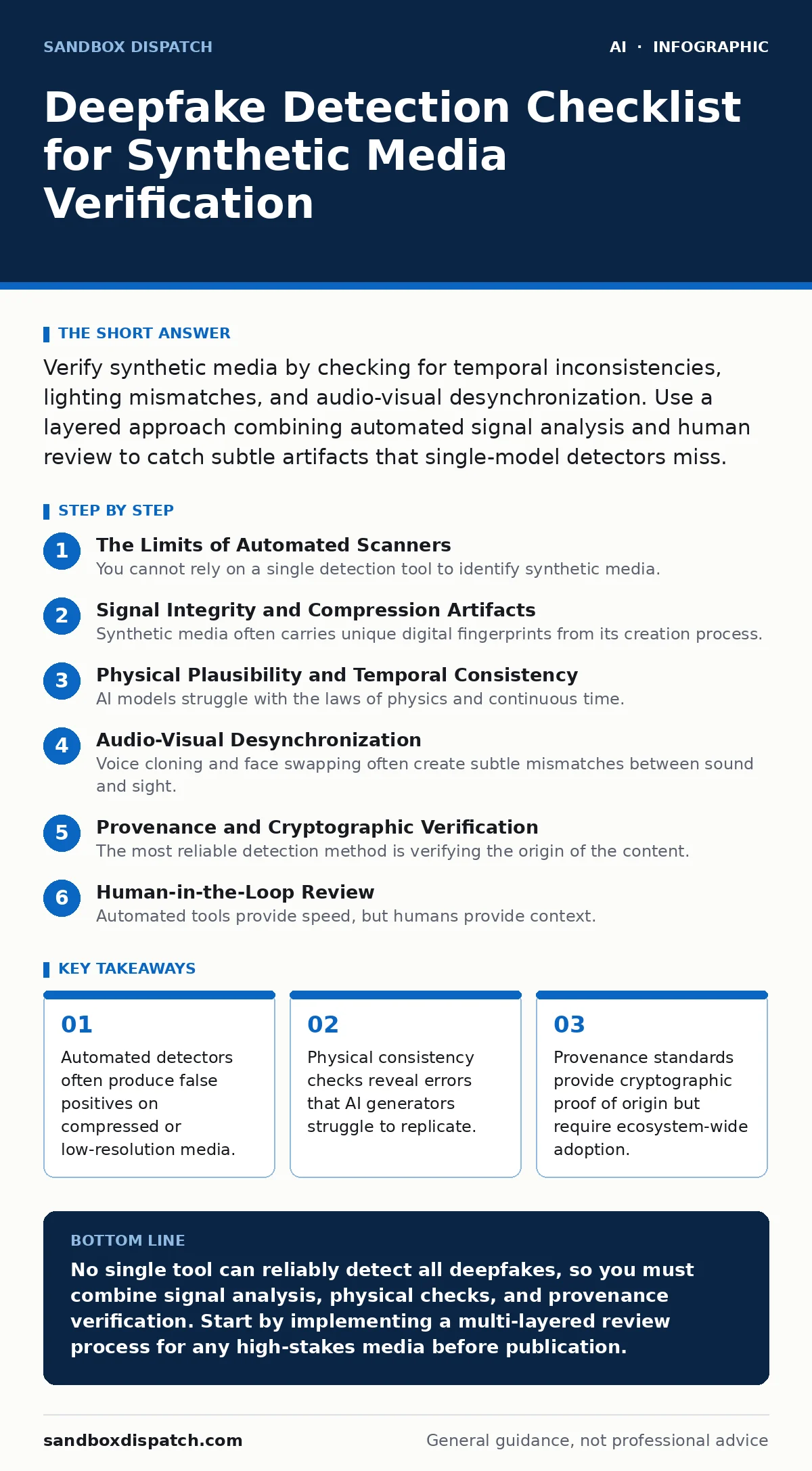
Verify synthetic media by checking for temporal inconsistencies, lighting mismatches, and audio-visual desynchronization. Use a layered approach combining automated signal analysis and human review to catch subtle artifacts that single-model detectors miss.
The Limits of Automated Scanners
You cannot rely on a single detection tool to identify synthetic media. Most commercial detectors train on specific generation models, meaning they struggle when facing new architectures. This creates a moving target where today’s reliable scanner becomes tomorrow’s obsolete tool. You must treat automated scores as indicators, not verdicts. The system flags anomalies, but it does not understand context.
Signal Integrity and Compression Artifacts
Synthetic media often carries unique digital fingerprints from its creation process. You must examine the raw signal for inconsistencies that natural cameras do not produce.
- Check for uniform noise patterns: Real sensors have random noise; generated images often have structured or absent noise.
- Analyze compression artifacts: Deepfakes are often re-encoded, leaving blocky edges or inconsistent JPEG quantization tables.
- Verify metadata provenance: Examine EXIF data for signs of manipulation or missing camera identifiers.
- Inspect frequency domain anomalies: Fourier transforms can reveal regular patterns invisible to the human eye.
These checks matter because generation models optimize for visual fidelity, not signal realism. They often fail to replicate the complex noise profiles of optical sensors.
Physical Plausibility and Temporal Consistency
AI models struggle with the laws of physics and continuous time. You can spot fakes by looking for breaks in physical logic.
- Monitor eye blink rates: Generated faces often blink too rarely or with unnatural timing.
- Check lip-sync alignment: Audio and mouth movements may drift slightly out of phase over time.
- Observe lighting coherence: Shadows and highlights must match the light source across all objects.
- Verify background motion: Static backgrounds should not warp when the subject moves.
- Assess hair and edge rendering: Fine details like hair often blend incorrectly into the background.
These indicators matter because generative models process frames independently or with limited temporal context. They do not understand that a shadow must move with the object casting it. This relates to adversarial examples, where small perturbations can fool models, but physical laws remain constant.
Audio-Visual Desynchronization
Voice cloning and face swapping often create subtle mismatches between sound and sight. You must listen and watch simultaneously to catch these errors.
- Listen for spectral artifacts: Synthesized voices may lack high-frequency breath sounds or have unnatural resonance.
- Check for prosody mismatches: The rhythm of speech may not match the emotional tone of the facial expression.
- Verify mouth-closure timing: Lips may close before or after the sound ends.
- Assess environmental audio: Background noise should remain consistent unless the scene changes.
These checks matter because audio generation and video generation are often separate processes. The alignment between them is rarely perfect, especially in long sequences. This is distinct from AI hallucinations, which refer to factual errors in text, whereas this is a sensory mismatch.
Provenance and Cryptographic Verification
The most reliable detection method is verifying the origin of the content. You should look for cryptographic signatures that prove the media was created by a specific device.
- Validate Content Authenticity Initiative (CAI) signatures: Check for embedded proofs of origin.
- Verify C2PA compliance: Ensure the file includes a manifest of edits and creation tools.
- Check for watermarking: Some platforms embed invisible watermarks to flag synthetic content.
- Confirm source chain: Trace the media back to the original capture device.
These items matter because they shift trust from detection to verification. You do not need to prove something is fake; you prove it is real. This aligns with the EU AI Act requirements for transparency and traceability in high-risk AI systems.
See also: Treat AI Models as Untrusted Insiders: 6 Common Misunderstandings
Human-in-the-Loop Review
Automated tools provide speed, but humans provide context. You must integrate human judgment to interpret ambiguous results.
- Cross-reference with known sources: Verify the event or person through independent channels.
- Assess contextual plausibility: Does the content make sense given the current situation?
- Review flagged anomalies manually: Investigate every alert from automated scanners.
- Document the verification process: Keep records of how you determined the media’s authenticity.
This step matters because agentic AI systems may generate content that is technically perfect but contextually wrong. Human intuition catches logical errors that statistical models miss. This approach supports explainable AI principles by requiring a human-readable justification for the verdict.
Integration with Existing Security Posture
Deepfake detection is not a standalone task. It must fit into your broader security strategy.
- Update incident response plans: Include procedures for verifying media during crises.
- Train staff on recognition: Teach teams to spot common artifacts and verify sources.
- Monitor for AI model theft: Ensure your proprietary detection models are not exposed.
- Review retrieval-augmented generation security: Prevent RAG systems from using unverified synthetic media as training data.
These actions matter because a breach in media integrity can lead to reputational damage or financial loss. You must treat synthetic media as a vector for social engineering. This connects to large language models security, as LLMs may generate text that supports fake media.
Key takeaways
- Automated detectors often produce false positives on compressed or low-resolution media.
- Physical consistency checks reveal errors that AI generators struggle to replicate.
- Provenance standards provide cryptographic proof of origin but require ecosystem-wide adoption.
No single tool can reliably detect all deepfakes, so you must combine signal analysis, physical checks, and provenance verification. Start by implementing a multi-layered review process for any high-stakes media before publication.
Frequently asked questions
How do I detect a deepfake video on my phone?
Use dedicated detection apps that analyze metadata and visual artifacts, but always cross-reference with trusted sources for critical content.
Are watermarks enough to prevent deepfake misuse?
Watermarks help identify origin but can be removed or forged; they should be part of a broader provenance strategy.
Can I trust automated detection scores?
No, automated scores are probabilistic and can produce false positives; always verify ambiguous results with human review.
What is the role of C2PA in deepfake detection?
C2PA provides a standard for embedding cryptographic proofs of origin, allowing you to verify the authenticity of media files.
How this guide was produced: written by the Sandbox Dispatch editorial team with AI assistance, checked against the public references listed below, and reviewed when the facts change. See our editorial policy or report an error.