Difference Between Intrusion Detection and Prevention System
Prevention systems drop traffic automatically, which blocks zero-day exploits but also halts legitimate business processes when the rule set misinterprets normal application behavior.

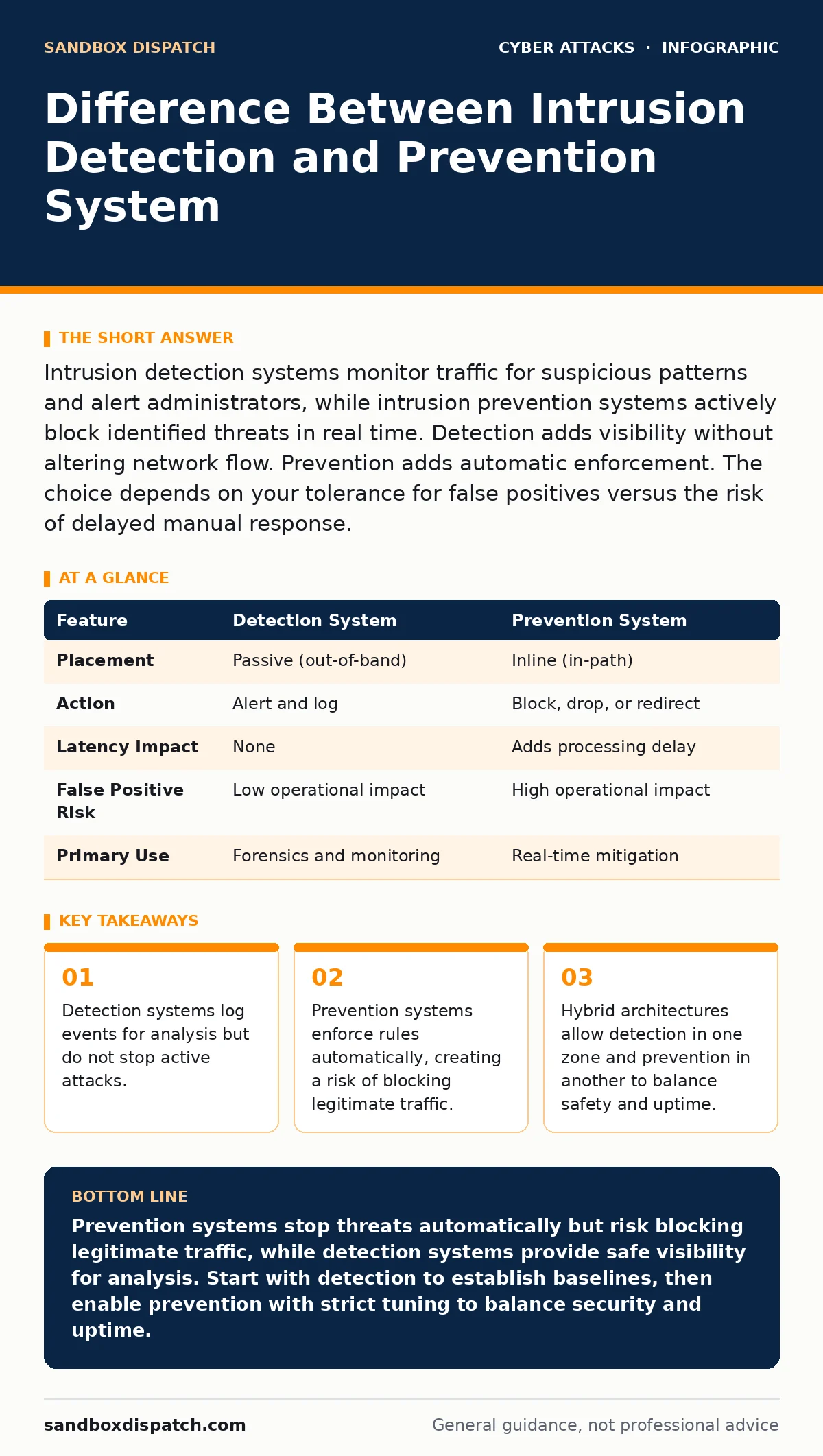
Intrusion detection systems monitor traffic for suspicious patterns and alert administrators, while intrusion prevention systems actively block identified threats in real time. Detection adds visibility without altering network flow. Prevention adds automatic enforcement. The choice depends on your tolerance for false positives versus the risk of delayed manual response.
What is the difference between intrusion detection and prevention system?
An intrusion detection system observes network traffic and raises alarms when it matches known threat signatures or anomalous behavior patterns. An intrusion prevention system performs the same observation but adds an active component that drops or rejects malicious packets before they reach their destination. The detection variant provides visibility for forensic analysis. The prevention variant provides automatic mitigation. You choose detection when you need to analyze traffic without interrupting it. You choose prevention when you need to stop threats before they execute.
How does an intrusion detection system operate?
An intrusion detection system sits passively on the network, often connected via a span port or network tap to copy traffic without interfering with it. It compares packet headers and payloads against a database of known attack signatures. It also uses heuristic analysis to identify deviations from baseline behavior, such as unusual data volumes or unexpected protocol sequences. When a match occurs, the system generates a log entry and sends an alert to your security information and event management platform. It does not modify the packet stream. This passive stance ensures that no legitimate traffic is ever blocked by mistake.
How does an intrusion prevention system operate?
An intrusion prevention system sits inline between the network source and the destination, forcing all traffic to pass through its inspection engine. It applies the same signature and heuristic checks as a detection system but includes an action module. When a threat is identified, the system immediately drops the packet, resets the connection, or redirects the traffic to a quarantine zone. This active intervention happens in milliseconds, often before the application layer processes the request. The trade-off is that any error in rule configuration results in immediate service disruption. You must tune rules carefully to avoid blocking critical business functions.
Which system creates more false positives?
Prevention systems generate more impactful false positives because they take action without human confirmation. A misconfigured rule in a prevention system can block a legitimate software update or a valid API call, causing immediate downtime. Detection systems also produce false positives, but they manifest as noisy alerts rather than service outages. You can ignore a false alarm in a detection log without consequence. You cannot ignore a blocked transaction in a prevention log. The cost of error in prevention is higher, requiring stricter validation of rules before deployment.
| Feature | Detection System | Prevention System |
|---|---|---|
| Placement | Passive (out-of-band) | Inline (in-path) |
| Action | Alert and log | Block, drop, or redirect |
| Latency Impact | None | Adds processing delay |
| False Positive Risk | Low operational impact | High operational impact |
| Primary Use | Forensics and monitoring | Real-time mitigation |
When should you use detection instead of prevention?
You should use detection in environments where traffic integrity is paramount and any interruption is unacceptable. High-frequency trading networks, real-time financial transaction systems, and critical medical data streams often prefer detection. In these cases, the cost of a blocked legitimate packet exceeds the cost of a delayed threat response. You also use detection during the initial deployment phase of a new application. You observe traffic patterns for weeks to establish a baseline before enabling any blocking rules. This approach prevents the prevention system from blocking normal application behavior that it has not yet learned to trust.
See also: Password Spraying Mistakes That Leave Your Account Open · Angler Phishing Attack: How Social Media Hijacking Steals Credentials
What are the hidden costs of prevention systems?
Prevention systems introduce latency into the network path because every packet must be inspected before forwarding. While modern hardware minimizes this delay, high-throughput networks may experience bottlenecks during peak traffic periods. The configuration overhead is also significant. You must regularly update signature databases and tune heuristic thresholds to adapt to changing application behaviors. A rule that was safe last month may block a new feature release today. The maintenance burden is higher than for detection systems, which simply record events. You pay for prevention with engineering time and potential performance degradation.
How do these systems handle encrypted traffic?
Both detection and prevention systems struggle with encrypted traffic because they cannot inspect the payload without decrypting it. To inspect encrypted data, the system must perform a man-in-the-middle decryption, which requires access to private keys or the installation of trusted certificates on client devices. This process adds significant computational overhead and raises privacy concerns. If you cannot decrypt the traffic, the system can only analyze metadata, such as packet size, timing, and source-destination pairs. This limited visibility reduces the effectiveness of both detection and prevention against sophisticated attacks hidden within encrypted tunnels.
What happens when both systems fail?
No network security tool provides complete protection against all threats. Advanced persistent threats may use techniques that bypass both signature-based and heuristic-based analysis. If your prevention system fails to block a threat, your detection system should still log the activity for later analysis. This layered approach ensures that even if the first line of defense fails, you retain visibility into the attack. You must have an incident response plan in place to handle breaches that slip through automated controls. The system’s failure does not mean the end of your security posture; it means the start of your manual investigation.
How do you integrate these systems with other controls?
Intrusion detection and prevention systems work best when integrated with broader security frameworks. They can trigger automated responses in other systems, such as isolating an infected endpoint or blocking a malicious IP address at the firewall. For example, if a prevention system detects a brute force attempt, it can share the attacker’s IP with your email security tools to block associated email spoofing attempts. You can also use detection logs to refine your login alerts, ensuring that only genuine anomalies trigger notifications. This integration reduces the workload on security teams by automating the correlation of events across different domains.
What is the role of human analysis in these systems?
Automated systems excel at volume but lack context. A prevention system may block a script that looks malicious but is actually a legitimate administrative tool. Human analysts review the alerts and logs to distinguish between true threats and benign anomalies. You need skilled personnel to interpret the data, update rules, and investigate incidents that the system cannot resolve automatically. The technology provides the raw data; the humans provide the judgment. Without human oversight, the system becomes a rigid filter that breaks under unexpected conditions.
Key takeaways
- Detection systems log events for analysis but do not stop active attacks.
- Prevention systems enforce rules automatically, creating a risk of blocking legitimate traffic.
- Hybrid architectures allow detection in one zone and prevention in another to balance safety and uptime.
Prevention systems stop threats automatically but risk blocking legitimate traffic, while detection systems provide safe visibility for analysis. Start with detection to establish baselines, then enable prevention with strict tuning to balance security and uptime.
Frequently asked questions
Can an intrusion detection system block an attack?
No, an intrusion detection system only monitors and alerts. It does not have the authority or mechanism to drop packets or reset connections. You must configure a separate prevention system or firewall to block the traffic based on the detection alerts.
Do I need both systems in my network?
You do not strictly need both, but using them together provides layered defense. Detection offers broad visibility without risk, while prevention offers automatic mitigation. Many modern devices combine both functions, allowing you to switch modes per rule or zone.
How do these systems help with password spraying?
They detect rapid, repeated login failures from a single source or across multiple accounts. Prevention systems can automatically block the source IP after a threshold is reached. Detection systems log the attempts for later analysis and correlation with other suspicious activities.
Are these systems effective against DNS hijacking?
They can detect unusual DNS query patterns or responses to known malicious domains. Prevention systems can block queries to hijacked DNS servers. However, they do not fix the root cause of the hijack, which often requires coordination with your domain registrar and ISP.
How this guide was produced: written by the Sandbox Dispatch editorial team with AI assistance, checked against the public references listed below, and reviewed when the facts change. See our editorial policy or report an error.