Ransomware Decryption Tools Explained: When They Work and When They Fail
Most ransomware decryption tools only work because the criminals made a mistake in their encryption logic, not because law enforcement cracked the code.

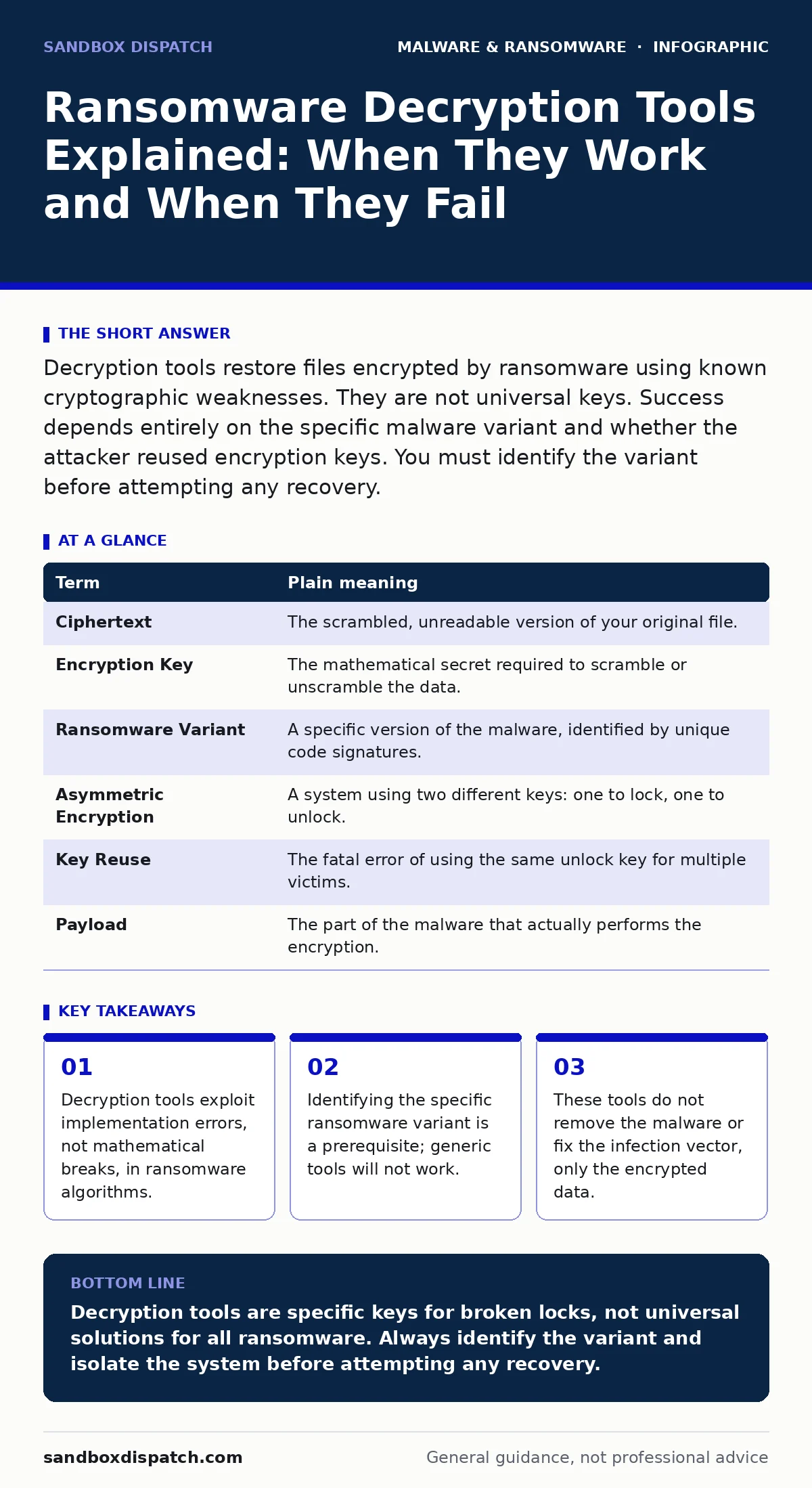
Decryption tools restore files encrypted by ransomware using known cryptographic weaknesses. They are not universal keys. Success depends entirely on the specific malware variant and whether the attacker reused encryption keys. You must identify the variant before attempting any recovery.
The Broken Lock Analogy
Imagine a thief who locks your filing cabinets with cheap padlocks. The thief claims the locks are unbreakable. In reality, the thief used the same combination for every cabinet in the building. You do not need to pick the lock. You only need to find one cabinet the thief forgot to change, note the combination, and apply it to the rest.
Ransomware decryption tools operate on this same principle. They do not defeat modern cryptography. They exploit the lazy or broken implementation of that cryptography by the attackers. If the malware uses a unique, strong key for every file and every victim, decryption is mathematically impossible without the original key.
Why Decryption Is Rarely Possible
Strong encryption algorithms like AES are secure when implemented correctly. The security relies on the secrecy and uniqueness of the encryption key. If an attacker generates a fresh, random key for each victim and never shares it, no tool can reverse the process.
Decryption becomes possible only when the attacker makes a mistake. This might involve reusing the same key across multiple victims. It might involve storing the key insecurely on a server that gets seized. Or it might involve a bug in the code that leaves some files unencrypted or reversible.
| Term | Plain meaning |
|---|---|
| Ciphertext | The scrambled, unreadable version of your original file. |
| Encryption Key | The mathematical secret required to scramble or unscramble the data. |
| Ransomware Variant | A specific version of the malware, identified by unique code signatures. |
| Asymmetric Encryption | A system using two different keys: one to lock, one to unlock. |
| Key Reuse | The fatal error of using the same unlock key for multiple victims. |
| Payload | The part of the malware that actually performs the encryption. |
The Critical First Step
You cannot decrypt files until you know exactly which ransomware variant encrypted them. Different variants use different algorithms and leave different artifacts. Using a tool for one variant on another will fail or corrupt data further.
Many families of malware leave a specific ransom note or change file extensions in a predictable way. Security researchers analyze these patterns to create identifiers. You must match your symptoms to a known variant before searching for a tool.
Where Tools Come From
Most free decryption tools are created by security vendors and law enforcement agencies. They release these tools when they capture command-and-control servers or find flaws in the malware code. These tools are public goods, available to anyone with the matching variant.
These tools are not magic wands. They are highly specific scripts. A tool for one branch of a ransomware family will not work on a newer version of that same family. The attackers frequently update their code to patch the very flaws that allow decryption.
The Hidden Cost of Success
Even if you successfully decrypt your files, the threat is not over. The malware remains on your system. It may still have established persistence mechanisms, allowing it to re-infect you. It may have stolen data before encrypting it, leading to extortion attempts.
Decrypting files does not remove the backdoor the attackers left open. You must treat the machine as compromised. You need to remove the malware completely and audit your system for other signs of intrusion.
Try This Now
- Identify the variant: Use a free online identifier tool provided by reputable security researchers. Upload the ransom note or a sample of the encrypted file to get a precise name.
- Check for a tool: Visit the No More Ransom project or similar public databases. Search for the identified variant to see if a decryption utility exists.
- Isolate and test: If a tool exists, disconnect the infected machine from the network. Test the decryption on a single, non-critical file before attempting full recovery.
Why You Should Not Pay
Paying the ransom does not guarantee you will receive the decryption key. It funds further criminal activity. More importantly, it signals that you are willing to pay, making you a target for future attacks.
Using a free decryption tool is the only safe path if one exists. If no tool exists, your only option is to restore from clean backups. This reinforces the need for offline backups that cannot be reached by network-based threats.
The Role of Prevention
Decryption tools are a last resort. They are reactive measures for when prevention fails. Relying on them is risky because they are not available for all variants.
The best defense is to make encryption ineffective. If attackers cannot reach your files, they cannot encrypt them. This involves segmenting your network and limiting permissions. It also means blocking the initial entry points, such as through browser isolation or script blocking.
Key takeaways
- Decryption tools exploit implementation errors, not mathematical breaks, in ransomware algorithms.
- Identifying the specific ransomware variant is a prerequisite; generic tools will not work.
- These tools do not remove the malware or fix the infection vector, only the encrypted data.
Decryption tools are specific keys for broken locks, not universal solutions for all ransomware. Always identify the variant and isolate the system before attempting any recovery.
Frequently asked questions
Can I decrypt files if I don't know which ransomware variant I have?
No. You must identify the specific variant first. Using the wrong tool will not work and may damage your data further.
Do decryption tools remove the ransomware from my computer?
No. They only restore the encrypted files. You must still remove the malware manually or with dedicated removal tools.
Why do some ransomware variants have no decryption tools?
These variants likely use strong, unique encryption keys for each victim. Without a flaw in the implementation or key reuse, reversal is impossible.
Are these decryption tools safe to use?
Yes, if downloaded from reputable public sources like the No More Ransom project. Always verify the source to avoid downloading more malware.
How this guide was produced: written by the Sandbox Dispatch editorial team with AI assistance, checked against the public references listed below, and reviewed when the facts change. See our editorial policy or report an error.