Breach and Attack Simulation Best Practices for Secure Infrastructure
Static scans miss logic flaws, but continuous simulation reveals exactly where your defenses fail when an attacker chains multiple weak points together.

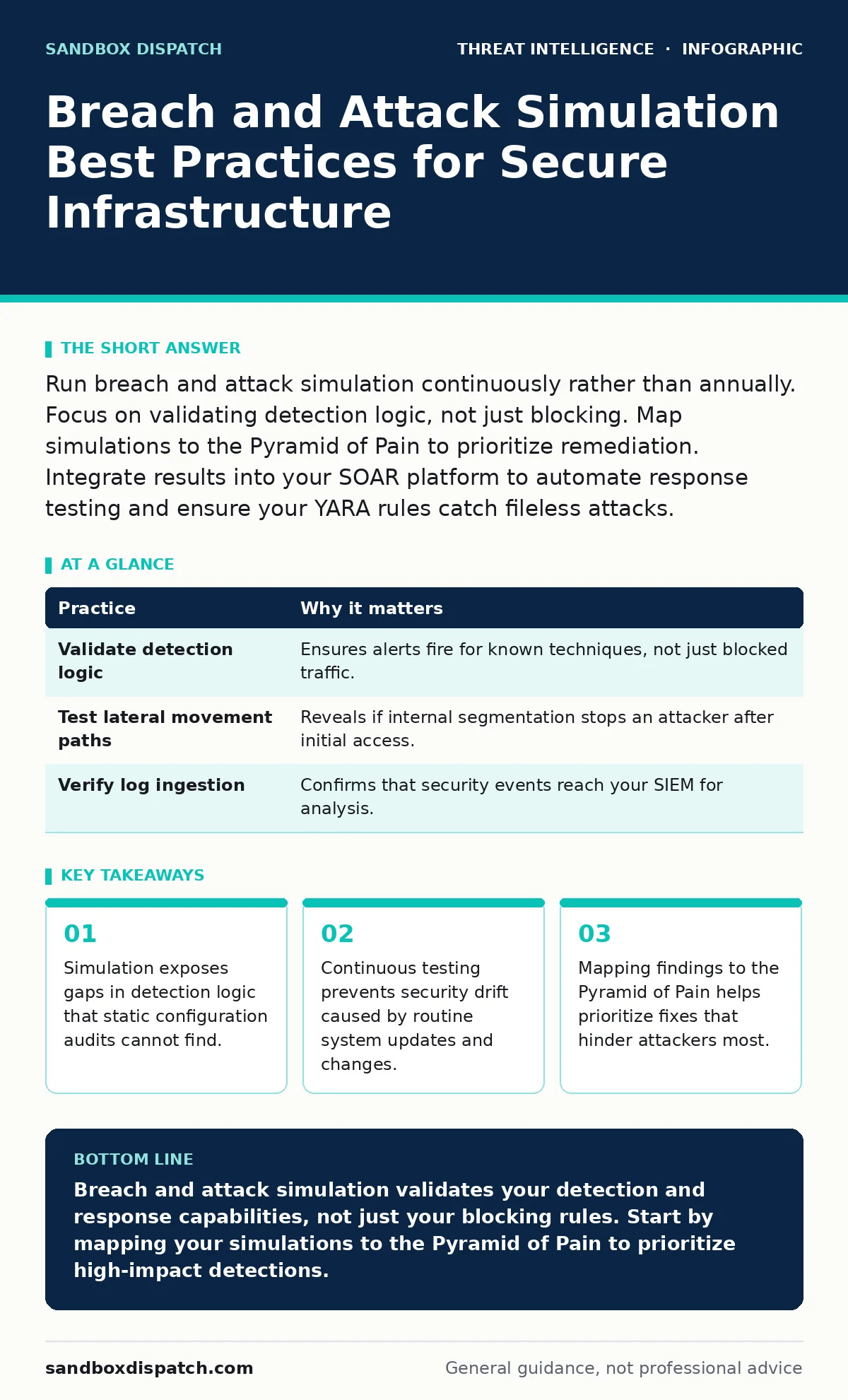
Run breach and attack simulation continuously rather than annually. Focus on validating detection logic, not just blocking. Map simulations to the Pyramid of Pain to prioritize remediation. Integrate results into your SOAR platform to automate response testing and ensure your YARA rules catch fileless attacks.
Validating Detection Logic Over Blocking
Breach and attack simulation, or BAS, is often misunderstood as a replacement for penetration testing. It is not. Penetration testing is a point-in-time assessment of exploitability. BAS is a continuous verification of your defensive controls. You need to know if your security information and event management system generates an alert when a specific technique occurs.
Imagine you have a firewall rule that blocks inbound traffic on a specific port. A static scan confirms the rule exists. It does not confirm that the rule fires when traffic arrives, nor does it confirm that the resulting log reaches your monitoring dashboard. BAS closes this gap. It generates benign traffic that mimics real attack patterns to verify that your sensors see the activity and your analysts receive the alert.
The goal is not to stop the simulated attack. The goal is to prove that your organization sees it. If the simulation completes without triggering an alert, your detection logic has failed. This is a critical distinction. You are testing the visibility of your security stack, not the strength of your perimeter.
| Practice | Why it matters |
|---|---|
| Validate detection logic | Ensures alerts fire for known techniques, not just blocked traffic. |
| Test lateral movement paths | Reveals if internal segmentation stops an attacker after initial access. |
| Verify log ingestion | Confirms that security events reach your SIEM for analysis. |
Mapping to the Pyramid of Pain
Not all security improvements are equal. Some actions are easy for attackers to change, while others force them to rebuild their entire operation. The Pyramid of Pain is a framework that ranks indicators of compromise by how difficult they are for an adversary to change. Low-level indicators, like IP addresses, are easy to swap. High-level indicators, like tactics and techniques, are hard to abandon.
When you run a simulation, you must map the results to this framework. If your simulation shows that you cannot detect a specific command-and-control communication channel, that is a high-value finding. It forces the attacker to change their infrastructure. If you only detect the file hash of a malicious script, the attacker can simply recompile the script with a different hash.
Focus your remediation efforts on detecting behaviors that sit high on the Pyramid. This approach maximizes the cost for the attacker. It makes their operations slower and more expensive. It also reduces the volume of alerts you need to triage, as you focus on persistent behaviors rather than transient artifacts.
Integrating with SOAR Workflows
Security orchestration, automation, and response, or SOAR, platforms are designed to handle repetitive tasks. They can enrich alerts, block IPs, or isolate hosts. However, automation is only as good as the logic that drives it. If your playbooks contain errors, they will execute those errors at scale.
BAS provides a safe environment to test these playbooks. You can trigger a simulation that mimics a specific attack, such as pass-the-ticket attacks, which involve stealing authentication tokens to move laterally. Your SOAR platform should automatically respond by isolating the affected account or resetting credentials. If the automation fails, you discover the flaw before a real incident occurs.
This integration turns your security stack into a self-verifying system. You are no longer relying on manual checks to ensure your automation works. The simulation acts as a continuous test harness for your response capabilities. This reduces the risk of failed automation during a real crisis.
Testing Fileless Attack Detection
Fileless attacks do not drop malicious executables on disk. They operate in memory, using legitimate system tools like PowerShell or Windows Script Host. Traditional antivirus software often misses these threats because there is no file to scan. This is where YARA rules, which are pattern-matching signatures used to identify and classify malware, become vital.
You must test your YARA rules against simulated fileless activity. Create a simulation that executes a known malicious script in memory. Check if your endpoint detection and response system triggers the correct YARA rule. If it does not, your rules may be too generic or too specific.
Generic rules generate false positives, causing alert fatigue. Specific rules miss variations of the attack. BAS helps you find the balance. It allows you to tune your rules until they catch the malicious behavior without triggering on legitimate administrative tasks. This tuning is essential for maintaining high detection rates without overwhelming your analysts.
Simulating Scheduled Task Abuse
Attackers often use scheduled tasks to persist on a system. They create a task that runs a malicious script at regular intervals. This technique is common in cyber espionage campaigns because it is stealthy and uses legitimate system functionality. Defending against it requires monitoring for the creation and modification of scheduled tasks.
Run a simulation that attempts to create a new scheduled task. Verify that your system generates an alert for this specific action. Check if the alert includes the name of the task, the user who created it, and the command it will execute. If any of this information is missing, your logging configuration is incomplete.
Incomplete logging makes it difficult to investigate incidents. You may know that something happened, but you will not know who did it or what they tried to do. BAS helps you identify these logging gaps. It ensures that your forensic data is sufficient to support incident response and legal proceedings.
See also: Incident Triage Meaning: How to Prioritize Alerts Fast
Verifying Internal Segmentation
Network segmentation is designed to limit the spread of an attack. If an attacker compromises a workstation, segmentation should prevent them from reaching critical servers. However, misconfigurations are common. Rules may be too permissive, or exceptions may have been added for convenience and never removed.
Use BAS to test lateral movement paths. Start a simulation on a low-privilege workstation. Attempt to move to a database server or a domain controller. If the simulation succeeds, your segmentation has failed. This is a critical finding. It means an attacker can move freely through your network.
Do not rely on network diagrams to verify segmentation. Diagrams are often outdated. Actual traffic tests provide ground truth. Regularly testing these paths ensures that your network design matches your security policy. It also helps you identify shadow IT connections that bypass your intended controls.
Continuous Testing in Development Pipelines
Security drift occurs when systems change faster than security controls are updated. New features, patches, and configurations can inadvertently introduce vulnerabilities or disable protections. Annual penetration testing cannot catch this drift. It only provides a snapshot of security at a single moment in time.
Integrate BAS into your continuous integration and continuous deployment pipelines. Run lightweight simulations whenever code is deployed or configurations are changed. This ensures that new changes do not break existing security controls. It shifts security left, catching issues before they reach production.
This practice aligns with the principles of DevSecOps. It makes security a continuous process rather than a periodic event. It reduces the window of exposure to misconfigurations. It also builds a culture of security accountability among development teams. They see the impact of their changes on security in real time.
Avoiding Alert Fatigue
Continuous simulation generates a high volume of alerts. If not managed carefully, this can lead to alert fatigue. Analysts may ignore alerts because they know some are from the simulation. This desensitization is dangerous. It can cause them to miss real attacks that look similar to the simulations.
You must clearly label simulation traffic in your logging and alerting systems. Use a specific tag or field to indicate that an alert originated from a simulation. This allows analysts to filter out simulation noise while reviewing real incidents. It also helps you tune your rules to reduce false positives from real traffic.
Do not run simulations during peak business hours if possible. Schedule them during maintenance windows or off-hours. This minimizes the impact on production systems and reduces the likelihood of confusing real users. It also allows you to review the results without the pressure of immediate incident response.
Key takeaways
- Simulation exposes gaps in detection logic that static configuration audits cannot find.
- Continuous testing prevents security drift caused by routine system updates and changes.
- Mapping findings to the Pyramid of Pain helps prioritize fixes that hinder attackers most.
Breach and attack simulation validates your detection and response capabilities, not just your blocking rules. Start by mapping your simulations to the Pyramid of Pain to prioritize high-impact detections.
Frequently asked questions
How often should I run breach and attack simulations?
Run them continuously or at least weekly. Security configurations change frequently, so continuous testing ensures your defenses remain effective against current threats.
How do I choose which techniques to simulate?
Focus on techniques that are relevant to your industry and infrastructure. Use threat intelligence to identify the most likely attack vectors. Prioritize techniques that sit high on the Pyramid of Pain.
How this guide was produced: written by the Sandbox Dispatch editorial team with AI assistance, checked against the public references listed below, and reviewed when the facts change. See our editorial policy or report an error.