How XDR Works: The Mechanics of Unified Threat Detection
Extended detection and response correlates siloed telemetry to find attacks that bypass single-layer security controls, revealing hidden lateral movement across your infrastructure.

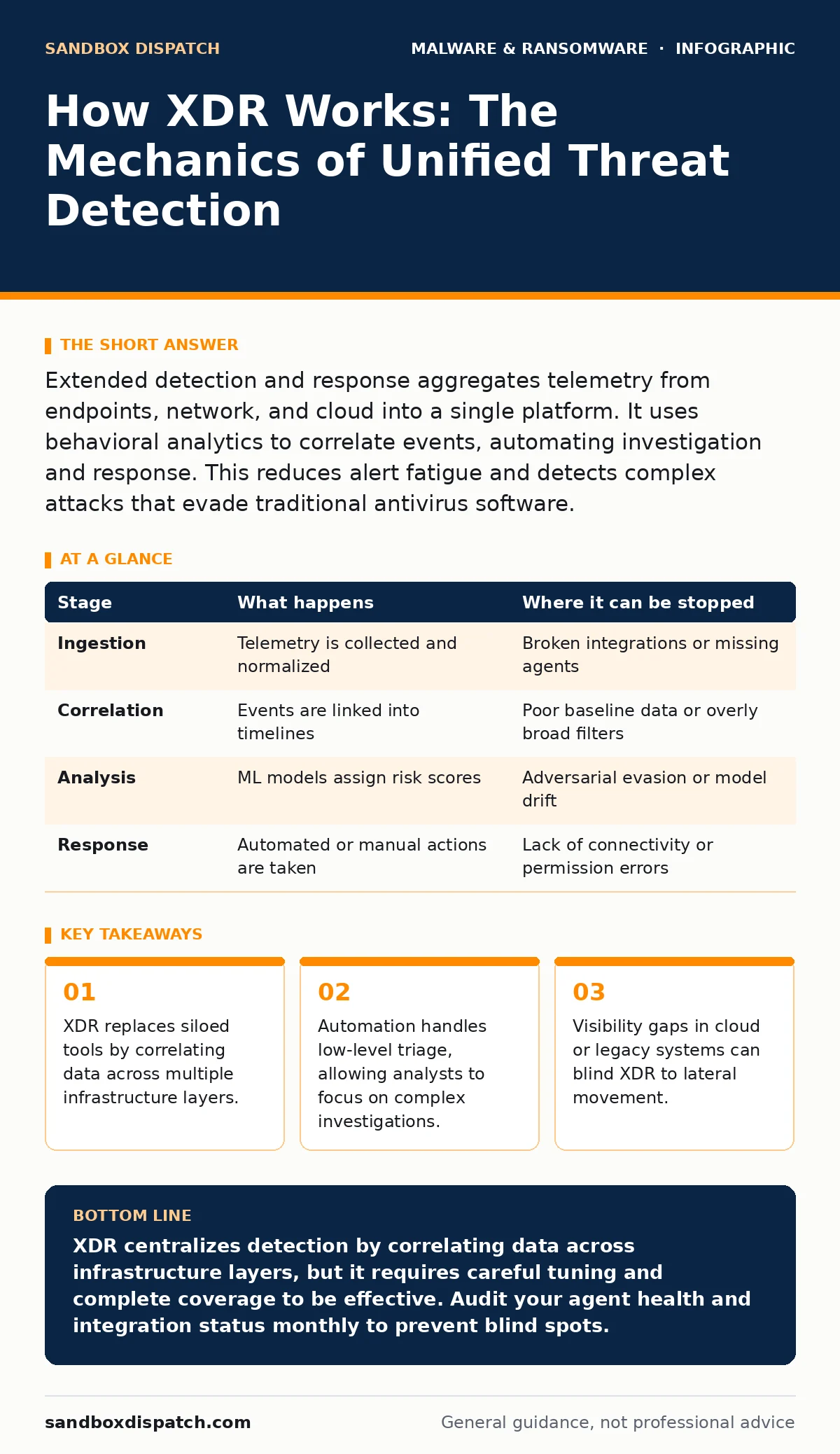
Extended detection and response aggregates telemetry from endpoints, network, and cloud into a single platform. It uses behavioral analytics to correlate events, automating investigation and response. This reduces alert fatigue and detects complex attacks that evade traditional antivirus software.
The Data Ingestion Challenge
Traditional security tools operate in isolation. An endpoint detection and response agent sees file changes, while a firewall sees network traffic. Extended detection and response changes this by centralizing telemetry. It pulls data from endpoints, networks, email servers, and cloud workspaces into a single repository.
This aggregation is not merely storage. It requires normalization. Different vendors use different formats for logs. The XDR platform must translate these varied inputs into a common schema. Without this step, the system cannot compare a login event from a cloud app with a process execution on a local server.
The volume of data is significant. A single enterprise generates terabytes of telemetry daily. The platform must filter noise before analysis. It discards routine, benign events to preserve computational resources. This filtering introduces the first risk. If the filter is too aggressive, it may discard subtle indicators of compromise.
Correlation and Contextualization
Once data is ingested, the engine looks for relationships. A single event is rarely malicious. A user logging in is normal. A user logging in from an unusual location at 3 a.m. is suspicious. The XDR engine applies rules and machine learning models to these events.
It builds a timeline of activity. It connects disparate dots. For example, it might link a phishing email click to a subsequent PowerShell execution. This context is vital. It transforms isolated alerts into a coherent narrative. The system assigns a risk score based on this narrative.
This stage relies heavily on historical baseline data. The system learns what "normal" looks like for each user and device. Deviations from this baseline trigger alerts. The accuracy of this detection depends on the quality of the baseline. If the baseline is noisy, the system generates false positives.
| Stage | What happens | Where it can be stopped |
|---|---|---|
| Ingestion | Telemetry is collected and normalized | Broken integrations or missing agents |
| Correlation | Events are linked into timelines | Poor baseline data or overly broad filters |
| Analysis | ML models assign risk scores | Adversarial evasion or model drift |
| Response | Automated or manual actions are taken | Lack of connectivity or permission errors |
Behavioral Analysis Engines
Static signatures are insufficient against modern threats. They only detect known malware. Behavioral analysis looks at what a process does, not what it is. It monitors system calls, memory access, and network connections. This allows detection of fileless attacks and custom scripts.
The engine uses heuristics to identify suspicious behavior. It looks for sequences of actions that match attack patterns. For instance, it might flag a document that spawns a shell process. This is not a signature match. It is a behavioral anomaly.
Machine learning models enhance this process. They are trained on vast datasets of malicious and benign activity. They can identify subtle patterns that rule-based systems miss. However, these models are not infallible. They can be fooled by novel attack techniques that do not resemble training data.
Automated Investigation Workflows
High-fidelity alerts reduce noise, but they still require attention. XDR platforms automate the initial investigation. They run playbooks to gather additional context. These playbooks are pre-defined sequences of actions. They might query a threat intelligence service or isolate a host.
This automation speeds up response times. It allows the system to act before an analyst picks up the alert. For example, it can automatically disable a compromised user account. This limits the damage window. It prevents the attacker from moving laterally.
However, automation carries risks. If the playbook is flawed, it can cause operational disruption. Isolating a critical server might halt business operations. The system must balance security with availability. You must configure these workflows carefully. Test them in a non-production environment first.
Human-in-the-Loop Response
Automation cannot handle every scenario. Complex incidents require human judgment. XDR provides a unified interface for analysts. It presents the correlated data in a single view. This eliminates the need to switch between multiple tools.
Analysts use this interface to validate alerts. They determine if an alert is a true positive. If it is, they initiate containment actions. These actions might include blocking an IP address or terminating a process. The platform logs these actions for audit purposes.
This human element is critical for handling edge cases. It allows for nuanced decision-making. The system can suggest actions, but the analyst makes the final call. This prevents automated systems from making catastrophic errors. It also allows for adaptation to new, unknown threats.
See also: What Is Attack Surface Management and How to Shrink It · Audit Logging Best Practices for Secure Systems
Limitations and Visibility Gaps
XDR is not a silver bullet. Its effectiveness depends on coverage. If a part of your infrastructure is not monitored, the XDR cannot see attacks there. This is common with legacy systems or air-gapped networks. These blind spots create vulnerabilities.
Integration complexity is another challenge. Connecting disparate systems requires careful configuration. If integrations are broken, data flows are interrupted. This reduces the platform's ability to correlate events. Regular maintenance is required to ensure health.
The platform also has processing limits. It cannot analyze every byte of traffic. It samples data or filters based on rules. Advanced attackers may craft traffic to evade these filters. They may use low-and-slow techniques to stay below detection thresholds.
Integration with Adjacent Defenses
XDR works best when paired with other security measures. It does not replace all security tools. It complements them. For instance, it can ingest logs from a firewall to understand network context. It can also trigger actions in an endpoint protection platform.
Consider how script blocking interacts with XDR. Script blocking prevents execution of unsigned scripts. This reduces the attack surface. The XDR can then focus on detecting execution of authorized scripts that behave maliciously. This layered approach improves detection accuracy.
Similarly, browser isolation prevents web-based attacks from reaching the endpoint. The XDR does not need to detect these attacks because they never land. This reduces noise and allows the XDR to focus on more sophisticated threats. Understanding these synergies is key to effective security.
Configuring for Precision
To get the most from XDR, you must tune it. Start with a conservative detection policy. Gradually tighten it as you understand the baseline. This avoids overwhelming your team with alerts.
Regularly review false positives. Update rules and models based on these reviews. This improves detection accuracy over time. Engage with your security vendor for updates. They often release new models and rules.
Test your response workflows frequently. Ensure they work as expected. Simulate attacks to validate detection and response. This builds confidence in the system. It also reveals gaps in coverage.
Key takeaways
- XDR replaces siloed tools by correlating data across multiple infrastructure layers.
- Automation handles low-level triage, allowing analysts to focus on complex investigations.
- Visibility gaps in cloud or legacy systems can blind XDR to lateral movement.
XDR centralizes detection by correlating data across infrastructure layers, but it requires careful tuning and complete coverage to be effective. Audit your agent health and integration status monthly to prevent blind spots.
Frequently asked questions
Does XDR replace antivirus software?
No, XDR complements antivirus. Antivirus blocks known malware signatures, while XDR detects behavioral anomalies across multiple layers of your infrastructure.
Can XDR detect ransomware?
Yes, XDR can detect ransomware by identifying encryption behaviors and rapid file modifications. It can also isolate infected hosts to prevent spread, though **ransomware decryption tools** are needed for recovery.
How does XDR handle cloud workloads?
XDR platforms integrate with cloud providers to collect logs from SaaS, IaaS, and PaaS. They monitor for unusual API calls, privilege escalation, and data exfiltration in cloud environments.
Is XDR effective against insider threats?
XDR can detect insider threats by correlating user activity across endpoints and network. It identifies deviations from normal behavior, such as accessing sensitive files at unusual times.
How this guide was produced: written by the Sandbox Dispatch editorial team with AI assistance, checked against the public references listed below, and reviewed when the facts change. See our editorial policy or report an error.