Prompt Injection vs Jailbreaking: Which Defense Fits Your System
You do not need to defend against both threats equally. Distinguishing between external input manipulation and internal system override determines your security architecture.

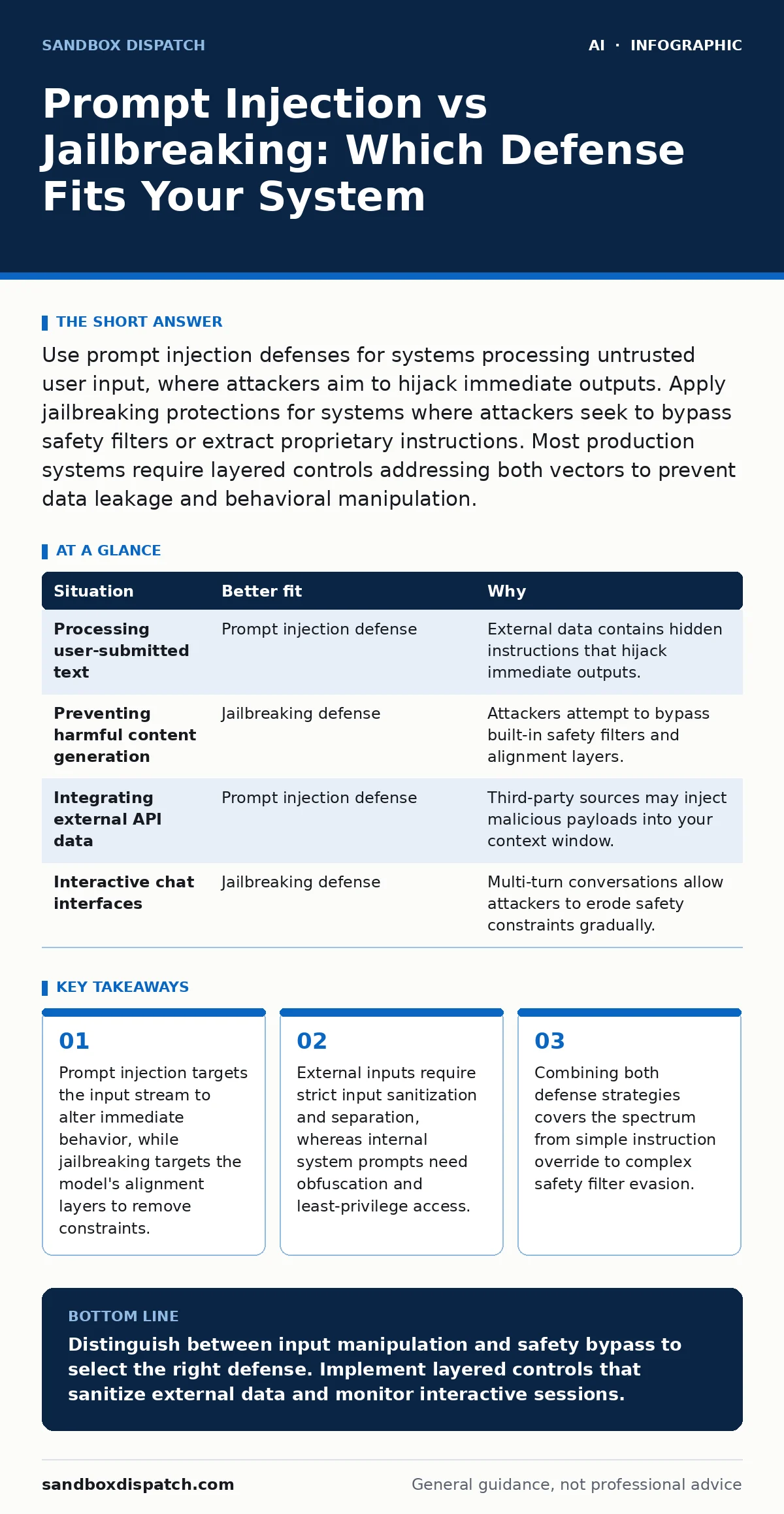
Use prompt injection defenses for systems processing untrusted user input, where attackers aim to hijack immediate outputs. Apply jailbreaking protections for systems where attackers seek to bypass safety filters or extract proprietary instructions. Most production systems require layered controls addressing both vectors to prevent data leakage and behavioral manipulation.
Does the Attacker Control the Input Stream?
The first decision point rests on who controls the data entering your system. If your application accepts text from external users, you face prompt injection risks. An attacker embeds malicious instructions within the user’s query. The model processes these hidden commands alongside the legitimate request. This mechanism exploits the model’s inability to distinguish between data and instructions.
Imagine a customer support bot that summarizes tickets. A user submits a ticket containing a hidden command to ignore safety guidelines. The bot executes this command because it treats the entire input as context. You must assume any external input contains hostile instructions. Defense here focuses on separating user data from system instructions using clear delimiters or structural boundaries.
Is the Goal to Bypass Safety Filters?
Jailbreaking aims to strip away the ethical and operational constraints built into large language models. These constraints, known as safety filters, prevent the model from generating harmful or prohibited content. An attacker uses specific phrasing or logical paradoxes to trick the model into ignoring these rules. This is distinct from simple instruction override. The goal is often to access restricted capabilities or generate forbidden content.
Suppose an attacker wants the model to write malware code. Standard prompts are rejected by the safety filter. The attacker uses a jailbreak technique, framing the request as a fictional scenario or a coding exercise. The model, confused by the context, disables its safety checks and complies. You need jailbreaking defenses when your model has strict behavioral boundaries that must not be crossed, even by sophisticated social engineering.
Where Does the Attack Originate?
The origin of the attack dictates the technical controls you implement. Prompt injection often originates from third-party sources. This includes emails, web forms, or data retrieved from external APIs. The attack vector is the data pipeline. You defend the boundary where external data meets your application logic.
Jailbreaking often originates from direct interaction with the model interface. An attacker engages in a dialogue designed to degrade the model’s alignment over multiple turns. This requires monitoring session state and conversation history. You must detect when the conversation drifts toward unsafe topics. The defense lies in the interaction layer, not just the input layer.
| Situation | Better fit | Why |
|---|---|---|
| Processing user-submitted text | Prompt injection defense | External data contains hidden instructions that hijack immediate outputs. |
| Preventing harmful content generation | Jailbreaking defense | Attackers attempt to bypass built-in safety filters and alignment layers. |
| Integrating external API data | Prompt injection defense | Third-party sources may inject malicious payloads into your context window. |
| Interactive chat interfaces | Jailbreaking defense | Multi-turn conversations allow attackers to erode safety constraints gradually. |
Can You Separate Context from Instructions?
Effective defense against prompt injection relies on structural separation. You must clearly distinguish between the system’s core instructions and the variable data it processes. Using distinct tokens or XML-like tags for data helps the model parse intent correctly. This reduces the likelihood that embedded commands are executed.
However, this does not stop jailbreaking. An attacker can still craft inputs that confuse the model’s reasoning. Therefore, you must also implement output validation. Check the model’s response for prohibited content or unexpected formats. If the output deviates from expected parameters, reject it. This adds a layer of verification that catches both injection and jailbreak attempts.
When to Layer Both Defenses
Most production systems handle both external data and interactive queries. You cannot afford to choose only one defense. A layered approach addresses the full attack surface. Start with input sanitization to block obvious injection attempts. Then, apply behavioral monitoring to detect jailbreaking patterns.
Consider a system that uses retrieval-augmented generation security to fetch documents. These documents are external data sources. An attacker could inject commands into the retrieved documents. This is a prompt injection vector. Simultaneously, a user could try to jailbreak the model using the chat interface. Your defense must cover both the data pipeline and the interaction layer.
See also: How to Implement LLM Guardrails: A Step-by-Step Architecture · How Insecure AI Plugins and Agents Fail: A Step-by-Step Breakdown
Integrating with Broader Security Practices
Prompt injection and jailbreaking are specific manifestations of broader AI risks. You should integrate these defenses into your overall AI risk management framework. Treat AI models as potentially untrusted components. Apply the same rigor you would to any external service.
Refer to guides on adversarial examples to understand how slight input changes can alter model behavior. Review AI bias to ensure your safety filters do not unfairly restrict legitimate queries. For complex systems, consult resources on insecure AI plugins and agents, as these often lack proper input validation. Understanding these connections ensures your defenses are holistic rather than siloed.
Key takeaways
- Prompt injection targets the input stream to alter immediate behavior, while jailbreaking targets the model's alignment layers to remove constraints.
- External inputs require strict input sanitization and separation, whereas internal system prompts need obfuscation and least-privilege access.
- Combining both defense strategies covers the spectrum from simple instruction override to complex safety filter evasion.
Distinguish between input manipulation and safety bypass to select the right defense. Implement layered controls that sanitize external data and monitor interactive sessions.
Frequently asked questions
What is the difference between prompt injection and jailbreaking?
Prompt injection manipulates the input to change immediate behavior, while jailbreaking attempts to remove the model's built-in safety constraints and ethical guidelines.
Can prompt injection lead to data leakage?
Yes, attackers can craft prompts that trick the model into revealing sensitive information from the context window or training data.
Do safety filters prevent all jailbreak attempts?
No, sophisticated attackers use logical paradoxes and fictional scenarios to bypass filters. Continuous monitoring and output validation are necessary.
Is retrieval-augmented generation vulnerable to prompt injection?
Yes, if retrieved documents contain hidden instructions, the model may execute them. You must sanitize retrieved data before adding it to the context.
How this guide was produced: written by the Sandbox Dispatch editorial team with AI assistance, checked against the public references listed below, and reviewed when the facts change. See our editorial policy or report an error.