AI-Generated Phishing Emails: How to Spot the Synthetic Trap
The real danger is not poor grammar but perfect mimicry that bypasses your brain’s natural skepticism and trust heuristics.

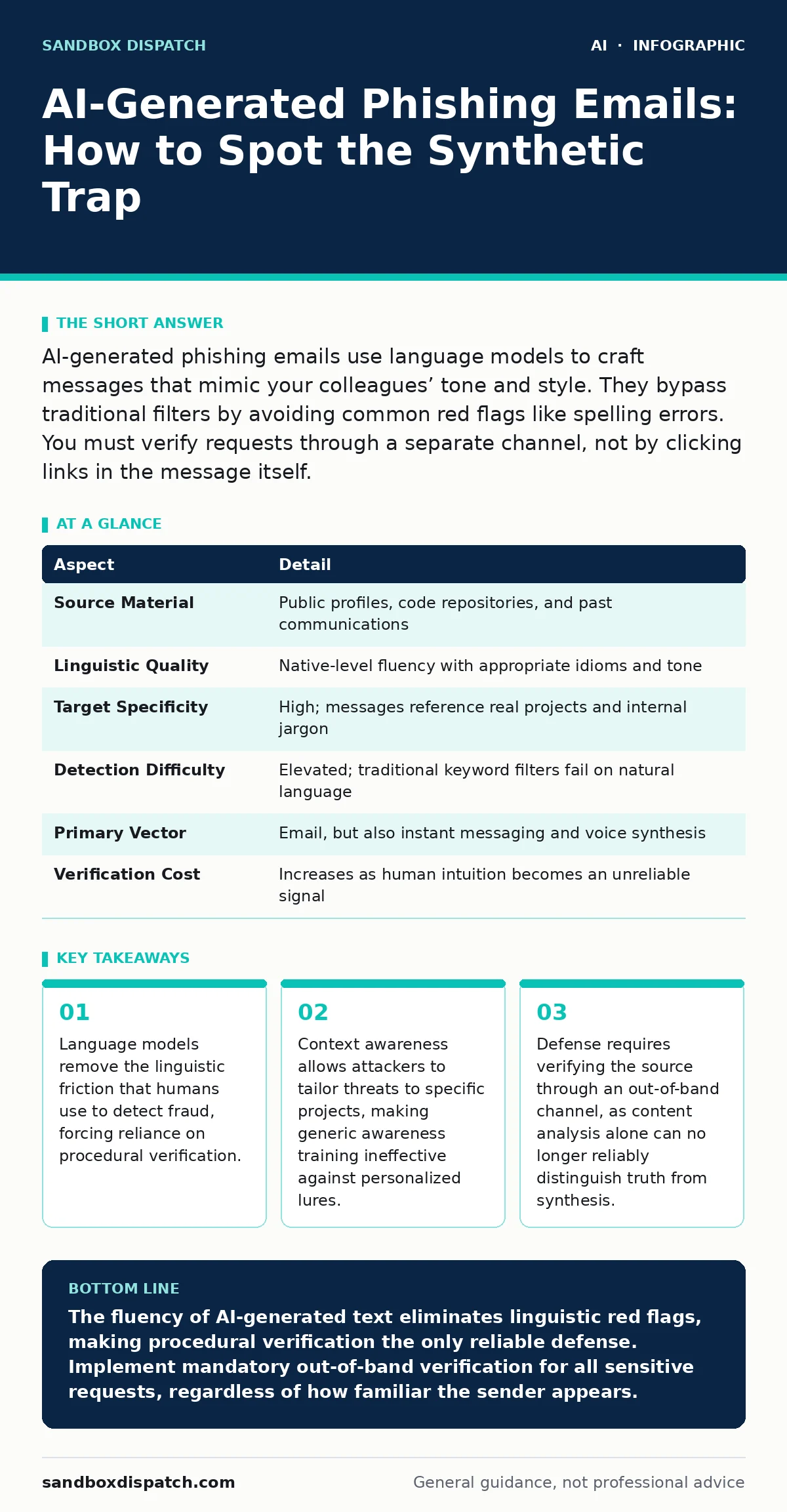
AI-generated phishing emails use language models to craft messages that mimic your colleagues’ tone and style. They bypass traditional filters by avoiding common red flags like spelling errors. You must verify requests through a separate channel, not by clicking links in the message itself.
The Mimicry Engine
Imagine receiving a note from your manager asking for login credentials to fix a server issue. The tone is casual, the urgency is real, and the grammar is flawless. You send the credentials. The request was fake. This scenario illustrates why AI-generated phishing emails represent a structural shift in social engineering.
Traditional phishing relied on broken English and generic greetings. Attackers used bulk templates that failed to pass basic scrutiny. Modern attackers use large language models to write persuasive, context-aware messages. These tools analyze public data to mimic a specific person’s writing style. The result is a message that feels familiar and trustworthy.
The mechanism relies on pattern matching rather than human insight. The model predicts the next likely word based on millions of examples. It does not understand intent or truth. It only understands probability. This creates content that is statistically likely to be persuasive, even if it is factually baseless.
| Aspect | Detail |
|---|---|
| Source Material | Public profiles, code repositories, and past communications |
| Linguistic Quality | Native-level fluency with appropriate idioms and tone |
| Target Specificity | High; messages reference real projects and internal jargon |
| Detection Difficulty | Elevated; traditional keyword filters fail on natural language |
| Primary Vector | Email, but also instant messaging and voice synthesis |
| Verification Cost | Increases as human intuition becomes an unreliable signal |
How Synthetic Social Engineering Works
The attack begins with data harvesting. Attackers scrape public profiles, commit histories, and forum posts to build a profile of the victim and their contacts. They identify relationships, project names, and communication habits. This data feeds the language model to generate a draft.
The model produces multiple variations. It adjusts tone to match the perceived relationship. A message from a CEO is formal and direct. A message from a peer is casual and collaborative. The attacker selects the version that best fits the context. They then inject a malicious payload or link.
The link often leads to a clone of a legitimate login page. The visual design matches the company’s branding. The URL may use a look-alike domain. The language in the email directs the user to this page with a sense of urgency. The user’s brain sees familiar words and recognizes the brand. It skips the security check.
This process exploits the cognitive shortcut known as heuristic processing. You rely on mental shortcuts to make quick decisions. When the language matches your expectations, you assume the source is valid. You do not inspect the sender’s address or the link’s destination. The AI has removed the friction that usually triggers suspicion.
Who Bears the Risk
This threat affects every organization with digital communications. However, certain roles face higher risk due to their visibility and access. Executives are targets for business email compromise. Developers are targets for credential theft and supply chain attacks. Finance staff are targets for payment diversion.
The risk is not limited to high-profile targets. Attackers use broad campaigns to find low-hanging fruit. They target anyone who can provide initial access. Once inside, they move laterally. The initial breach is often the least significant part of the attack. The goal is persistence and data exfiltration.
Teams that use agentic AI may face unique risks. If an agent has access to email or messaging, it could be manipulated into forwarding sensitive data. The agent acts as a bridge between the human and the system. If the agent lacks proper constraints, it becomes an attack vector. Understanding how to treat AI models as untrusted insiders is critical here.
Remote and hybrid workers are also vulnerable. They have fewer physical cues to verify identity. They rely more on digital channels. The isolation reduces the likelihood of a casual verbal check. This makes them ideal targets for AI-generated social engineering.
What People Usually Get Wrong
Many organizations believe that better filters will solve this problem. They invest in spam filters and keyword blockers. These tools fail because the language is natural. There are no obvious keywords to block. The content is designed to look like normal business communication.
Another common mistake is relying on grammar and spelling as indicators. AI-generated text is often grammatically perfect. It uses idioms and slang correctly. The absence of errors does not mean the message is legitimate. In fact, the perfection is the red flag.
Teams also assume that security awareness training is sufficient. Training helps, but it cannot teach you to detect every variation of human-like language. The volume and variety of attacks exceed human cognitive capacity. You cannot stay vigilant against every possible mimic.
The biggest error is trusting the content over the channel. You read the message and assume the sender is who they claim to be. You do not verify the request through a separate method. This trust is the vulnerability. The content is synthetic. The channel is compromised. The only reliable signal is out-of-band verification.
Defense Strategies That Persist
You must shift from content analysis to procedural verification. Do not trust the email. Trust the process. Establish a clear policy for sensitive requests. Any request for credentials, money, or data changes must be verified through a second channel.
This second channel must be independent of the original message. If the request comes via email, verify via phone. If it comes via chat, verify via a separate call. Do not use the contact information in the suspicious message. Use a known, trusted number or directory entry.
Implement technical controls that limit damage. Use multi-factor authentication to protect accounts. Even if credentials are stolen, the attacker cannot access the account without the second factor. Use least privilege principles. Limit what each user can do. This reduces the impact of a successful breach.
Monitor for unusual activity. Look for logins from new locations or devices. Detect changes to account settings. These actions often follow a successful phishing attempt. Early detection allows you to contain the incident before it spreads.
See also: Treat AI Models as Untrusted Insiders: 6 Common Misunderstandings
The Hidden Cost of Trust
The real cost of AI-generated phishing is not just financial. It is the erosion of trust within an organization. When employees are caught in these traps, they may feel ashamed. They may hesitate to report future incidents. This silence allows attackers to persist.
You must create a culture where mistakes are reported, not punished. Encourage employees to flag suspicious messages without fear of reprimand. This feedback loop improves your defenses. It provides data on what the attackers are doing.
The cognitive load on employees increases. They must question every request. This can slow down work. It can create friction. You must balance security with productivity. Streamline the verification process. Make it easy to do the right thing.
This challenge is not going away. As language models improve, the mimicry will become more perfect. You cannot win by trying to spot the fake. You must win by changing the rules of engagement. Verification is not optional. It is the baseline.
Adapting to the New Normal
The landscape of threat has changed. You must adapt your defenses accordingly. This is not a one-time fix. It is a continuous process. You must review your policies regularly. You must update your training. You must monitor for new tactics.
Consider how your organization uses AI. If you use AI tools, ensure they are secure. Review how to implement LLM guardrails to prevent misuse. Ensure that exposed AI model servers are protected. These tools can be abused by attackers.
Collaborate with other teams. Share information about threats. Learn from their experiences. Security is a team sport. No single person can defend against all attacks.
Stay informed about emerging threats. Read security advisories. Participate in industry groups. Share your findings. The more you know, the better you can protect your organization.
The goal is not to stop every attack. The goal is to reduce the impact. To limit the damage. To recover quickly. To learn and improve. This is the realistic approach to cybersecurity.
The Path Forward
You face a new kind of adversary. One that writes like your boss. One that knows your projects. One that speaks your language. You cannot out-write them. You must out-process them.
Build systems that do not rely on human intuition. Build systems that require verification. Build systems that limit damage. This is the only sustainable path.
Remember that security is a process, not a product. It requires constant attention. It requires discipline. It requires culture. You must commit to this path. There is no shortcut.
The future of communication is synthetic. The future of security is procedural. Align your practices with this reality. Protect your organization. Protect your team. Protect your data.
Key takeaways
- Language models remove the linguistic friction that humans use to detect fraud, forcing reliance on procedural verification.
- Context awareness allows attackers to tailor threats to specific projects, making generic awareness training ineffective against personalized lures.
- Defense requires verifying the source through an out-of-band channel, as content analysis alone can no longer reliably distinguish truth from synthesis.
The fluency of AI-generated text eliminates linguistic red flags, making procedural verification the only reliable defense. Implement mandatory out-of-band verification for all sensitive requests, regardless of how familiar the sender appears.
Frequently asked questions
Can email filters detect AI-generated phishing emails?
Traditional filters struggle because the language is natural and context-aware. Advanced filters use behavioral analysis, but they are not perfect. You should not rely on filters alone.
How do I verify a request without revealing I suspect fraud?
Use neutral language when contacting the sender through a separate channel. Ask for confirmation of the request details. This avoids alerting the attacker if the account is compromised.
Is multi-factor authentication enough to stop these attacks?
MFA protects accounts but does not stop the initial phishing. It prevents account takeover if credentials are stolen. It is a necessary layer, but not a complete solution.
Should I block all external emails to stay safe?
Blocking all external emails is impractical for most organizations. It hampers business operations. Instead, focus on verification and monitoring. Limit trust, but do not eliminate connectivity.
How this guide was produced: written by the Sandbox Dispatch editorial team with AI assistance, checked against the public references listed below, and reviewed when the facts change. See our editorial policy or report an error.