How Tailgating Works and Simple Ways to Stop It
Physical access bypasses every digital lock you own, making a momentary lapse in door etiquette a permanent breach of your organization's security posture.
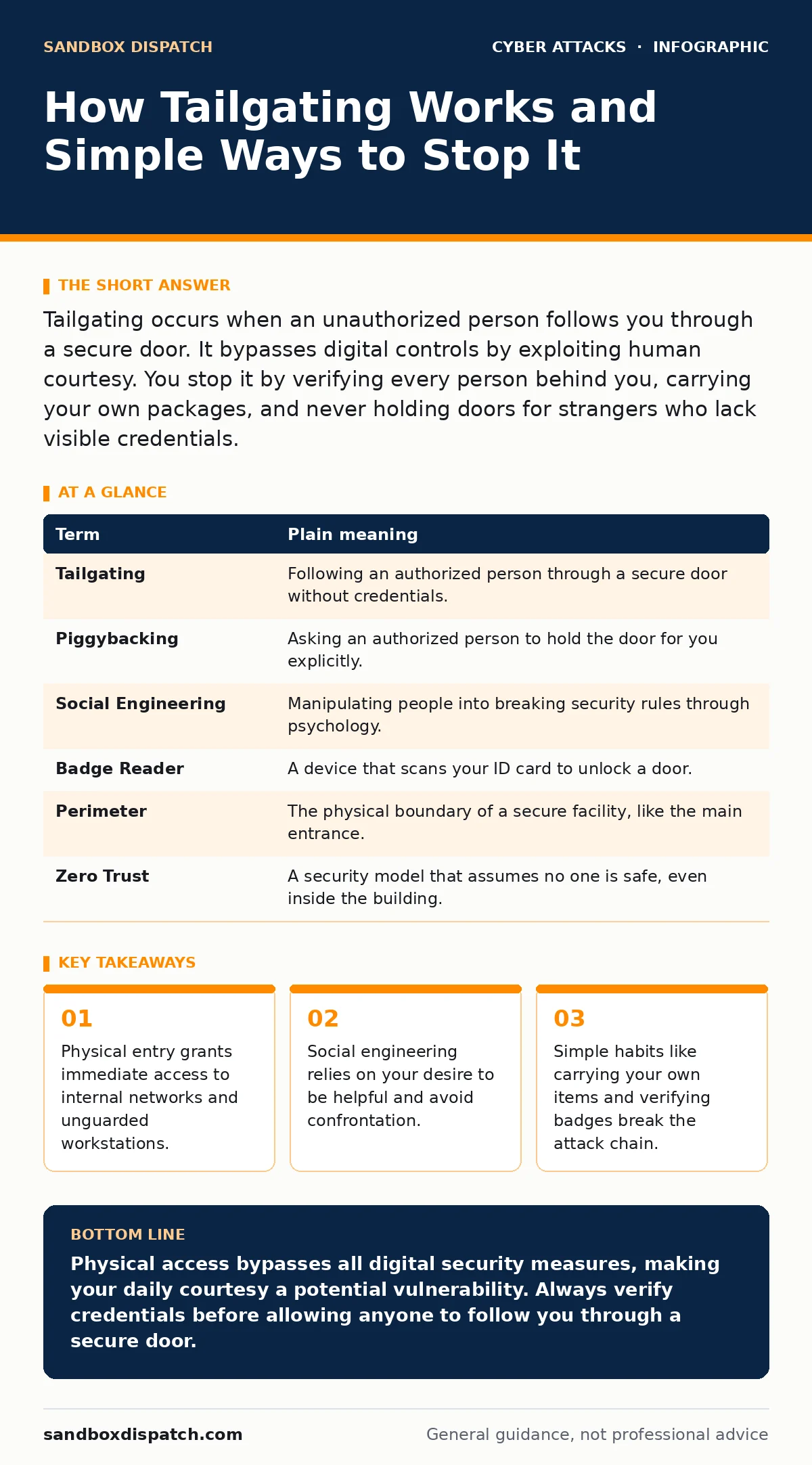
Tailgating occurs when an unauthorized person follows you through a secure door. It bypasses digital controls by exploiting human courtesy. You stop it by verifying every person behind you, carrying your own packages, and never holding doors for strangers who lack visible credentials.
The Coffee Shop Analogy
Imagine you are waiting in line at a busy coffee shop. The person ahead of you is paying for five lattes. You are holding your own credit card, ready to pay for your single black coffee. The barista hands the large order to the person in front, who turns to leave. You step forward, but the person ahead waves you through, saying, "Go ahead, I've got it covered." You walk out without paying. You received a free drink, but you bypassed the transaction. In security, this is tailgating. You bypassed the payment mechanism because someone else validated your entry. The system never saw you. It only saw the person who paid.
What Tailgating Actually Is
Tailgating is the act of an unauthorized person gaining access to a restricted area by following an authorized person. It happens at turnstiles, badge readers, and heavy doors. The attacker does not hack the lock. They hack the human standing next to it. They rely on your instinct to hold the door or your assumption that anyone standing close to you belongs there. This is a physical breach, not a digital one. Once inside, the attacker is already past the perimeter. They are now in the same room as your servers and your desks.
Why Digital Defenses Fail Here
You might have strong endpoint protection on your laptop. You might use multi-factor authentication for every login. These tools protect data that is already inside the system. They do nothing to stop someone from walking in and sitting at your desk. If an attacker is physically present, they can plug a malicious USB drive into your computer. They can read notes on your sticky notes. They can watch you type your password. Physical access is the master key. It renders remote security controls irrelevant for that specific session. The attacker does not need to guess your password. They just need to be in the room.
The Hidden Cost of Courtesy
We are trained to be helpful. We hold doors for people with full hands. We let neighbors in when we are late. This social contract is the attacker's primary tool. They exploit your fear of being rude. They might drop a pen as you approach the door. They might look confused by the badge reader. They might say they are lost. Your hesitation creates the opening. The cost of being polite is often higher than the cost of being brief. A five-second delay to ask for a badge is cheaper than a full system compromise. The attacker counts on you to prioritize social ease over security procedure.
Key Terms You Need to Know
Understanding the vocabulary helps you spot the behavior. These terms describe the mechanics of physical intrusion.
| Term | Plain meaning |
|---|---|
| Tailgating | Following an authorized person through a secure door without credentials. |
| Piggybacking | Asking an authorized person to hold the door for you explicitly. |
| Social Engineering | Manipulating people into breaking security rules through psychology. |
| Badge Reader | A device that scans your ID card to unlock a door. |
| Perimeter | The physical boundary of a secure facility, like the main entrance. |
| Zero Trust | A security model that assumes no one is safe, even inside the building. |
See also: Callback Verification: How to Stop Impersonation Attacks · QR Code Phishing: How to Spot Fake Scans and Secure Inputs
Simple Habits to Break the Chain
You can defend yourself with small, consistent actions. These habits remove the opportunity for the attacker. They do not require special equipment. They require attention.
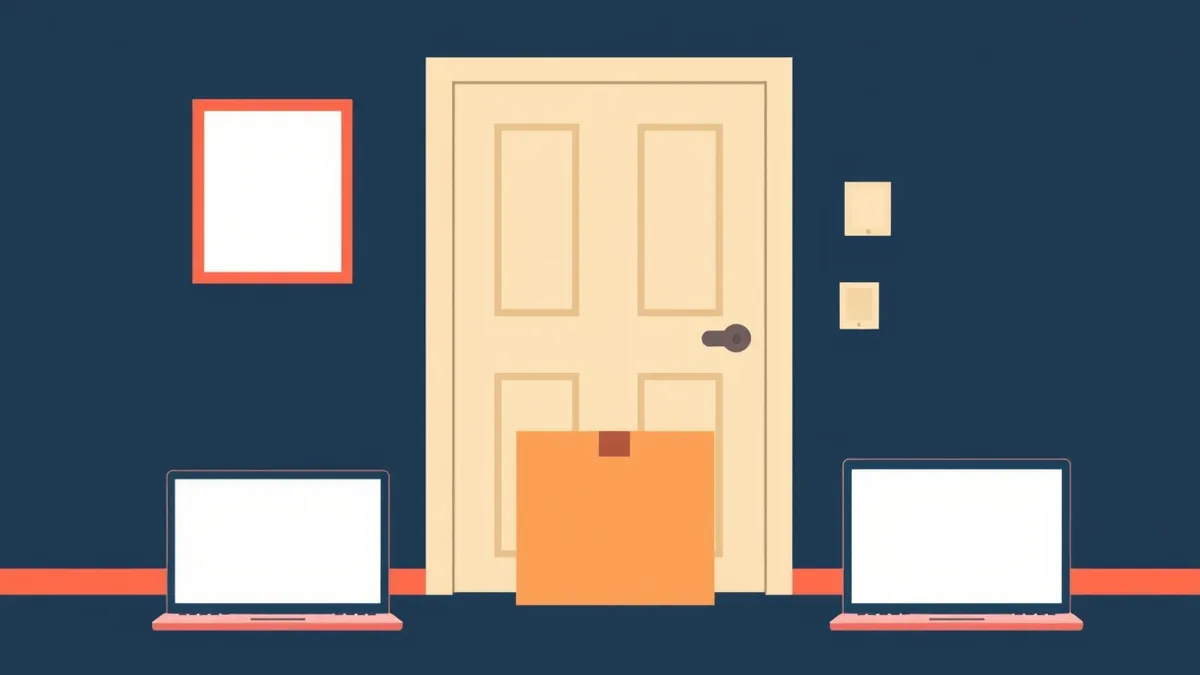
- Carry your own packages. If you are holding boxes or bags, you are a target. Put them down, scan your badge, pick them up, and enter. Do not let anyone hold the door for you. If you must carry items, ask the person behind you to wait until you have entered and the door has closed.
- Verify every person. If someone is close behind you, slow down. Wait for them to present a badge. If they do not have one, do not let them in. A simple "I need you to scan your badge" is enough. You do not need to explain why. The rule is the rule.
- Challenge the confused. If someone claims they forgot their badge, do not let them in. Direct them to the front desk or security office. This is where callback verification comes in. If they claim to be a visitor, they must go to reception. You are not the security guard. You are the user. Your job is to protect your access point.
The Ripple Effect on Your Data
When someone tailgates, they are not just entering a building. They are entering your digital environment. They can walk up to an unlocked computer. They can connect to internal Wi-Fi networks that are hidden from the outside. They can steal hardware. This is why incident response plans must include physical breaches. A digital hack is one thing. A person walking in is another. The response is different. You cannot patch a physical intrusion with software. You must secure the door. You must review who entered. You must assume that internal systems are compromised.
Protecting Your Digital Footprint
Physical security and digital security are linked. If you leave your phone unlocked on your desk, a tailgater has your emails. They have your login alerts. They have your banking apps. You must treat your physical space as a secure zone. Lock your screen when you stand up. Remove sensitive papers from your desk. Use privacy filters on your monitor. These steps assume that someone might be watching. They reduce the damage if a tailgater succeeds. You cannot control who enters the building, but you can control what they see on your desk.
Key takeaways
- Physical entry grants immediate access to internal networks and unguarded workstations.
- Social engineering relies on your desire to be helpful and avoid confrontation.
- Simple habits like carrying your own items and verifying badges break the attack chain.
Physical access bypasses all digital security measures, making your daily courtesy a potential vulnerability. Always verify credentials before allowing anyone to follow you through a secure door.
Frequently asked questions
Is it rude to ask someone for their badge?
It is not rude to protect your security. A brief, polite request for verification is standard practice in secure environments. Most people understand the need for safety.
What if I am in a hurry and someone is right behind me?
Slow down. Security is more important than speed. Let the door close and ask them to wait or follow the proper entry process. Rushing creates the gap attackers exploit.
Can remote workers be tailgated?
Remote workers face digital equivalents, such as **email spoofing** or **QR code phishing**. While they do not have physical doors, they must verify identities through secure channels. The principle of verification remains the same.
How do I know if someone is pretending to be IT?
Never trust appearance. If someone claims to be IT, verify their identity through your company's official directory or help desk. Do not grant access based on a badge or uniform alone.
How this guide was produced: written by the Sandbox Dispatch editorial team with AI assistance, checked against the public references listed below, and reviewed when the facts change. See our editorial policy or report an error.