Sensitive Personal Data: Small Business Protection Tactics
Small teams face disproportionate risk because sensitive personal data often bypasses standard security controls due to informal handling and shared access patterns.
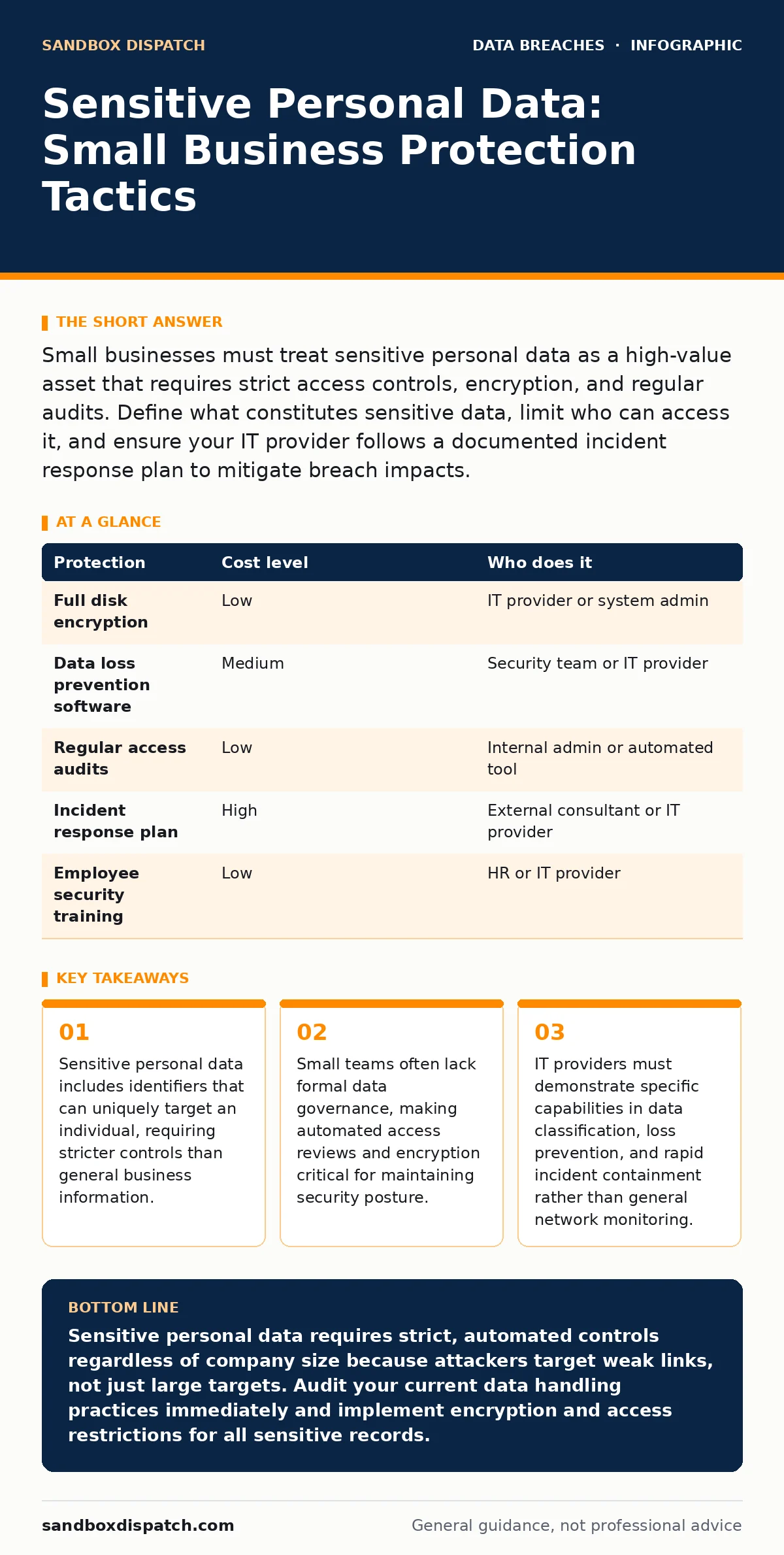
Small businesses must treat sensitive personal data as a high-value asset that requires strict access controls, encryption, and regular audits. Define what constitutes sensitive data, limit who can access it, and ensure your IT provider follows a documented incident response plan to mitigate breach impacts.
Defining Sensitive Personal Data Scope
Sensitive personal data extends beyond obvious identifiers like social security numbers or credit card details. It includes any information that, when combined with other data, can uniquely identify an individual or cause them harm. This category covers precise geolocation data, biometric templates, genetic information, and detailed health records. Even seemingly benign data points, such as IP addresses combined with browsing history, can become sensitive when aggregated.
You must define your specific data categories clearly. Ambiguity leads to inconsistent protection. If you do not know what data you hold, you cannot protect it. Refer to data inventory and mapping practices to catalog every data source, storage location, and transmission path. Without a complete map, security controls are applied randomly rather than strategically.
Why Small Scale Increases Exposure Risk
Small businesses often operate with fewer layers of defense, assuming they are too small to be targeted. This assumption is incorrect. Attackers frequently target smaller organizations because they perceive weaker security controls and easier exploitation paths. Small teams often rely on shared credentials, informal communication channels, and manual processes. These practices create hidden vulnerabilities.
A single misconfigured cloud storage bucket can expose thousands of records. See how misconfigured cloud storage leaks occur when default permissions are left open. Small organizations also lack the staff to monitor logs or respond to incidents quickly. The cost of a breach scales with the sensitivity of the data, not the size of the company. Regulatory bodies apply the same standards regardless of employee count.
Practical Handling and Storage Controls
You must implement technical controls that enforce data protection automatically. Manual processes fail under pressure or during staff turnover. Encryption protects data at rest and in transit. Use strong, standard encryption algorithms for all sensitive personal data stored on devices, servers, and cloud platforms. Encryption ensures that even if data is stolen, it remains unreadable without the decryption keys.
Implement data loss prevention tools to monitor and block unauthorized transfers. These tools scan outgoing emails, file uploads, and network traffic for sensitive patterns. Combine this with strict access controls. Only grant access to individuals who need it for their specific role. Review these permissions regularly. Automated user access provisioning systems help manage these changes efficiently.
| Protection | Cost level | Who does it |
|---|---|---|
| Full disk encryption | Low | IT provider or system admin |
| Data loss prevention software | Medium | Security team or IT provider |
| Regular access audits | Low | Internal admin or automated tool |
| Incident response plan | High | External consultant or IT provider |
| Employee security training | Low | HR or IT provider |
The Hidden Cost of Shared Access
Shared access to sensitive data creates accountability gaps. When multiple users share a single account or have broad read/write permissions, it becomes impossible to trace who accessed or modified data. This lack of auditability complicates incident response. If a breach occurs, you cannot determine the scope or the source. This uncertainty increases legal liability and remediation costs.
You must enforce individual accounts with unique credentials. Multi-factor authentication adds a layer of security that prevents unauthorized access even if passwords are compromised. However, MFA does not prevent insider threats or social engineering attacks. You must also limit the duration of access. Temporary access should expire automatically. Permanent access requires regular justification.
What to Ask Your IT Provider
Your IT provider plays a critical role in protecting sensitive personal data. Do not assume they understand your specific data risks. Ask specific questions to verify their capabilities. Do not accept vague assurances. You need concrete answers about their processes, tools, and experience.
- How do you classify and label sensitive personal data within our systems?
- What specific data loss prevention tools do you use, and how are they configured?
- How do you monitor and audit access to sensitive data repositories?
- What is your incident response plan for a data breach involving sensitive personal data?
- How do you handle encryption key management and rotation?
- Can you provide references from other small businesses with similar data profiles?
Review their answers carefully. Look for specificity and evidence of experience. A provider who cannot explain their data handling procedures is a risk. Consider how lost and stolen devices are handled. Your provider must have a plan to remotely wipe or encrypt data on lost hardware.
See also: Broken Access Control Risks and Protection for Small Businesses
Integrating Data Protection into Workflow
Security controls must integrate seamlessly into your daily workflow. Friction leads to workarounds. If employees find security measures difficult, they will bypass them. This creates new vulnerabilities. Design your security processes to be intuitive and minimal. Automate as much as possible. Use tools that integrate with your existing software stack.
For example, if you use cloud collaboration tools, ensure they support strong encryption and access controls. Train employees on why these controls matter. Explain the consequences of mishandling sensitive personal data. Reference protected health information guidelines if you handle medical data, as the standards are stricter and more defined. Even if you are not in healthcare, adopting similar rigor improves your overall security posture.
Monitoring and Continuous Improvement
Data protection is not a one-time setup. Threats evolve, and your data landscape changes. New data sources emerge, and old ones become obsolete. You must continuously monitor your environment for anomalies. Look for unusual access patterns, large data transfers, or failed login attempts. Automated monitoring tools can alert you to these events in real time. Regularly review your security policies and procedures.
Update them to reflect new threats and changes in your business. Conduct periodic risk assessments. Identify new vulnerabilities and prioritize remediation. Stay informed about emerging data scraping techniques that might target your public-facing data. Proactive monitoring and continuous improvement reduce the likelihood of a breach and minimize its impact if one occurs.
Key takeaways
- Sensitive personal data includes identifiers that can uniquely target an individual, requiring stricter controls than general business information.
- Small teams often lack formal data governance, making automated access reviews and encryption critical for maintaining security posture.
- IT providers must demonstrate specific capabilities in data classification, loss prevention, and rapid incident containment rather than general network monitoring.
Sensitive personal data requires strict, automated controls regardless of company size because attackers target weak links, not just large targets. Audit your current data handling practices immediately and implement encryption and access restrictions for all sensitive records.
Frequently asked questions
What is the difference between personal data and sensitive personal data?
Personal data can identify an individual, while sensitive personal data reveals intimate details like health, race, or political views, carrying higher risk and stricter regulatory requirements.
Do small businesses need a dedicated Data Protection Officer?
Not necessarily, but someone must be responsible for data governance. This person ensures compliance, manages access controls, and oversees incident response plans.
How often should access permissions be reviewed?
Review access permissions at least quarterly or whenever an employee changes roles or leaves the organization to prevent unauthorized access.
Is encryption enough to protect sensitive personal data?
No, encryption protects data at rest and in transit, but you also need access controls, monitoring, and incident response plans to prevent unauthorized access and misuse.
How this guide was produced: written by the Sandbox Dispatch editorial team with AI assistance, checked against the public references listed below, and reviewed when the facts change. See our editorial policy or report an error.