Why Classifying Sensitive Personal Data Prevents Security Failures
Treating all data as equally sensitive creates blind spots that allow attackers to bypass perimeter defenses and extract high-value records unnoticed.

Classifying sensitive personal data allows teams to apply specific controls to high-risk assets. Without this distinction, resources are wasted protecting low-value logs while critical identity information remains exposed to unauthorized access and misuse.
The Cost of Indistinct Data
You likely store terabytes of information in your infrastructure. Some of it is ephemeral debug logs. Other pieces are government-issued identifiers or health records. Treating these two categories identically is a structural error. When you apply the same security posture to all data, you create a false sense of safety.
The perimeter defense fails because the attacker does not need to breach the outer wall. They only need to find the one file inside that matters. Without classification, your systems cannot distinguish between a user profile picture and a social security number. This ambiguity forces you to either over-protect everything, slowing down performance, or under-protect critical assets.
Defining the Boundaries
Sensitive personal data refers to information that, if disclosed, could cause significant harm to the individual. This includes financial account numbers, biometric scans, and precise location history. It is distinct from general personal data, which might include a public email address or a username.
The harm potential drives the security requirement. A leaked username allows an attacker to attempt a password guess. A leaked biometric template allows an attacker to impersonate the user permanently, as fingerprints cannot be reset like passwords. You must identify which fields in your schema carry this higher risk.
This definition informs your legal and technical obligations. Frameworks often mandate specific safeguards for this class of information. If you do not map your data to these categories, you cannot prove compliance. You also cannot prioritize your incident response efforts effectively when a breach occurs.
Decisions Driven by Classification
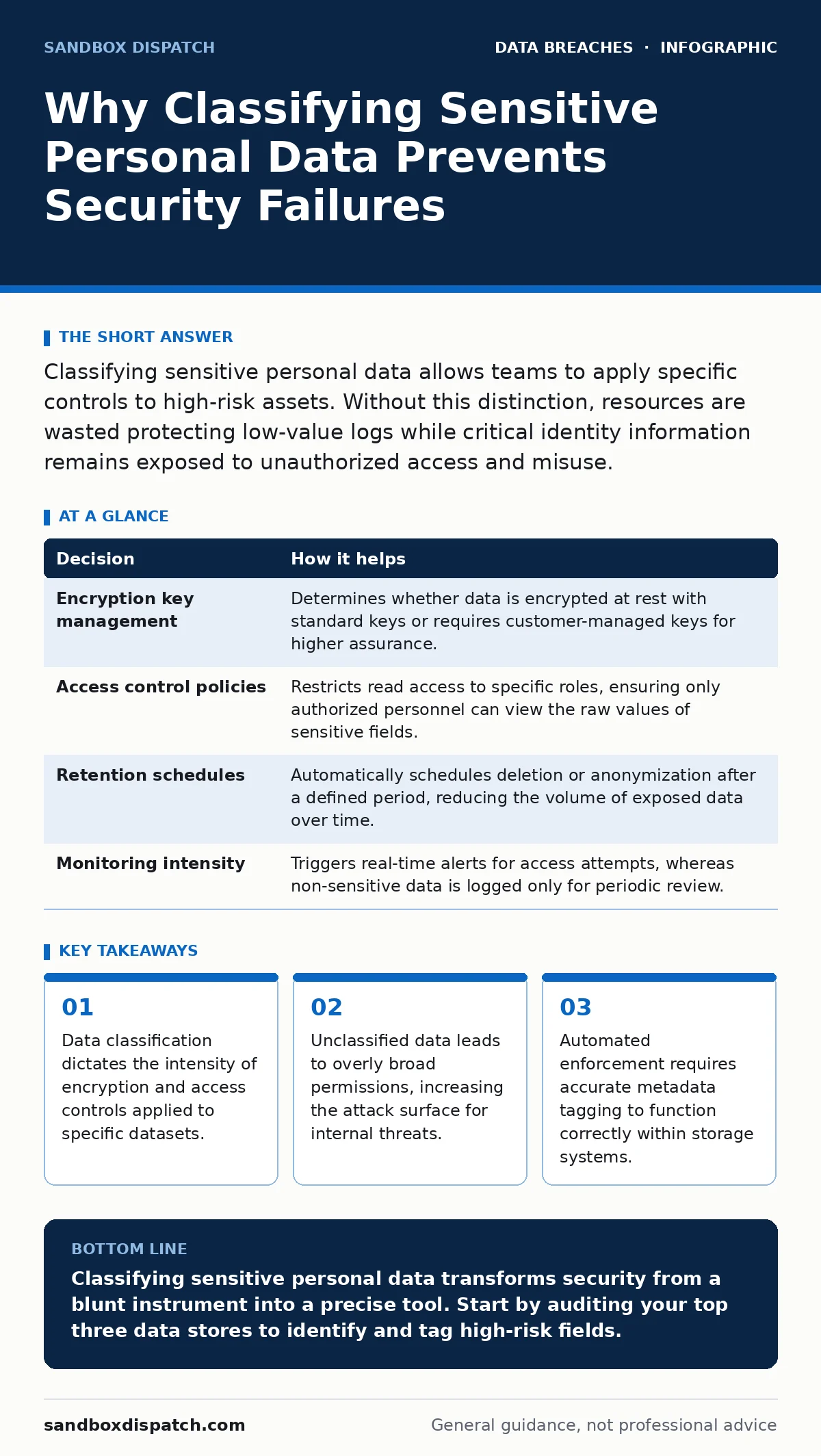
Classification is not just a label; it is a trigger for automated actions. Your infrastructure responds to the tag you assign. The following table illustrates how classification dictates technical and operational decisions.
| Decision | How it helps |
|---|---|
| Encryption key management | Determines whether data is encrypted at rest with standard keys or requires customer-managed keys for higher assurance. |
| Access control policies | Restricts read access to specific roles, ensuring only authorized personnel can view the raw values of sensitive fields. |
| Retention schedules | Automatically schedules deletion or anonymization after a defined period, reducing the volume of exposed data over time. |
| Monitoring intensity | Triggers real-time alerts for access attempts, whereas non-sensitive data is logged only for periodic review. |
These decisions reduce the attack surface. By locking down only what is necessary, you avoid the complexity of managing excessive permissions. This aligns with the principle of least privilege, but applied at the data object level rather than just the user account level.
What Breaks Without Tags
When you fail to classify data, your tools become blind. Encryption engines encrypt everything they are told to, but if you do not tell them what is sensitive, they may skip critical fields for performance reasons. Database administrators may grant broad read access to developers for testing, unaware that the test dataset contains real sensitive personal data.
This lack of visibility creates hidden liabilities. You cannot audit what you do not know exists. If a vendor processes your data, you must inform them of the sensitivity level. If you cannot articulate what is sensitive, you cannot enforce contractual protections. This gap often leads to data leaks where information is shared with third parties under incorrect assumptions about its risk profile.
Furthermore, incident response becomes chaotic. When a breach is detected, responders must manually sift through logs to determine what was taken. This delay allows attackers to exfiltrate more data. Classification allows you to immediately know the scope and severity of the exposure.
Automating Control Enforcement
Manual classification is prone to human error. Developers forget to tag new fields. Database migrations strip metadata. You must automate the identification and protection of sensitive personal data. This involves scanning data stores for patterns, such as credit card number formats or date of birth structures.
Once identified, the system applies policies automatically. This might mean masking the last four digits of an account number in application logs. It might mean blocking the export of this data to personal devices. Automation ensures consistency across your environment.
This approach supports audit logging requirements by creating a clear trail of who accessed what data and when. The logs are easier to parse because the data objects are already categorized. You can filter for all accesses to "high-sensitivity" records without reviewing millions of benign log entries.
See also: Data Inventory and Mapping: Track Every Byte to Prevent Leaks · Employee Offboarding Security Checklist: Prevent Data Leaks
Integrating with Broader Security
Data classification does not exist in a vacuum. It connects to other security disciplines. For instance, data inventory and mapping provides the catalog of where data lives. Classification provides the risk context for that catalog. Without both, you have a list of assets without knowing which ones are targets.
Similarly, user access provisioning systems should integrate with classification tags. When a new employee is onboarded, their access rights should be constrained by the sensitivity of the data they need. They should not have default access to high-risk records. This prevents privilege creep, where users accumulate unnecessary permissions over time.
Consider also employee offboarding security. When an employee leaves, their access is revoked. If data was not classified, you might not know that they had access to critical records via a shared service account. Classification helps you trace data exposure even when user accounts are complex or shared.
The Hidden Cost of Misclassification
The most dangerous error is false negative classification. Labeling sensitive personal data as "public" or "internal" exposes it to casual scrutiny. Attackers often look for these mislabeled assets because they are easier to find. They know that organizations often overlook data that is not flagged as critical.
False positives are also costly. Labeling non-sensitive data as critical triggers unnecessary alerts and controls. This leads to alert fatigue, where security teams ignore warnings because most are false alarms. Eventually, they miss the real threat. Accuracy in classification is a balance between protection and operational efficiency.
Key takeaways
- Data classification dictates the intensity of encryption and access controls applied to specific datasets.
- Unclassified data leads to overly broad permissions, increasing the attack surface for internal threats.
- Automated enforcement requires accurate metadata tagging to function correctly within storage systems.
Classifying sensitive personal data transforms security from a blunt instrument into a precise tool. Start by auditing your top three data stores to identify and tag high-risk fields.
Frequently asked questions
How do I start classifying data in a legacy system?
Begin by identifying the most critical data types defined by your compliance requirements. Scan these specific tables or fields first, applying tags before expanding to less critical datasets.
Can metadata alone protect sensitive personal data?
No. Metadata guides controls but does not encrypt or block access. You must implement technical controls like encryption and access lists that respond to the metadata tags.
What happens if a developer misclassifies data intentionally?
Implement secondary controls like data loss prevention tools that scan for patterns regardless of tags. Regular audits can catch discrepancies between tags and actual content.
Does classification help with ransomware?
Indirectly. It ensures that your backups of sensitive personal data are encrypted and access-controlled, making them harder for attackers to corrupt or steal during an incident.
How this guide was produced: written by the Sandbox Dispatch editorial team with AI assistance, checked against the public references listed below, and reviewed when the facts change. See our editorial policy or report an error.