Threat Modeling STRIDE: How to Map Every Hidden Risk
Threat modeling STRIDE exposes logical flaws and access gaps that automated scanners miss, turning abstract design decisions into concrete security controls before code exists.

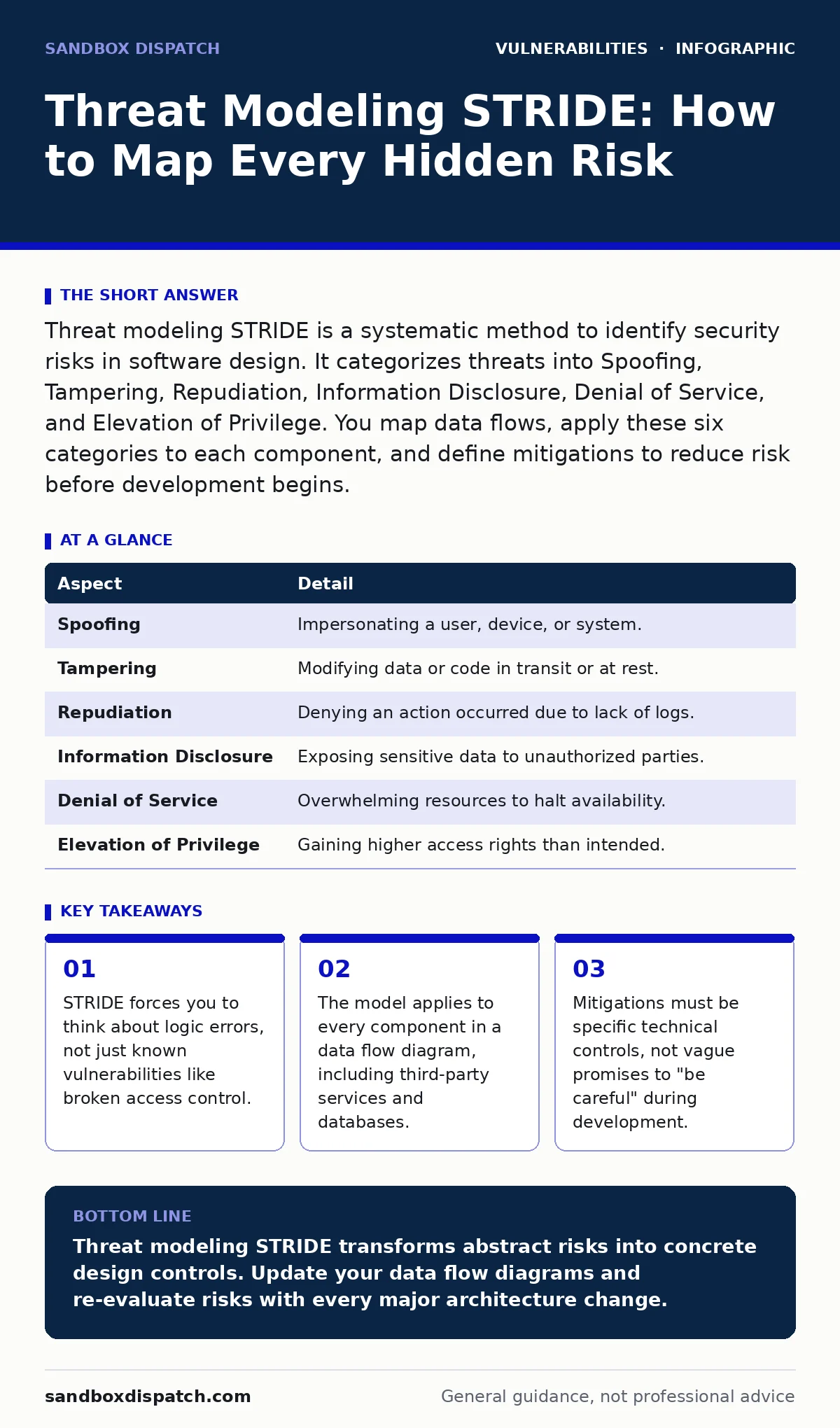
Threat modeling STRIDE is a systematic method to identify security risks in software design. It categorizes threats into Spoofing, Tampering, Repudiation, Information Disclosure, Denial of Service, and Elevation of Privilege. You map data flows, apply these six categories to each component, and define mitigations to reduce risk before development begins.
Everyday Analogy for System Design
Imagine building a bank vault. You do not just buy a heavy door. You consider who can copy the key, who can drill through the wall, and who can claim they never opened it. Threat modeling works the same way. You look at your software architecture before you write code. You ask what an attacker could do to each piece. This shifts security from a final test to a design constraint. You catch expensive mistakes early.
At a Glance: STRIDE Components
| Aspect | Detail |
|---|---|
| Spoofing | Impersonating a user, device, or system. |
| Tampering | Modifying data or code in transit or at rest. |
| Repudiation | Denying an action occurred due to lack of logs. |
| Information Disclosure | Exposing sensitive data to unauthorized parties. |
| Denial of Service | Overwhelming resources to halt availability. |
| Elevation of Privilege | Gaining higher access rights than intended. |
What Is Threat Modeling STRIDE?
Threat modeling STRIDE is a structured approach to identifying security risks in software systems. It breaks potential attacks into six distinct categories. This framework helps developers understand how attackers might exploit their design. It does not find bugs in existing code. It finds flaws in the architecture. You use it during the design phase. You create a data flow diagram. You identify trust boundaries. You apply the STRIDE categories to each component and data flow. This process reveals hidden attack vectors in CVSS terms before implementation.
How STRIDE Works in Practice
The process starts with a clear data flow diagram. You must map every component, every data store, and every external interface. Trust boundaries are critical. These are points where data crosses from a trusted zone to an untrusted zone. Attackers exploit these boundaries. For each component inside a trust boundary, you ask six questions. Can it be spoofed? Can it be tampered with? Can actions be repudiated? Can it leak information? Can it be denied service? Can it elevate privilege? You record the answers. You define specific mitigations for high risks. This creates a living document that guides development.
Who STRIDE Affects and Why It Matters
Threat modeling affects every developer, architect, and product owner. It changes how you think about features. You stop asking "does it work?" and start asking "how can it break?" This mindset shift reduces the cost of security. Fixing a design flaw costs hours. Fixing a deployed vulnerability costs days or weeks. It also affects your legal and compliance posture. You can demonstrate due diligence. You show regulators that you considered risks. You improve your vulnerability disclosure policies by knowing where attackers look. Teams that model threats build fewer exploit chains. They create software that is harder to compromise.
What People Usually Get Wrong
Many teams treat threat modeling as a one-time checkbox. They write a document and forget it. Software changes. New features add new risks. Old mitigations become obsolete. Threat modeling must be iterative. You update it with every major change. Another common error is focusing only on external threats. Insiders and compromised components pose equal risks. You must model internal trust boundaries.
Some teams list risks but do not define mitigations. A risk without a mitigation is just a worry. You must assign ownership. You must track remediation. Finally, teams often ignore Repudiation. They build logging systems but do not verify their integrity. An attacker who can alter logs can deny their actions. You must protect logs with cryptographic signatures.
Integrating STRIDE with Attack Surface Management
Threat modeling STRIDE complements attack surface management. One defines the internal logic risks. The other maps the external exposure points. You need both. Attack surface management identifies what is visible to the internet. STRIDE tells you what happens when that visibility is exploited. You combine them to get a full picture. You prioritize risks based on exposure and impact. This helps you allocate security resources effectively. You do not waste time protecting internal services that have no external path. You focus on the intersections. This synergy reduces noise. You address the most dangerous flaws first.
Common Pitfalls in STRIDE Analysis
A major pitfall is incomplete data flow diagrams. If a component is missing, its risks are invisible. You must map every interaction. Another pitfall is assuming third-party services are secure. You must treat them as untrusted. You validate their inputs and outputs. You define fail-safes. Some teams skip the Denial of Service category. They assume infrastructure handles it. Application-layer DoS attacks bypass infrastructure limits. You must rate-limit and validate resource usage. Finally, teams often ignore the human element. Social engineering bypasses technical controls. You must model user behavior. You assume users will make mistakes. You design for failure.
Beyond the Basics: Advanced Considerations
Advanced threat modeling includes business logic risks. STRIDE covers technical flaws. It does not cover logical abuse. You must ask if the system can be used in unintended ways. Imagine a discount coupon system. An attacker might create negative order totals. This is not a STRIDE category. It is a business logic flaw. You must supplement STRIDE with scenario-based testing. You also consider privacy regulations. Information Disclosure risks extend to PII. You must classify data. You apply different controls to different data types. This depth ensures your model reflects reality. It prepares you for sophisticated attackers.
Key takeaways
- STRIDE forces you to think about logic errors, not just known vulnerabilities like broken access control.
- The model applies to every component in a data flow diagram, including third-party services and databases.
- Mitigations must be specific technical controls, not vague promises to "be careful" during development.
Threat modeling STRIDE transforms abstract risks into concrete design controls. Update your data flow diagrams and re-evaluate risks with every major architecture change.
Frequently asked questions
How often should I update my threat model?
Update it whenever you change the architecture, add new components, or modify trust boundaries. Treat it as a living document, not a static report.
Does STRIDE replace penetration testing?
No. STRIDE identifies design risks. Penetration testing validates implementation. Both are necessary for secure software.
Can I use STRIDE for cloud-native applications?
Yes. Cloud applications have complex trust boundaries. STRIDE helps identify risks in microservices, APIs, and serverless functions.
What is the difference between STRIDE and PASTA?
STRIDE is a threat categorization framework. PASTA is a full threat modeling process. You can use STRIDE within PASTA.
How this guide was produced: written by the Sandbox Dispatch editorial team with AI assistance, checked against the public references listed below, and reviewed when the facts change. See our editorial policy or report an error.