What Is Attack Surface Management and How to Shrink It
Attack surface management maps every external entry point to prevent attackers from finding the hidden doors you forgot to lock.

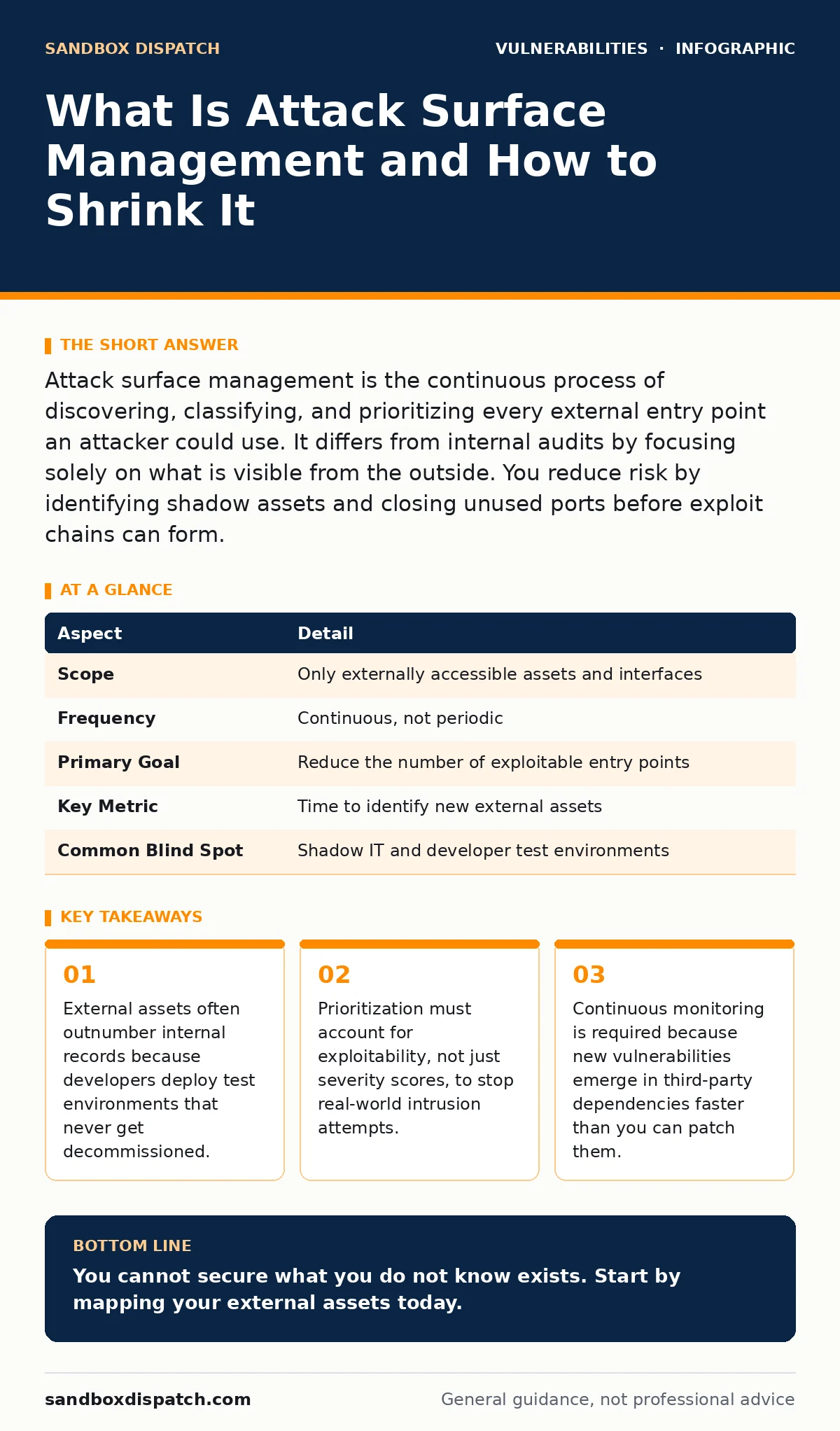
Attack surface management is the continuous process of discovering, classifying, and prioritizing every external entry point an attacker could use. It differs from internal audits by focusing solely on what is visible from the outside. You reduce risk by identifying shadow assets and closing unused ports before exploit chains can form.
The Digital Footprint Analogy
Imagine your organization is a large estate with a high fence. Traditional security focuses on locking the front door and checking the windows. Attack surface management is the act of walking the entire perimeter every day to find the loose gate, the open shed, and the forgotten side entrance. You cannot protect what you do not know exists.
Most organizations believe they know their infrastructure. In reality, the external view is vastly different from the internal inventory. Cloud instances, abandoned subdomains, and third-party integrations create hidden doors. These doors remain open because no one assigned ownership or scheduled maintenance. The goal is to align the external reality with internal records.
At a Glance
| Aspect | Detail |
|---|---|
| Scope | Only externally accessible assets and interfaces |
| Frequency | Continuous, not periodic |
| Primary Goal | Reduce the number of exploitable entry points |
| Key Metric | Time to identify new external assets |
| Common Blind Spot | Shadow IT and developer test environments |
What Is Attack Surface Management
What is attack surface management? It is the systematic identification and reduction of all externally facing entry points that could be exploited by an adversary. This process goes beyond traditional vulnerability scanning. It includes discovering assets that internal teams may have forgotten or never recorded.
You must map every public-facing interface. This includes web applications, APIs, DNS records, and cloud storage buckets. The definition extends to human factors. Employee social media profiles that reveal internal tools can become part of the attack surface. Social engineering relies on this information leakage.
The core mechanism is continuous discovery. You scan the internet for references to your organization. You compare these findings against your internal asset inventory. Any mismatch represents a risk. Unmanaged assets lack security controls. They lack monitoring. They lack patching. Attackers target these gaps specifically because they know defenders overlook them.
How the Process Works
The workflow begins with passive and active reconnaissance. Passive methods search public databases, search engines, and certificate transparency logs. Active methods probe your network for open ports and services. You combine these data sources to build a complete picture.
Next, you classify each asset by function and criticality. A public marketing blog carries less risk than a customer-facing API. You assign ownership to each asset. Ownership ensures someone is responsible for security updates. Without ownership, vulnerabilities persist indefinitely.
Finally, you prioritize remediation. Not all vulnerabilities require immediate action. You assess the likelihood of exploitation. An unpatched server with no internet exposure poses no immediate threat. An exposed database with weak credentials poses a critical threat. You focus resources on the highest risk items.
Who It Affects
Every organization with an internet presence is affected. Small startups often lack the resources to track their growing infrastructure. Large enterprises struggle with legacy systems and complex supply chains. The complexity scales with the number of cloud providers and third-party integrations.
Developers are primary contributors to the attack surface. They deploy code, create instances, and configure services. If security is not integrated into their workflow, they inadvertently create exposure. Security teams cannot manually track every deployment. Automation is required to keep pace with development velocity.
Third-party vendors also expand the surface. When you integrate a payment processor or a chat widget, you inherit their security posture. If their service is compromised, your users may be exposed. You must monitor these dependencies as part of your own surface.
See also: Audit Logging Best Practices for Secure Systems · How XDR Works: The Mechanics of Unified Threat Detection
Common Misconceptions
Many teams confuse attack surface management with vulnerability management. Vulnerability management focuses on known weaknesses in known assets. Attack surface management focuses on discovering the unknown assets first. You cannot manage vulnerabilities in assets you do not know exist.
Another mistake is relying solely on internal scanners. Internal tools only see what is connected to the corporate network. They miss assets hosted in public clouds or managed by partners. External scanning is mandatory to see the world as attackers see it.
Teams often assume that closing ports is sufficient. Modern attacks rarely target open ports directly. They target logic flaws in applications. They target misconfigured permissions. They target insecure dependencies. Closing ports hides the asset but does not secure the application logic.
Prioritization and Risk
You cannot fix everything at once. Prioritization requires context. A critical severity score means little if the component is not reachable. A low severity score matters if the component is exposed and widely used. You must combine severity with reachability and business impact.
Exploit chains often require multiple steps. An attacker might use a low-risk vulnerability to gain initial access, then move laterally to a high-risk system. Attack surface management helps you break these chains. By securing the initial entry point, you prevent the chain from starting.
Consider the concept of attack vectors in CVSS. The Common Vulnerability Scoring System rates how easy it is to exploit a flaw. A vector with "Network" accessibility is higher risk than one requiring "Local" access. Your management process should weight network-accessible flaws more heavily.
Reducing the Surface
The most effective reduction strategy is elimination. Remove unused services. Decommission old domains. Delete test environments. Every active service is a potential target. Minimization is the ultimate security control.
For necessary services, apply least privilege access. Services should only have the permissions they need to function. A web server does not need database admin rights. Restricting permissions limits the damage if the service is compromised.
Implement configuration hardening standards. Default configurations are often insecure. You must disable unnecessary features. You must enforce strong authentication. You must encrypt data in transit. Automation ensures these standards are applied consistently across all new assets.
Integration with Development
Security must shift left. Developers need visibility into the attack surface they create. Integrate scanning tools into the deployment pipeline. Block deployments that introduce new external exposure without approval.
Provide developers with clear guidelines. Show them how to configure services securely. Teach them to use secrets management instead of hardcoding credentials. Empower them to secure their own code.
Regular reviews are necessary. The attack surface changes daily. New features are added. Old ones are removed. Continuous monitoring ensures you stay ahead of changes. You cannot audit once and forget. The internet is dynamic. Your defense must be too.
Key takeaways
- External assets often outnumber internal records because developers deploy test environments that never get decommissioned.
- Prioritization must account for exploitability, not just severity scores, to stop real-world intrusion attempts.
- Continuous monitoring is required because new vulnerabilities emerge in third-party dependencies faster than you can patch them.
You cannot secure what you do not know exists. Start by mapping your external assets today.
Frequently asked questions
How does attack surface management differ from penetration testing?
Penetration testing is a periodic, manual assessment of specific systems. Attack surface management is a continuous, automated process that discovers all external assets and their vulnerabilities over time.
Do I need special software for attack surface management?
You need tools that can scan the public internet for your assets. Many organizations use specialized platforms, but basic scripts and public APIs can also provide discovery capabilities for smaller teams.
How often should I scan my attack surface?
Scan continuously. New assets are deployed and decommissioned daily. Weekly scans may miss critical windows of exposure. Daily or real-time monitoring is ideal for high-risk organizations.
Can I automate attack surface management?
Yes. Automation is essential for scale. You can automate discovery, classification, and alerting. Manual review is still needed for complex prioritization decisions and false positive reduction.
How this guide was produced: written by the Sandbox Dispatch editorial team with AI assistance, checked against the public references listed below, and reviewed when the facts change. See our editorial policy or report an error.