Exploit Chains: How Attackers Link Weaknesses to Break In
Most breaches fail at the first step; exploit chains succeed by chaining minor flaws into a single, unstoppable path to critical data.

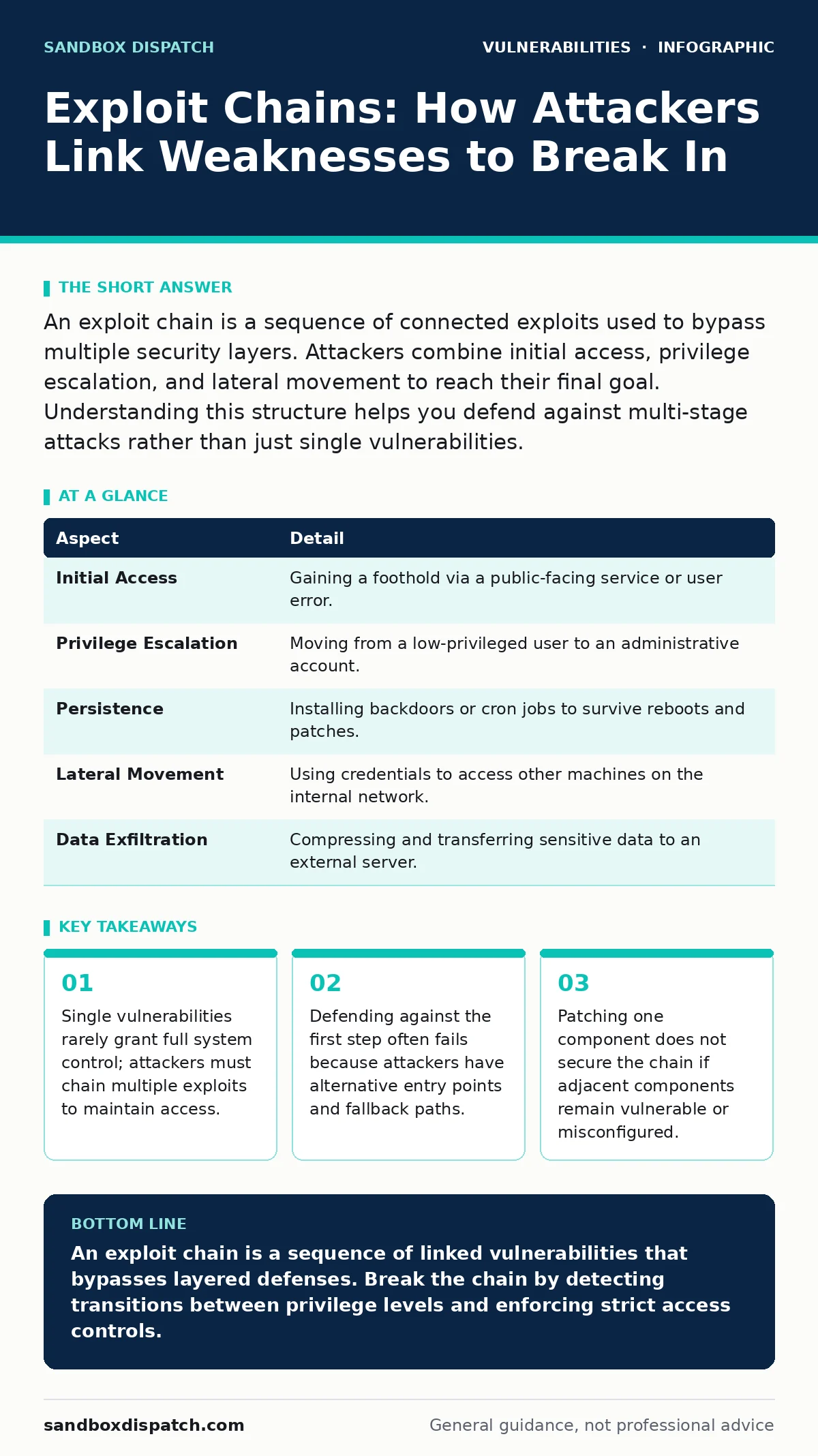
An exploit chain is a sequence of connected exploits used to bypass multiple security layers. Attackers combine initial access, privilege escalation, and lateral movement to reach their final goal. Understanding this structure helps you defend against multi-stage attacks rather than just single vulnerabilities.
The Domino Effect in Cybersecurity
Imagine a bank vault protected by three locks. A thief cannot open the vault by picking just one lock. Instead, they use a chemical solvent to disable the first lock, a shim to bypass the second, and a forged key for the third. The vault remains secure against any single method of attack. It falls only when all three methods are combined in sequence.
This is how an exploit chain works in software systems. You do not face a single point of failure. You face a series of dependencies that, when linked, create a path to your most sensitive data. The term comes from the practice of linking discrete exploits together. Each step in the chain solves a specific problem the previous step could not.
The first step usually gains initial access. The second step elevates privileges. The third step moves laterally to target systems. Each link must succeed for the chain to complete. If one link breaks, the attack stops. This structure creates a specific defensive advantage. You do not need to stop every attempt. You only need to break one link.
Anatomy of a Multi-Stage Attack
An exploit chain is not a single tool. It is a workflow. The attacker identifies a series of weaknesses that, individually, seem manageable. Together, they form a bridge across your security perimeter. The chain typically follows a logical progression from outside to inside.
| Aspect | Detail |
|---|---|
| Initial Access | Gaining a foothold via a public-facing service or user error. |
| Privilege Escalation | Moving from a low-privileged user to an administrative account. |
| Persistence | Installing backdoors or cron jobs to survive reboots and patches. |
| Lateral Movement | Using credentials to access other machines on the internal network. |
| Data Exfiltration | Compressing and transferring sensitive data to an external server. |
Each stage relies on the output of the previous one. The initial access provides the credentials needed for escalation. The escalated privileges allow the installation of persistence mechanisms. This dependency means that monitoring for unusual privilege changes can detect the chain early. You are looking for the transition between states, not just the presence of a virus.
Where the Term Comes From in Practice
The concept emerged from the realization that systems are complex. No single vulnerability grants total control in modern, segmented environments. Early malware focused on a single exploit. As defenses improved, attackers had to adapt. They began to automate the process of finding and chaining multiple flaws.
In practice, the term describes the methodology, not the code. It refers to the strategic linking of exploits. Security researchers use the term to describe how seemingly unrelated bugs interact. A bug in a web framework might allow code execution. A bug in the operating system might allow that code to run as administrator. The chain is the combination of these two events.
This approach is common in both manual penetration testing and automated malware. Automated tools often contain modules for each stage. They try to chain them together dynamically. If one module fails, the tool tries another. This makes the attack resilient. It also makes it harder to attribute the attack to a specific vulnerability.
Day-to-Day Usage in Security Operations
Security teams use the term to analyze incidents. When an intrusion occurs, investigators map the steps the attacker took. This map is the exploit chain. By understanding the chain, teams can identify which defenses failed. It also reveals which defenses worked.
In day-to-day operations, you use this concept to prioritize fixes. Not all vulnerabilities are equal. A vulnerability that breaks a critical link in a common exploit chain is more dangerous than an isolated bug. You assess the risk based on the chain, not the individual flaw. This changes how you view patch management.
You also use the term to design detection rules. Instead of looking for a specific signature, you look for sequences of events. A login followed by a privilege change followed by a large data transfer is suspicious. This sequence-based detection is more effective than signature-based detection. It catches new attacks that do not have known signatures.
What People Usually Get Wrong
Many believe that fixing the initial vulnerability stops the attack. This is incorrect. Attackers often have backup entry points. If you patch the web application, they may use a phishing email. If you block the email, they may exploit a misconfigured API. The chain adapts.
Another common error is assuming that internal networks are safe. Once an attacker has initial access, they are inside. The internal network becomes the new battlefield. Lateral movement exploits are often more effective than external attacks. This is because internal traffic is trusted. Security tools often ignore it.
People also misunderstand the role of security misconfigurations. These are often the weakest link in the chain. A default password or an open port can bypass complex authentication. Attackers prefer these easy wins. They are faster and more reliable than exploiting complex code bugs.
See also: Detect Tailgating Attempts via Access Logs and Behavioral Signals · How Tailgating Works and Simple Ways to Stop It
Breaking the Chain Effectively
To break the chain, you must identify the most fragile link. This is often the transition from initial access to privilege escalation. Most attackers start with low privileges. They must escalate to do real damage. If you can detect and stop this transition, you stop the attack.
One way to do this is through strict access controls. Limit what each user and service can do. This is known as the principle of least privilege. If a web server is compromised, it should not have access to the database. This breaks the lateral movement link.
Another way is to monitor for unexpected behavior. Use tools that track process creation and network connections. Look for anomalies. A web server trying to execute a command shell is unusual. A database server connecting to an external IP is suspicious. These anomalies indicate a chain in progress.
The Role of Broken Access Control
Broken access control is a frequent component of exploit chains. It allows attackers to bypass intended restrictions. This can happen at any stage. It might allow initial access by letting a user log in as an admin. It might allow lateral movement by letting a service access another service's data.
When designing your systems, assume that access controls will be tested. Validate every request. Do not trust the client. Do not trust the internal network. Every component should verify that the requester has the right to perform the action. This adds friction to the chain. Friction slows attackers down. It also increases the chance of detection.
Integrating SQL injection defenses is part of this. While SQL injection is a specific technique, it is often used to break access controls. By manipulating database queries, attackers can bypass authentication. They can read data they should not see. Preventing this requires parameterized queries and strict input validation.
Connecting to Broader Security Practices
Understanding exploit chains changes how you view vulnerability disclosure policies. When a researcher reports a bug, you must ask how it fits into a chain. Does it allow initial access? Does it allow escalation? This context helps you prioritize the fix. A bug that completes a common chain is higher priority than an isolated bug.
It also influences how you use attack vectors in CVSS. Common Vulnerability Scoring System scores often focus on the difficulty of exploitation. They do not always account for the chain. A low-score vulnerability might be critical if it is a key link in a common chain. You must look beyond the score.
Finally, it reinforces the need for continuous monitoring. Patch management is not enough. You must detect attempts to chain exploits. This requires a holistic view of your security. You must see the system as a whole, not as a collection of parts. Only then can you break the chain before it completes.
Key takeaways
- Single vulnerabilities rarely grant full system control; attackers must chain multiple exploits to maintain access.
- Defending against the first step often fails because attackers have alternative entry points and fallback paths.
- Patching one component does not secure the chain if adjacent components remain vulnerable or misconfigured.
An exploit chain is a sequence of linked vulnerabilities that bypasses layered defenses. Break the chain by detecting transitions between privilege levels and enforcing strict access controls.
Frequently asked questions
How do I detect an exploit chain in progress?
Look for sequences of events that indicate progression, such as login followed by privilege escalation and then data access.
Is patching the initial vulnerability enough to stop the chain?
No, attackers often have multiple entry points. You must defend multiple links in the chain to be effective.
What is the most common link in an exploit chain?
Privilege escalation is often the most critical link, as it allows attackers to gain control over the system.
Can configuration errors create an exploit chain?
Yes, misconfigurations like default passwords or open ports can serve as easy links in the chain.
How this guide was produced: written by the Sandbox Dispatch editorial team with AI assistance, checked against the public references listed below, and reviewed when the facts change. See our editorial policy or report an error.